
the cat litter box problem diary
Accidents feel random. This diary shows the pattern: which cat, where, when and on what. Change one thing at a time and see what helped, then bring your vet a clear history. It never names a medicine. Your vet sets the plan.
Launch sale: you save $19. The price goes back to $38 after 30 November.
Binder + Sitter Kit + Medical Tracker ($59 if bought separately). See the complete set
see the real PDF at work.
A few seconds of the real PDF: type the name once, click a contents line, see the sections.
it does more than a printable.
Three things most pet planners cannot do. Try them here.
type it once.
Type each cat's name in one box. It fills every page that needs it, all through the diary.
click to jump.
The contents page is clickable. Every page has a "Contents" link at the bottom, so you find any page fast.
 Contents
colour or ink-saver.
Every size comes in two editions. Print the ink-saver edition to use almost no colour ink.
made for the moments that matter.
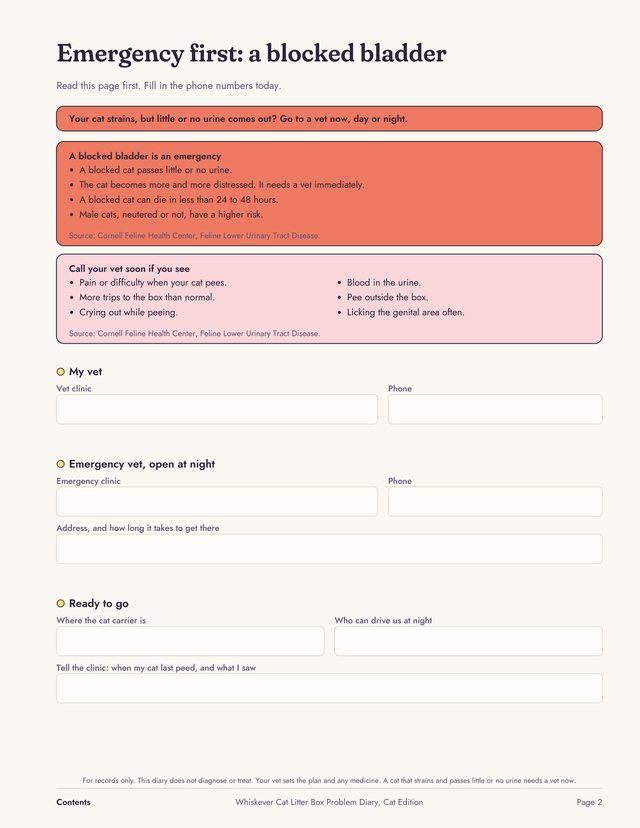
know when it is an emergency.
A cat that strains and passes little or no urine may have a blocked bladder. Cornell Feline Health Center calls this an absolute emergency: a blocked cat can die in less than 24 to 48 hours. Page 2 lists the signs and holds your emergency vet number.
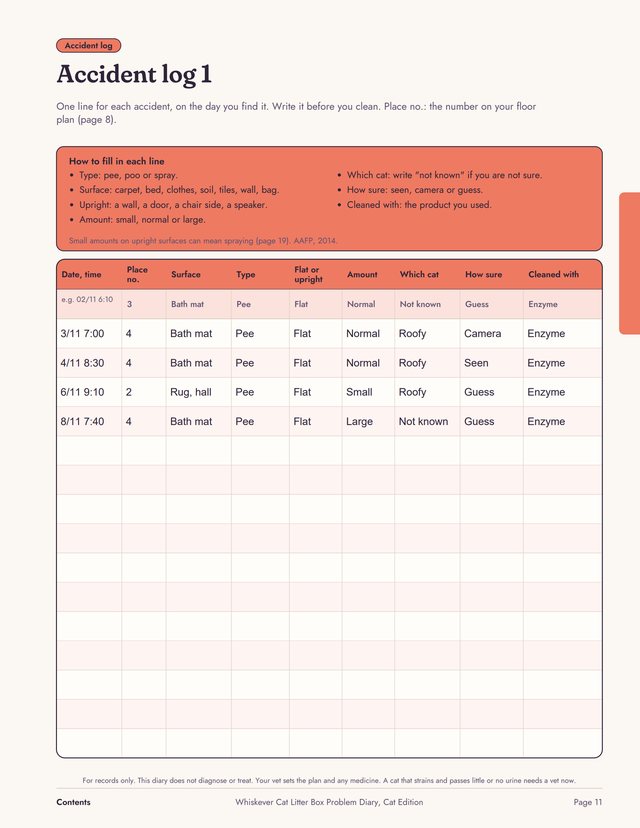
one line per accident.
Write the time, the place on your floor plan, the surface, and pee, poo or spray. Small amounts on upright surfaces can mean spraying, which has a different cause. After two weeks, the pattern shows: which cat, where and when.
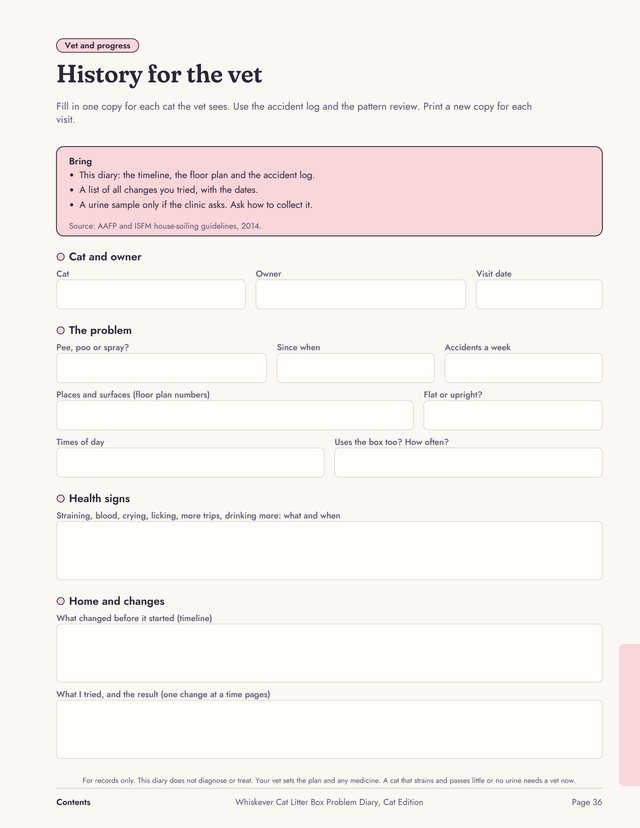
bring a clear history.
The AAFP and ISFM guidelines say the vet uses a timeline and a floor plan of the home with each soiling place. The diary has both, and a one-page history. A urine sample is best tested within 30 to 60 minutes of collection.
every page, explained.
Five colour-tabbed sections: 32 pages, plus a cover, an emergency page, a Start here page and a clickable contents page.
Cats and home4 pages
- The cats: up to 4, with the box size each one needs
- Timeline: when it started, and what changed before
- Floor plan: main floor
- Floor plan: other floor or garden
Accident log10 pages
- Accident log, 8 pages: place, surface, type, which cat
- Pee, poo or spray? Marking or toileting
- Cleaning log
Litter boxes9 pages
- Litter box audit: place, size, litter, depth
- Scoop and wash log
- How my cat uses the box
- Older cats and sore joints
- One change at a time, 4 pages (8 changes)
- Litter choice test
Stress and other cats3 pages
- Stress and change log
- Other cats, inside and outside
- Which cat uses which box
Vet and progress6 pages
- History for the vet: a one-page summary
- Urine sample and questions to ask
- The vet's plan, copied as written
- Weekly pattern review
- Progress chart, by cat, 12 weeks
- Notes
the details.
- Format
- Fillable PDF, 6 files in one ZIP
- Pages
- 36 + 5 dividers
- Paper sizes
- US Letter, A4, A5
- Cats
- Up to 4 cats in one diary
- Fill it in with
- Adobe Acrobat Reader, free
- Licence
- Personal household use
how it compares.
| Whiskever Litter Box Diary | A blank notebook | A phone note | |
|---|---|---|---|
| Blocked-bladder emergency signs on page 2 | Yes | No | No |
| Floor plan with numbered accident places | Yes | No | No |
| Pee, poo or spray: marking or toileting | Yes | No | No |
| Litter box audit against vet guidelines | Yes | No | No |
| Up to 4 cats: which cat uses which box | Yes | No | No |
| Every fact names its source | Yes | No | No |
good questions.
Why is my cat peeing outside the litter box?
It is not spite. The AAFP and ISFM guidelines say a cat soils the house when its physical, social or medical needs are not met. There are four groups of causes, and more than one can happen at the same time: a medical problem, bladder inflammation with no known cause (FIC), marking, and the home or other cats. See your vet first.
When is it an emergency?
Go to a vet now, day or night, if your cat strains and passes little or no urine, or becomes more and more distressed. Cornell Feline Health Center says a blocked urethra is an absolute emergency, and a blocked cat can die in less than 24 to 48 hours. Male cats have a higher risk. This is on page 2 of the diary.
Is my cat spraying or peeing?
A spraying cat usually stands with the tail straight up, often twitching, and leaves a small amount on an upright surface, such as a wall or a chair side. It still uses the box for normal pee and poo (ASPCA; AAFP and ISFM). Toileting is usually a normal amount, on a flat surface. The diary has a page to tick what you see.
How many litter boxes do I need?
The AAFP and ISFM guidelines suggest 2 boxes in 2 places for one cat, and one more box than the number of cats for more cats, with one box on each floor. Boxes side by side count as one. The ASPCA also says one box per cat, plus one. The litter box audit page lists the rest: size, litter, depth and place.
How do I find out which cat it is?
The ASPCA suggests asking your vet about a dye that makes urine glow under UV light for about 24 hours, or keeping the cats apart one at a time. The accident log has a "which cat" column and a "how sure" column, and a page shows which cat uses which box.
Does the diary tell me which medicine to use?
No. The diary never names a medicine, a food or a dose. Your vet sets the plan, and the page "The vet's plan" is a box to copy it, word for word, with each medicine exactly as the label says.
How do I get the diary after I pay?
Wix, our checkout provider, emails you a download link as soon as your payment goes through. The link works for 30 days. Download the ZIP file and save it. All sales are final; if your file is broken or never arrives, we fix it fast.