
the dog separation anxiety log
You cannot see what your dog does when you are out, and the mess does not tell the whole story. Film each absence, write one line, and see the progress your memory misses. It never sets the steps. Your vet and a qualified behaviour professional do.
Launch sale: you save $19. The price goes back to $38 after 30 November.
Binder + Sitter Kit + Medical Tracker ($59 if bought separately). See the complete set
see the real PDF at work.
Ten seconds of the real PDF: type the name once, click a contents line, see the sections.
it does more than a printable.
Three things most pet planners cannot do. Try them here.
type it once.
Type your dog's name in one box. It fills every page that needs it, all through the log.
click to jump.
The contents page is clickable. Every page has a "Contents" link at the bottom, so you find any page fast.
 Contents
colour or ink-saver.
Every size comes in two editions. Print the ink-saver edition to use almost no colour ink.
made for the moments that matter.
see what really happens.
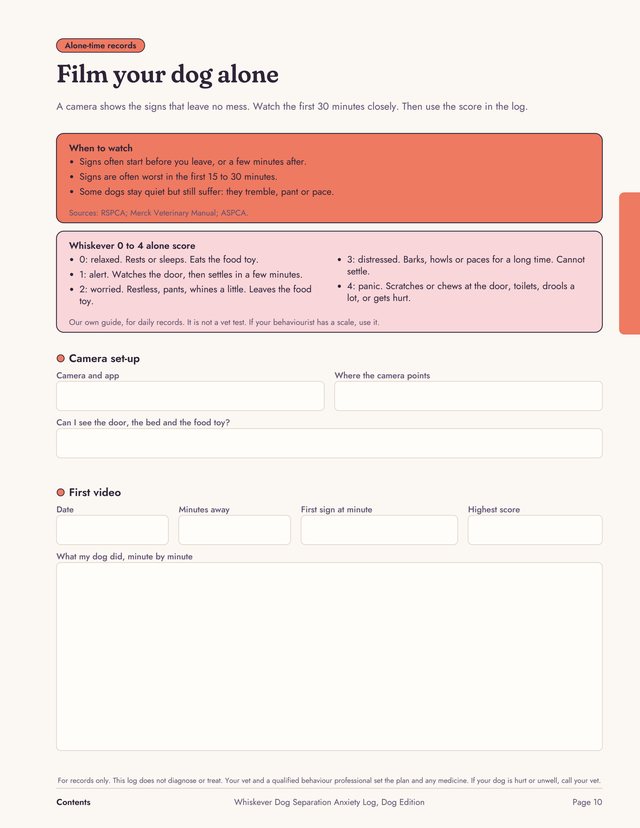
The RSPCA says about half of dogs who find it hard to be alone show no obvious sign, and suggests a camera. The Merck Veterinary Manual says signs are often worst in the first 15 to 30 minutes. This page tells you what to watch for, minute by minute.
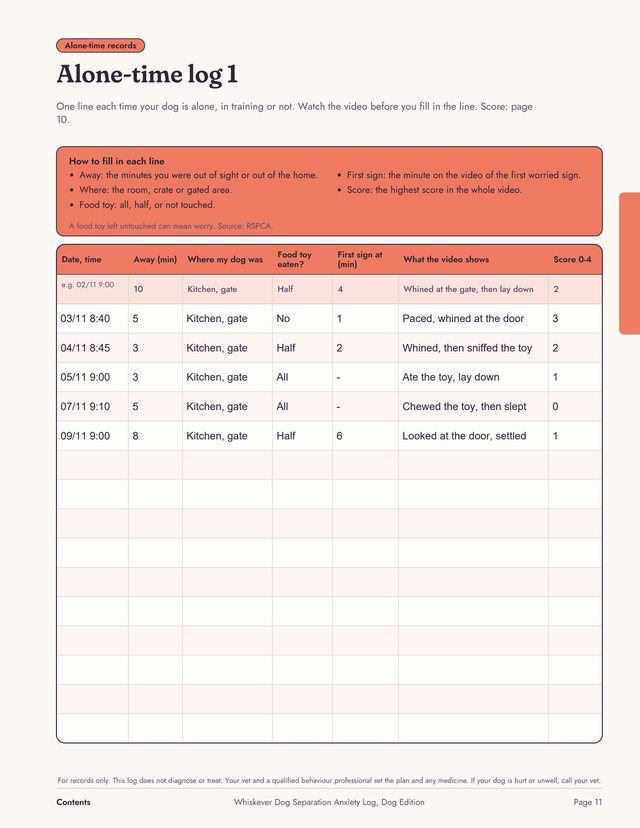
one line per absence.
Write the minutes away, where your dog was, whether the food toy was eaten, the minute of the first worried sign and the score. The RSPCA says a food toy left untouched can mean worry. Over weeks, the log shows the progress you cannot feel.
never alone past the limit.
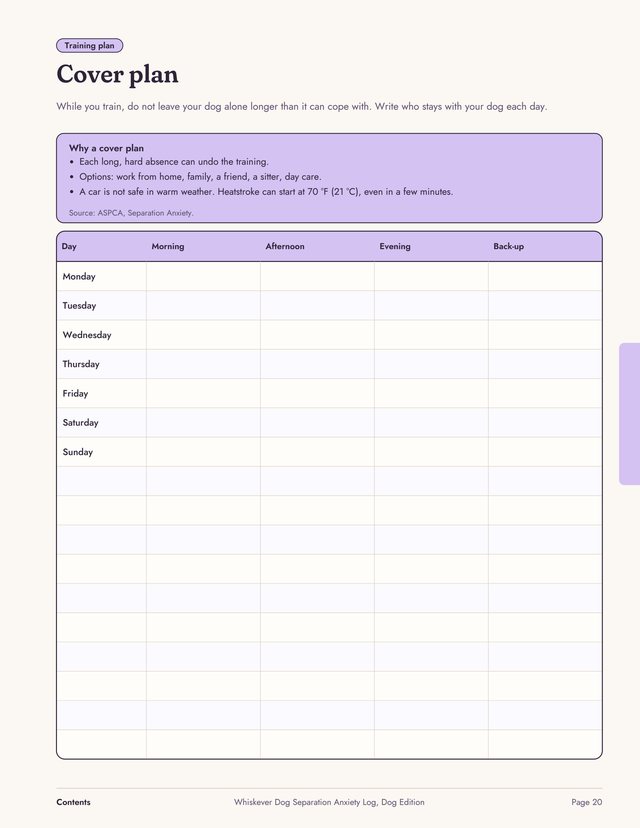
The ASPCA says not to leave the dog alone outside training sessions while you work on the problem: family, a friend, a sitter or day care can help. The cover plan holds who stays with your dog on each day of the week.
every page, explained.
Five colour-tabbed sections: 32 pages, plus a cover, a Start here page and a clickable contents page.
Know your dog4 pages
- My dog's profile: when it started, and what changed before
- Signs when alone: easy to see, easy to miss
- Separation, or something else? Health checks and look-alikes
- Departure cues: keys, coat, shoes, bag
Alone-time records8 pages
- Film your dog alone, and the Whiskever 0 to 4 alone score
- Alone-time log, 6 pages: minutes away, food toy, first sign, score
- Coming home: toilet, damage, greeting
Training plan11 pages
- My dog's team: who can help
- Cover plan: who stays with your dog, each day
- My dog's plan, set by your behaviourist
- Step ladder: from seconds to hours
- Training session log, 4 pages
- Before I go, when I come back
- Exercise and enrichment, and the food toy test
- Changes log
Progress4 pages
- Progress chart: longest calm absence, 12 weeks
- Alone-time calendar (month)
- Good days and setbacks
- Wins
Vet and behaviourist5 pages
- Before the visit: the last 4 weeks on one page
- Questions to ask
- Visits and plans
- Handover for sitters and family
- Notes
the details.
- Format
- Fillable PDF, 6 files in one ZIP
- Pages
- 35 + 5 dividers
- Paper sizes
- US Letter, A4, A5
- Dogs
- One dog per log
- Fill it in with
- Adobe Acrobat Reader, free
- Licence
- Personal household use
how it compares.
| Whiskever Separation Anxiety Log | A blank notebook | A phone note | |
|---|---|---|---|
| Signs when alone, including the easy-to-miss ones | Yes | No | No |
| Separation, or something else: health checks and look-alikes | Yes | No | No |
| Alone-time log built for your camera videos | Yes | No | No |
| Step ladder and session log for the plan | Yes | No | No |
| Cover plan: who stays with your dog, each day | Yes | No | No |
| Every fact names its source | Yes | No | No |
good questions.
What are the signs of separation anxiety in dogs?
The RSPCA lists destruction near doors and windows, barking, howling or whining, toileting indoors, an over-excited greeting and worry before you leave. Some signs are easy to miss: trembling, panting, drooling, pacing, and not eating food toys while you are out. About half of dogs who find it hard show no obvious sign, so the RSPCA suggests a camera.
Is it separation anxiety, or something else?
The ASPCA says that if the behaviour also happens when you are home, separation anxiety is less likely. Incomplete house training, urine marking, young-dog chewing, boredom and barking at noises can look the same. Toileting indoors can be a medical problem, such as a bladder infection, so see your vet first. The log has a page to tick what you see.
How long does it take to treat?
It takes weeks to months. The ASPCA plan starts with absences of 1 to 2 seconds and builds up in small steps over many weeks, and it says many owners go too fast. The RSPCA says never to leave a dog so long that it becomes distressed. The progress chart shows the longest calm absence each week, so you see the trend.
How long can I leave my dog alone?
The RSPCA says no more than 4 hours for an adult dog, and much less for puppies. While you train a dog with separation anxiety, the ASPCA says not to leave it alone outside training sessions at all. The cover plan page holds who stays with your dog each day: family, a friend, a sitter or day care.
Does the log tell me which steps or medicine to use?
No. The log never sets the steps and never names a medicine or a dose. A qualified behaviour professional sets the plan, and your vet decides about medicine. The ASPCA says most dogs that need medicine also need behaviour work. The log has pages to copy the plan and each medicine exactly as written.
How do I get the log after I pay?
Wix, our checkout provider, emails you a download link as soon as your payment goes through. The link works for 30 days. Download the ZIP file and save it. All sales are final; if your file is broken or never arrives, we fix it fast.