
the lost cat kit
A lost cat usually hides close to home, quiet and scared. The kit tells you where to search first, how to search at night and at dawn, and what to ask each neighbour. It gives you a poster and a log for every call and sighting.
Launch sale: you save $15. The price goes back to $30 after 30 November.
Binder + Sitter Kit + Medical Tracker ($59 if bought separately). See the complete set
see the real PDF at work.
A few seconds of the real PDF: type the name once, click a contents line, see the sections.
it does more than a printable.
Three things most pet planners cannot do. Try them here.
type it once.
Type your cat's name in one box. It fills every page that needs it, all through the kit.
click to jump.
The contents page is clickable. Every page has a "Contents" link at the bottom, so you find any page fast.
 Contents
colour or ink-saver.
Every size comes in two editions. Print the ink-saver edition to use almost no colour ink.
made for the moments that matter.
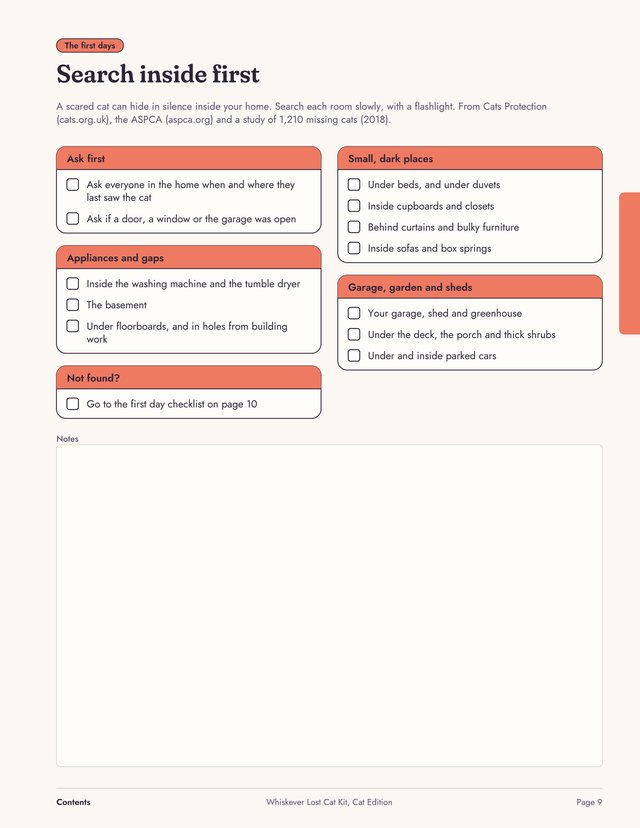
search inside first.
A scared cat can hide in silence in your own home: in cupboards, under duvets, in the tumble dryer. Then search the gardens next to yours. In a study of 1,210 missing cats, 75% were found within 500 m.
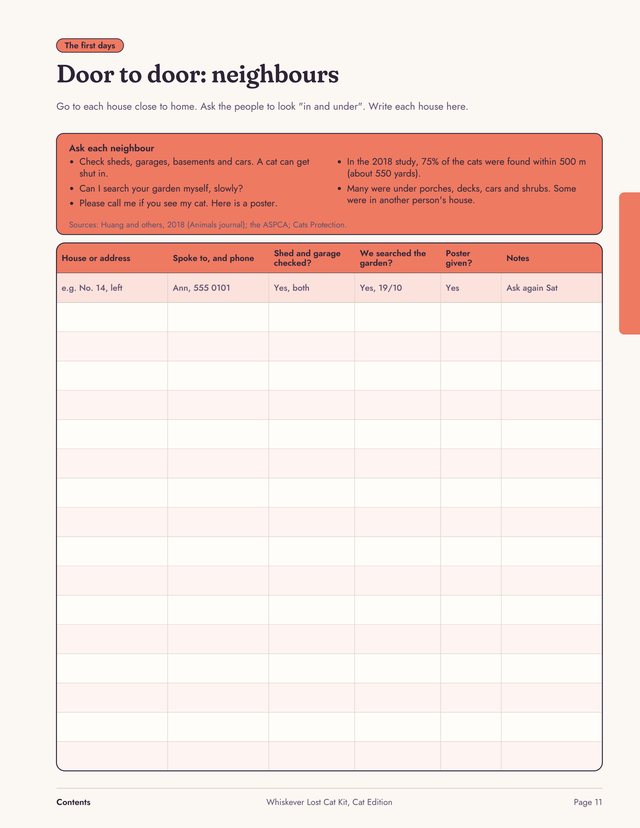
ask each neighbour to look in and under.
Sheds, garages, basements and parked cars. A cat can get shut in. The log keeps track of each house, what they checked and who has a poster.
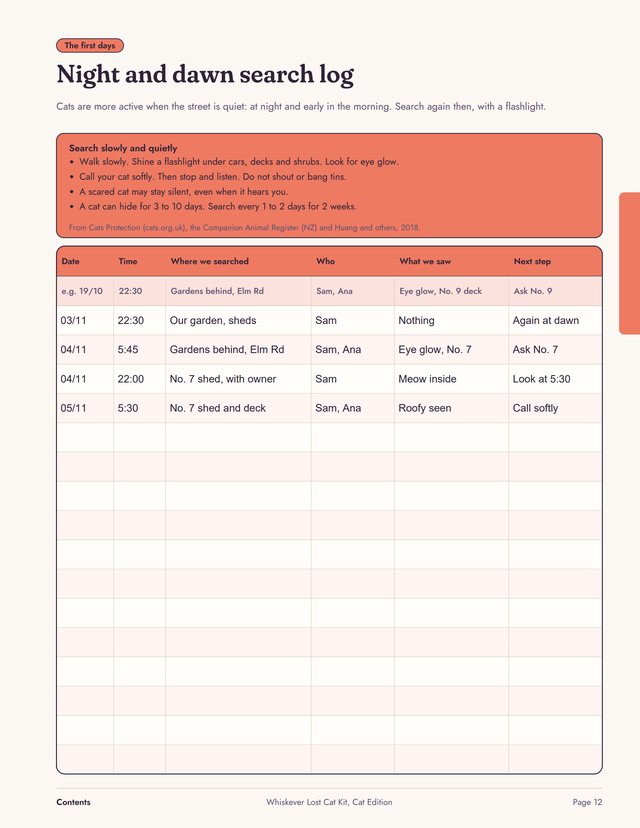
search when the street is quiet.
Cats are more active at night and early in the morning. Walk slowly with a flashlight and look for eye glow. A cat can hide for 3 to 10 days, so search again every day or two.
every page, explained.
Five colour-tabbed sections: 19 pages, plus a cover, a Start here page and a clickable contents page.
Be ready now3 pages
- ID and microchip record for up to 4 cats
- Lost cat file: a photo and the details for each cat
- Hiding places and territory: a map to draw today
The first days7 pages
- Search inside first: room by room, with a flashlight
- First day checklist
- Door to door: what to ask each neighbour
- Night and dawn search log
- Scent and food at home
- If you see your cat: do not chase
- Search map with a distance guide
Spread the word3 pages
- A LOST CAT poster with big type for the phone numbers
- Poster and online posts, with one mark kept back
- Where to put up posters: close to home first
Calls, traps and sightings4 pages
- Call and visit list: the chip registry, shelters, vets, the council
- Humane trap plan, with a log of trap checks
- Sightings log
- Calls from finders: check first
Home again2 pages
- When your cat comes home: tell everyone, stop it happening again
- Notes
the details.
- Format
- Fillable PDF, 6 files in one ZIP
- Pages
- 22 + 5 dividers
- Paper sizes
- US Letter, A4, A5
- Cats
- Up to 4 cats in one kit
- Fill it in with
- Adobe Acrobat Reader, free
- Licence
- Personal household use
how it compares.
| Whiskever Lost Cat Kit | Free poster maker | Notes app on a phone | |
|---|---|---|---|
| Inside search, room by room | Yes | No | No |
| Door to door and night search logs | Yes | No | No |
| LOST CAT poster with big phone numbers | Yes | Yes | No |
| Humane trap plan with trap checks | Yes | No | No |
| Every fact names its source | Yes | No | No |
| Works with no internet | Yes | No | Yes |
good questions.
My cat is lost now. What do I do first?
Search inside your home first: cupboards, under beds and duvets, behind furniture and in appliances. Then search your garden and ask each neighbour to check sheds, garages and cars. Call the microchip registry, the shelters and the vets. Search again after dark and early in the morning.
How far do lost cats go?
Usually not far. In a study of 1,210 missing cats, 75% were found within 500 m of the place they got out. Indoor-only cats were found closer to home than cats that went outside (Huang and others, 2018).
Why does my cat not come when I call?
A scared cat often hides and stays silent, even when it hears you. Call softly, then stop and listen. Do not shout or bang tins. Search slowly with a flashlight, also at night.
When should I use a humane trap?
Only when you have good reason to think your cat is in one place but will not come out. Get the property owner's OK, use food your cat likes, and check the trap often. The trap plan page has the safety steps from the Companion Animal Register (NZ).
How is it different from the Lost Pet Recovery Kit?
This kit is for cats only. It adds the inside search, door to door with the neighbours, night and dawn searches, scent and food, and a humane trap plan. The Lost Pet Recovery Kit covers dogs and cats in one kit.
How do I get the kit after I pay?
Wix, our checkout provider, emails you a download link as soon as your payment goes through. The link works for 30 days. Download the ZIP file and save it. All sales are final; if your file is broken or never arrives, we fix it fast.