
the senior dog comfort & cognition journal
Old age brings slow changes, and slow changes are easy to miss. This journal puts them on paper: stiffness, sleep, accidents, mood and good days. Each vet visit is clearer, and you see the trend. It never diagnoses. Your vet does.
Launch sale: you save $19. The price goes back to $38 after 30 November.
Binder + Sitter Kit + Medical Tracker ($59 if bought separately). See the complete set
see the real PDF at work.
Ten seconds of the real PDF: type the name once, click a contents line, see the sections.
it does more than a printable.
Three things most pet planners cannot do. Try them here.
type it once.
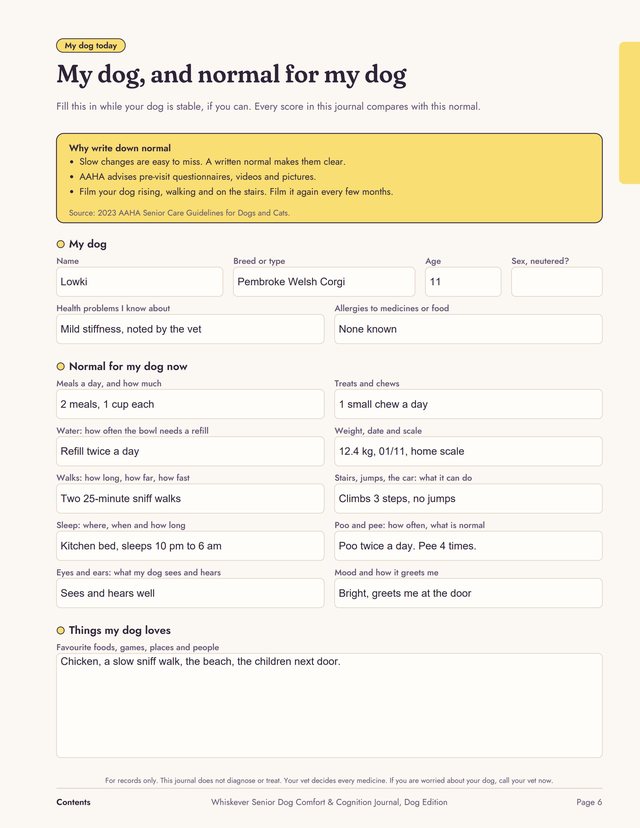
Type your dog's name in one box. It fills every page that needs it, all through the journal.
click to jump.
The contents page is clickable. Every page has a "Contents" link at the bottom, so you find any page fast.
 Contents
colour or ink-saver.
Every size comes in two editions. Print the ink-saver edition to use almost no colour ink.
made for the moments that matter.
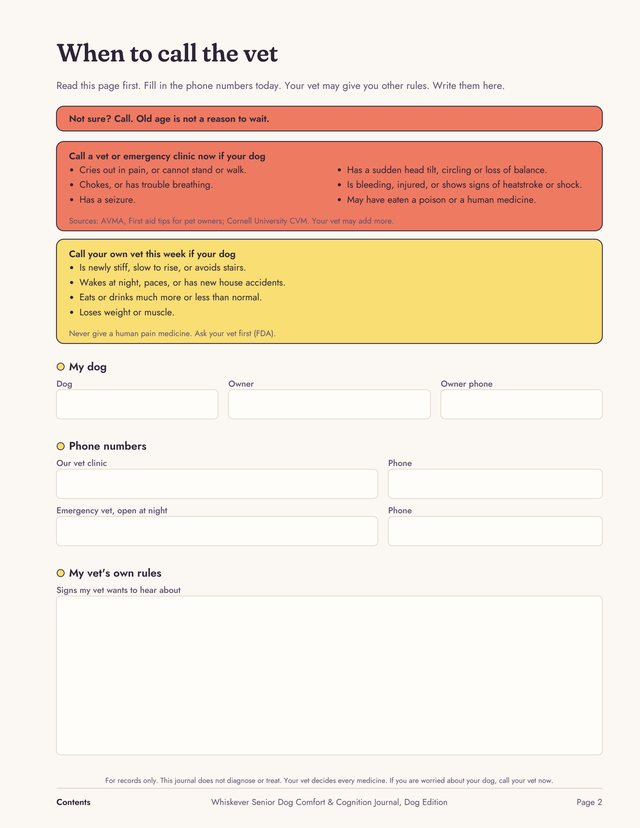
know when to call.
Page 2 lists the signs that need a vet or an emergency clinic now, such as a seizure, a sudden loss of balance, or a cry of pain. It also lists the signs to report this week, and holds your vet and emergency numbers.
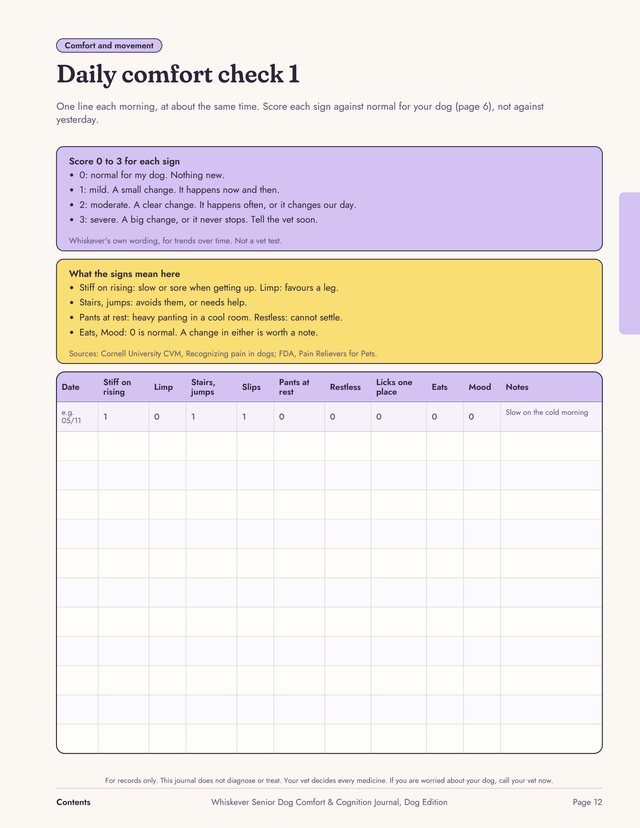
compare with normal, not with yesterday.
Marcellin-Little and others (2026) say arthritis affects nearly half of adult dogs, and shows as trouble with stairs, jumping and rising. Score each sign 0 to 3 against normal for your dog. A slow change shows up in weeks.
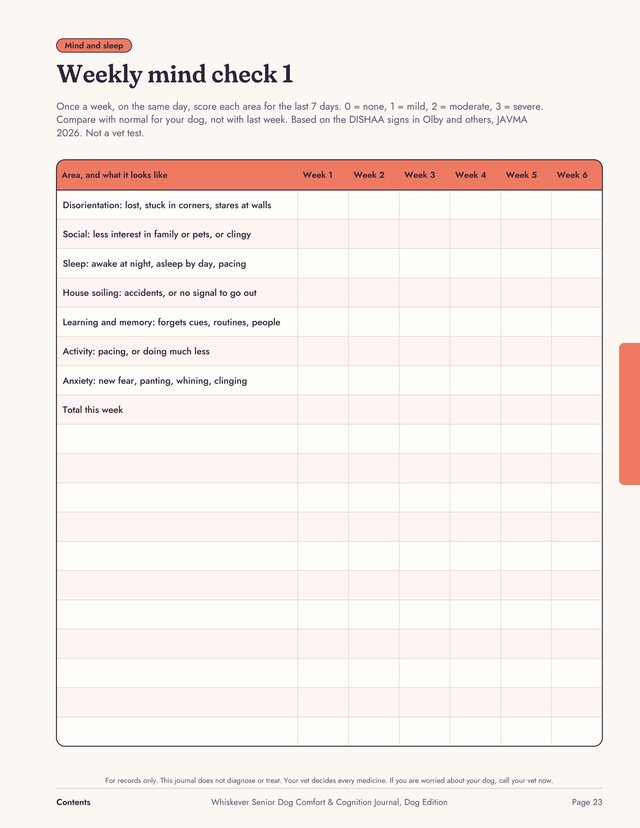
watch the mind and the sleep.
The 2026 working group on canine cognitive dysfunction groups the signs in 7 areas, called DISHAA. Once a week, score each area. Bring the page to your vet, who first looks for other causes such as pain.
every page, explained.
Five colour-tabbed sections: 36 pages, plus a cover, a "when to call the vet" page, a Start here page and a clickable contents page.
My dog today5 pages
- My dog, and normal for my dog
- Health record
- My dog's care team
- Vet visits
- Questions for the senior check-up
Comfort and movement8 pages
- Daily comfort check, 3 pages: stiffness, limp, stairs, slips, panting, mood
- Weekly movement check, 12 weeks
- Weight and body
- Walk round the home
- What I changed, and did it help
Mind and sleep10 pages
- The DISHAA list of dementia signs
- What else could it be
- Weekly mind check, 12 weeks
- Night and sleep log, 3 pages
- Accidents in the house
- Routine and brain games
- Month at a glance
Health and vet visits6 pages
- Medicines, as the label says
- Food, supplements and changes
- Eating, drinking and the toilet
- Test results
- Eyes, ears and teeth
- New signs to tell the vet
Good days and decisions7 pages
- Good days and hard days
- What makes a good day
- Costs
- Decision notes
- Planning ahead
- Good moments
- Notes
the details.
- Format
- Fillable PDF, 6 files in one ZIP
- Pages
- 40 + 5 dividers
- Paper sizes
- US Letter, A4, A5
- Dogs
- One dog per journal
- Fill it in with
- Adobe Acrobat Reader, free
- Licence
- Personal household use
how it compares.
| Whiskever Senior Dog Journal | A blank notebook | A phone note | |
|---|---|---|---|
| When to call the vet, with your numbers | Yes | No | No |
| Daily comfort signs scored against normal for your dog | Yes | No | No |
| Weekly movement check and weekly mind check, 12 weeks | Yes | No | No |
| Night and sleep log, and accident log | Yes | No | No |
| Home safety walk: floors, stairs, ramps, bedding | Yes | No | No |
| Every fact names its source | Yes | No | No |
good questions.
How do I know if my old dog has dementia?
Only your vet can tell. The 2026 Canine Cognitive Dysfunction Syndrome Working Group lists 7 areas of change, called DISHAA: disorientation, social interaction, sleep, house soiling, learning and memory, activity and anxiety. The vet first looks for other causes with exams and lab work. The journal lists the signs, scores them each week and gives you a record to bring.
How do I know if my old dog is in pain?
Cornell University lists changes in movement, activity, behaviour and daily habits, such as stiffness, trouble on stairs, panting at rest, restlessness and licking one spot. Signs of pain often develop slowly. The daily comfort check scores these against normal for your dog, and the weekly movement check shows the trend.
Can I use it if my dog has arthritis?
Yes. A 2026 review says osteoarthritis affects nearly half of adult dogs and calls for a validated owner questionnaire and regular reassessment. This journal is a record, not a vet test. It has daily and weekly checks, a weight and body page, and a home walk for floors, stairs and ramps.
Does the journal tell me which medicine to give?
No. The journal never names a medicine for you to give and never gives a dose. It has a page to copy each medicine exactly as the label says. The US Food and Drug Administration says never to give a human pain medicine to a dog without asking a vet.
Why does my old dog pace at night?
Cornell University says night pacing, calling and whining are often the first sign families notice with dementia. Pain, a full bladder, and poor sight or hearing can also wake a dog. The night and sleep log shows the pattern, so your vet can look for the cause.
What if my dog is near the end of life?
Your vet can talk with you early, and you do not have to decide alone. The journal has a good days and hard days page and a planning page. For the last weeks, the Dog End-of-Life and Memory Book has a calendar, questions for the vet and pages for memories.
How do I get the journal after I pay?
Wix, our checkout provider, emails you a download link as soon as your payment goes through. The link works for 30 days. Download the ZIP file and save it. All sales are final; if your file is broken or never arrives, we fix it fast.