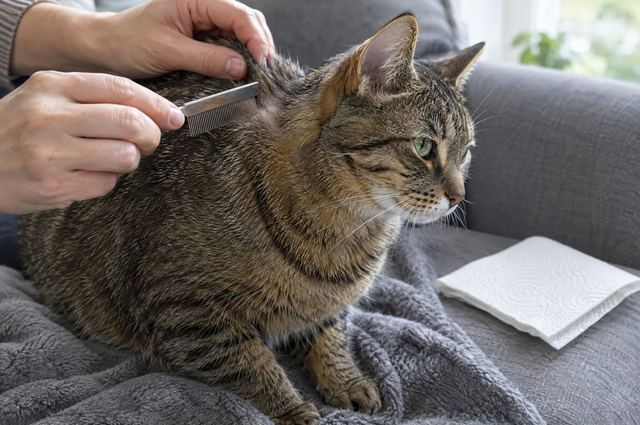
Cat over-grooming and bald patches: allergy, fleas, stress or pain?
You find a thin patch of fur on your cat’s belly. Then one on the inner thigh. You never see your cat scratch. Is it stress? Is it an allergy? Is something wrong inside?
Cats hide discomfort well, and many groom in private. So the first sign is often the bald patch itself.
Stress is often not the cause
A 2006 study looked at 21 cats. Each cat was sent to specialists with a diagnosis of hair loss from stress. The specialists then did a full set of tests.
- 16 cats (76%) had a medical cause of itch.
- Only 2 cats (10%) had stress alone.
- 3 cats (14%) had both.
The most common medical cause was a reaction to food, in 12 cats. Other causes included environmental allergy, flea allergy, parasites, infection and an overactive thyroid. The authors say it is easy to find stress in a cat’s life. That does not mean the stress started the problem.
Where cats over-groom
Cats lick the places they can reach easily. The 2006 study and the 2021 feline guidelines name these areas:
- The belly and the groin
- The inner side of the front legs and the thighs
- The lower back, the rump and the tail
- The head, the neck and the ear flaps
These are the same areas that many other diseases affect. So the place of the patch alone does not show the cause.
Signs that need a vet the same day
Over-grooming of the belly or genital area can be a sign of bladder pain. The Cornell Feline Health Center lists the signs of lower urinary tract disease:
- Straining or pain when the cat passes urine
- Passing urine more often, or crying out
- Blood in the urine
- Urine outside the litter box
- Much licking of the genital area
Cornell calls a cat that passes little or no urine an absolute emergency. Male cats are at greater risk. Call your vet at once.
Check for fleas, and treat every pet
The 2021 guidelines say that flea allergy can look like any skin pattern in cats. Flea control often fails when not all pets in the home are treated, including dogs.
Never use a dog flea product on a cat. The AAFP warns that dog products with permethrin are a major cause of poisoning in cats. A cat can also be poisoned when it grooms a dog that was just treated.
What to record before the visit
A dated record helps your vet see what changed and when.
- Photos of each patch. Use the same light and the same angle. Date each photo.
- A grooming score. Note each day if grooming looks normal, more than normal, or much more.
- Food. List every food, treat and flavoured medicine your cat gets.
- Litter box. Note changes in urine, stools or litter box habits.
- Changes at home. A new pet, a move, building work or a new routine.
- Clues of hidden grooming. Hairballs, vomited hair or hair in the faeces.
Our free vet summary tool makes a one-page summary of your cat for the visit.
If your vet starts a food trial
A strict food trial is the way to test for food allergy. A 2015 review found that 90% of affected cats were better by 8 weeks. The trial should last at least 8 weeks. During the trial, your cat eats only the prescribed food and water.
A 2016 review found that beef, fish and chicken were the most common food allergens in cats. Your vet will choose a trial food without them, or a special diet.
Never let your cat go without food to make it accept a new diet. The University of Illinois vet school warns that a cat that does not eat for a few days can get a dangerous liver disease. Call your vet if your cat refuses the trial food.
Keep the full record in one place
The Cat Allergy and Over-grooming Diary has a bald-patch map with outline drawings, a patch check over time, a daily grooming score, a litter box and bladder record, a stress and change log, and a flea record for every pet. It does not diagnose. It shows your vet the pattern.
If you feel small, crusty scabs on the neck or head, read what causes scabs on a cat’s neck.
Questions
Is my cat over-grooming because of stress?
Sometimes, but stress is often blamed too fast. In a 2006 study of 21 cats first thought to have stress-related hair loss, only 2 had stress alone. 16 had a medical cause of itch. Ask your vet to check for medical causes first.
My cat's hair seems to fall out by itself. Is it over-grooming?
Maybe. Veterinary guidelines say that cats often over-groom in private. The owner then thinks the hair falls out by itself. Hairballs, vomited hair and hair in the faeces are clues. Tell your vet what you see.
Can I use my dog's flea treatment on my cat?
No. The AAFP warns that dog flea products with permethrin are a major cause of poisoning in cats. Cats can also be poisoned when they groom a dog that was just treated. Use only products made for cats, and follow the label.
Which foods cause allergy in cats?
A 2016 review of 78 cats found that beef, fish and chicken were the most common causes of food allergy. Your vet tests this with a strict food trial of at least 8 weeks, not with a blood test.
Sources
- Waisglass SE, Landsberg GM, Yager JA, Hall JA. Underlying medical conditions in cats with presumptive psychogenic alopecia. JAVMA 2006;228(11):1705-1709
- Santoro D, Pucheu-Haston CM, Prost C, et al. Clinical signs and diagnosis of feline atopic syndrome: detailed guidelines for a correct diagnosis. Vet Dermatol 2021;32:26-e6
- Mueller RS, Olivry T, Prélaud P. Critically appraised topic on adverse food reactions of companion animals (2): common food allergen sources in dogs and cats. BMC Vet Res 2016;12:9
- Olivry T, Mueller RS, Prélaud P. Critically appraised topic on adverse food reactions of companion animals (1): duration of elimination diets. BMC Vet Res 2015;11:225
- Cornell Feline Health Center: Feline lower urinary tract disease
- University of Illinois College of Veterinary Medicine: Hepatic lipidosis, a serious problem when cats stop eating
- AAFP: Permethrin poisoning and cats
This article helps you organise care. It does not replace advice from your vet.