Cat scabs on the neck: fleas, food or another allergy? What to check
You stroke your cat’s neck and feel small, hard bumps under the fur. You part the fur and see tiny scabs. Your cat scratches its neck more than before. These scabs are common, and they have a short list of usual causes. Fleas come first, even when you see none.
When to see a vet soon
Book a visit for any new scabs that do not go away. See a vet the same day or the next day if:
- The skin is open, wet, bleeding or smells bad.
- Your cat scratches so hard that it makes wounds on its head or neck.
- Your cat stops eating, hides or seems ill.
- Your cat drools, trembles or twitches after a flea product. This can be poisoning. Call your vet at once.
What the scabs usually are: miliary dermatitis
Many small, crusty bumps on a cat’s skin have a name: miliary dermatitis. The name comes from millet, a small seed. The Merck Veterinary Manual says it is one of the most common signs of allergic skin disease in cats.
- The bumps are small. In longhaired cats, you may feel them before you see them.
- They can be in one area or all over the body.
- Merck says flea-allergic cats get the bumps mostly on the back, neck and face.
Miliary dermatitis is a sign, not a diagnosis. Your vet must find the cause.
Cause 1: flea allergy, even if you see no fleas
Merck says flea allergy is the most common allergic skin disease in cats. So vets check flea control first in any itchy cat.
Many cats are allergic to flea saliva. Merck says the scabs are not the bites themselves. They are a reaction of the whole body to the bites. Itch can be mild or severe.
You may see no fleas at all. Merck says very allergic cats groom the fleas off. An indoor cat can get fleas too: Merck says flea allergy can occur all year in indoor pets. Other pets and people can bring fleas into the home.
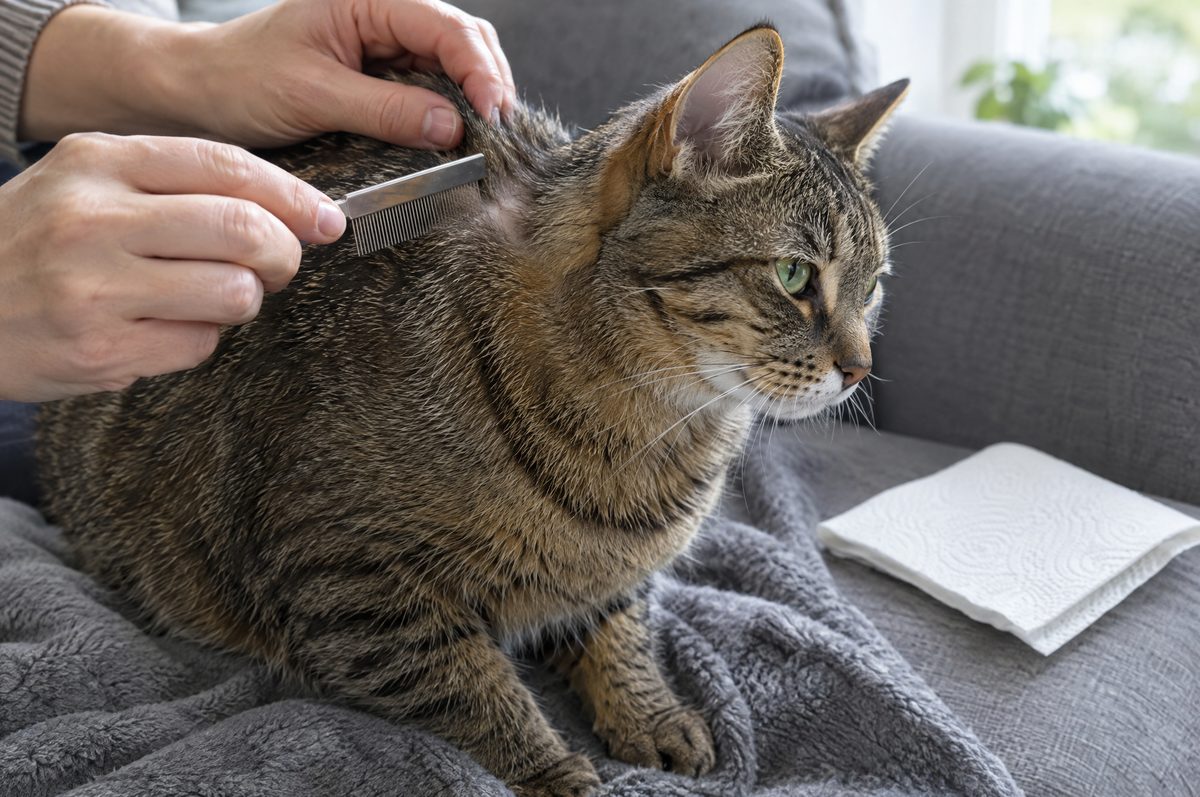
How to check for flea dirt
- Sit your cat on a white towel or sheet.
- Comb the neck, the back and the base of the tail with a fine flea comb.
- Tap the comb onto a damp white paper towel.
- Watch the dark specks. Merck says flea dirt dissolves to a reddish-brown colour.
- Check your cat’s bedding too.
No flea dirt does not rule out fleas. Tell your vet what you found either way.
Flea control takes time
Merck says flea control can take 2 to 3 months, because of the flea life cycle. Flea eggs and larvae live in carpets, bedding and furniture. Treat every pet in the home. Wash pet bedding and vacuum where your pets rest.
Never use a dog flea product on a cat. The American Association of Feline Practitioners says dog products with permethrin are a major cause of poisoning in cats. A cat can also be poisoned when it grooms a dog that was just treated. Signs range from drooling and restlessness to seizures and death. Ask your vet to choose the product for each pet.
Cause 2: food allergy
Food allergy is the next cause your vet may check. A 2019 review collected data on 210 cats with skin signs of food allergy:
- Nearly all were itchy.
- The face or head was itchy in 53% of the cats.
- A crusted, scratched rash on the head and neck was found in 30 to 65% of cats in three studies.
- Miliary dermatitis was found in 21 to 40% of cats in seven studies.
- Hair loss from over-grooming, often on both sides, was also common.
- The mean age at the start of signs was 3.9 years.
Merck says a food trial is the way to check this in a cat whose itch is there all year. Your vet chooses the trial diet. The trial must be strict, with no other food or treats.
Cause 3: environmental allergy
Merck describes feline atopic skin syndrome, an allergy to things in the environment. It shows as the same patterns: miliary dermatitis, head and neck itch, hair loss from over-grooming, and eosinophilic skin lesions. The signs can be seasonal or present all year. They often start before 5 years of age.
Vets diagnose it only after they rule out fleas, food and other causes. So this cause takes time to confirm.
Other causes your vet will rule out
Merck lists many other causes of an itchy, scabby cat:
- Other parasites, such as mites, and mosquito bite allergy.
- Ringworm and other skin infections.
- Reactions to a medicine.
- Autoimmune skin disease.
- Skin cancer, in some cats.
Your vet may comb for fleas, take skin scrapings, press tape on the skin to look at it under a microscope, or take a fungal culture.
What to record before the visit
A clear record helps your vet put the causes in order. Write down:
- Where the scabs are: neck, head, back, base of the tail or belly.
- When you first felt them, and whether there are more each week.
- A photo of each area, with the date.
- The flea product for each pet, and the date of each dose.
- Everything your cat eats, including treats and food from other homes.
- Whether the itch is worse in some months.
- Any over-grooming or bald patches.
Our free vet visit summary puts your cat’s food, medicines and notes on one page.
Keep the full record in one place
The Cat Allergy and Over-grooming Diary keeps this record for one cat. It has a bald-patch map with outline drawings of the sides, underside and face, a patch check every 2 weeks, a daily grooming calendar, a flea control record for every pet, an “everything my cat eats” list and a 12-week food trial check. It records only. Your vet chooses the diet and any medicine. If your cat also licks its fur away, read why cats over-groom and get bald patches.
Questions
Why does my cat have scabs on its neck but no fleas?
Fleas can still be the cause. The Merck Veterinary Manual says fleas may not be visible on very allergic cats, because they groom them off. Food allergy and environmental allergy can also cause neck scabs.
What is miliary dermatitis in cats?
It is a rash of many small, crusty bumps, like millet seeds. Merck says it is one of the most common signs of allergy in cats. The bumps are often easier to feel than to see, mostly on the back, neck and face.
How do I check my cat for flea dirt?
Comb the fur with a fine flea comb, then tap the comb onto a damp white paper towel. Merck says flea dirt is reddish black and dissolves to a reddish-brown colour on a damp paper towel. Also check your cat's bedding.
Can I use my dog's flea treatment on my cat?
No. The American Association of Feline Practitioners warns that dog flea products with permethrin are a major cause of poisoning in cats. A cat can also be poisoned by grooming a dog that was just treated. Use only a product your vet chooses for your cat.
Can a food allergy cause scabs on a cat's neck?
Yes. A 2019 review of 210 cats with food allergy found that half had an itchy face or head. A crusted rash on the head and neck was common, and so was miliary dermatitis.
Sources
- Merck Veterinary Manual: Fleas of cats (pet owner version; Dryden MW)
- Merck Veterinary Manual: Feline atopic skin syndrome (Hoff S; full review May 2026)
- Olivry T, Mueller RS. Critically appraised topic on adverse food reactions of companion animals (7): signalment and cutaneous manifestations of dogs and cats with adverse food reactions. BMC Vet Res 2019;15:140
- American Association of Feline Practitioners: Permethrin poisoning and cats
This article helps you organise care. It does not replace advice from your vet.