Is a Christmas tree safe for cats? How to cat-proof your tree
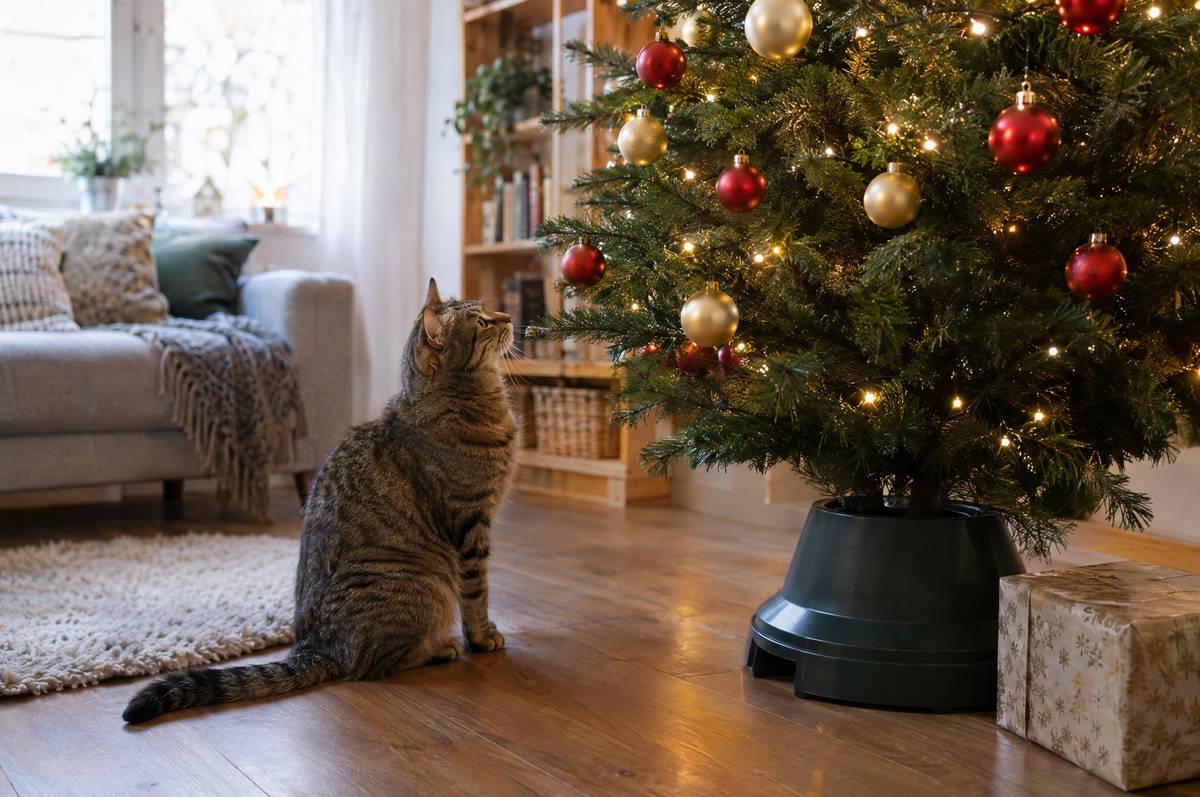
The tree goes up, and your cat is at its base within a minute. Cats love to climb into a tree, bat the baubles and chew the lights. You can have a tree and a cat. The tree itself is a small risk. The real dangers are what you put on it, under it and next to it.
This guide starts with the signs that mean you must call a vet now. Then it shows you how to cat-proof the tree, step by step.
When to call a vet now
Call your vet or an emergency clinic at once if your cat:
- ate tinsel, ribbon, string or part of an ornament;
- has a string or ribbon that hangs from its mouth or its bottom;
- chewed any part of a lily, licked lily pollen, or drank water from a lily vase;
- chewed a light cord, has burns in its mouth, or has trouble breathing;
- tries to vomit again and again, and nothing comes up;
- licked liquid from a broken snow globe.
Pet Poison Helpline says a cat that chewed through a light cord must go to the vet at once. The US Food and Drug Administration (FDA) says lily poisoning needs treatment fast. If treatment starts 18 hours or more after a cat eats a lily, the kidney damage is generally permanent. Blue Cross says snow globes can contain antifreeze, and even a small amount can make a cat very ill.
Keep these numbers where everyone can see them. The American Veterinary Medical Association (AVMA) lists:
- your own vet’s phone number;
- your 24/7 emergency clinic, if it is a different one;
- ASPCA Animal Poison Control: (888) 426-4435;
- Pet Poison Helpline: (855) 764-7661.
A fee may apply for the poison lines. The AVMA also tells owners to know the route to the emergency clinic before the holidays, so you do not search for it in a panic. Blue Cross reminds UK owners that all vet practices must have an emergency service over Christmas.
Is a Christmas tree safe for cats? The main dangers
Tinsel. Pet Poison Helpline says tinsel is a common cause of a blocked gut in cats. The cat cannot pass it, tries to vomit it out, and often needs surgery. Blue Cross says it can be fatal.
Ribbon and string. Pet Poison Helpline calls ribbon a linear foreign body. Once stuck, it pulls tight and acts like a saw against the gut wall. Cats with this problem hide it well and may eat and drink for a time. Blue Cross adds the string from meat, which smells good and is even more tempting.
Tree water. Pet Poison Helpline says sap, needles and tree water can cause nausea, vomiting, skin irritation or injury to the stomach. It says cats are very sensitive to pine oils. The AVMA says water additives can be hazardous if swallowed.
Lights. Chewed cords can cause electrocution. Pet Poison Helpline says these cats often have burns in the mouth and trouble breathing.
Ornaments. The AVMA says breakable ornaments can cause injuries, and swallowed ornaments can block the gut. Keep ornaments made of salt dough or other food away from pets.
A falling tree. A climbing cat can pull the whole tree down.
Real tree or fake tree?
Each has its own risks. Blue Cross lists these for a real tree:
- The oils from some real trees are mildly toxic and can irritate the mouth and stomach.
- Many fertilisers and plant foods are toxic to cats and can leak into the tray.
- A cat can use the soil in a potted tree as a litter tray.
- Sharp needles can, in rare cases, damage the stomach if swallowed.
Pet Poison Helpline suggests an artificial tree, so your cat cannot eat sap, needles or tree water. Blue Cross says that a non-drop real tree helps, but it still drops needles in the end.
A fake tree does not fix everything. Tinsel, ribbon, lights and a falling tree are still risks.
How to keep your cat out of the Christmas tree
Use these steps from Blue Cross, Pet Poison Helpline and the AVMA:
- Fix the tree at the top and the bottom. Use a heavy base. The AVMA suggests fishing line from the tree to the ceiling or a doorframe.
- Leave out the tinsel. Pet Poison Helpline suggests no tinsel, or very little, until you know your cat leaves it alone.
- Hang ornaments high and tight. Blue Cross says to fix decorations tightly and keep them high, out of reach of paws. Use ornaments that do not break.
- Cover the water. Do not let your cat reach the tree basin, and add nothing to the water.
- Protect the cords. Blue Cross suggests plastic or cardboard tubes over exposed wires, or battery LED lights.
- Switch off when you go out. The AVMA says to unplug decorations when you are not home.
- Keep presents away from the tree. Blue Cross says not to put tempting presents under it. Avoid long ribbons.
- Close the door. If your cat is playful, Blue Cross suggests you shut the tree room when nobody can watch.
- Give your cat something better to do. Play with your cat away from the tree every day.
If you see sap on your cat’s fur, wash it off at once. Pet Poison Helpline says that a cat cleans it off itself, and then it eats the sap.
Christmas plants that are poisonous to cats
Blue Cross lists these festive plants:
| Plant | How dangerous |
|---|---|
| Lilies | All parts are poisonous. Can be fatal. |
| Poinsettia | Mild poisoning |
| Holly and mistletoe | The berries are the most toxic |
| Amaryllis | Bulbs, stalks and flowers are all toxic |
The FDA says true lilies and daylilies are very dangerous for cats. A small bite of a leaf or petal can kill a cat. So can a few pollen grains licked off the fur, or a drink from the vase. The FDA says kidney failure can come in less than 3 days. The FDA says it is best not to bring these lilies into a home with a cat. Ask guests not to bring them as a gift.
Visitors, open doors and holiday stress
Christmas brings guests, noise and open doors. The AVMA says to give every pet a quiet room where guests do not follow. It also says to watch the exits when people come and go, because a pet can slip out. Check that your cat’s microchip details are current. If your indoor cat gets out, our guide on what to do when an indoor cat gets out explains where to look first.
Blue Cross says that change, new smells and visitors can stress cats. Keep the litter tray in a quiet place. A change in how your cat uses the tray can be a sign of stress. Our guide to why a cat pees outside the litter box explains the causes.
Put it all on one page before the holidays
In an emergency, nobody wants to search for a phone number. Write your vet, the emergency clinic and both poison lines on one page, and stick it to the fridge. The emergency section of the Household Command Binder has an emergency contacts page and a grab-and-go summary for each pet.
If you travel and a sitter looks after your cat, the sitter needs the same numbers. Make a free pet sitter sheet in a few minutes. Our guide on what to leave your pet sitter lists the rest. The Household Command Binder also has a sitter fridge sheet and a signed vet authorisation, so a sitter can get care for your cat when you cannot be reached.
When the tree comes down, check the floor for fallen tinsel, hooks and needles. Then put the emergency page back in the binder, ready for next year.
Questions
Is a real or a fake Christmas tree safer for cats?
A fake tree removes some risks. Pet Poison Helpline suggests an artificial tree, so your cat cannot eat sap, needles or tree water. Blue Cross says the oils of some real trees are mildly toxic and can irritate the mouth and stomach. Tinsel, ribbon, lights and a falling tree are risks with both kinds.
Is Christmas tree water bad for cats?
It can be. Pet Poison Helpline says tree water can cause nausea and vomiting, and that cats should not reach the water basin. The AVMA says that water additives can be hazardous if swallowed, so add nothing to the water if you have pets. Cover the basin.
What do I do if my cat ate tinsel or ribbon?
Call your vet now, even if your cat seems fine. Pet Poison Helpline says ribbon can become a linear foreign body that acts like a saw on the gut. Cats with this problem can hide it and still eat for a time, so do not wait for signs.
Are poinsettias poisonous to cats?
Mildly. Blue Cross says poinsettia poisoning is mild. Lilies are the real danger: the US FDA says a small bite of a leaf, a few grains of pollen, or the vase water can cause fatal kidney failure in cats. Holly and mistletoe berries and amaryllis are also toxic, says Blue Cross.
How do I keep my cat from climbing the Christmas tree?
Blue Cross suggests a heavy base, decorations fixed tightly and hung high, no tempting presents under the tree, and more play away from it. The AVMA suggests tying the tree to the ceiling or a doorframe with fishing line. Close the door to the room when nobody can watch.
What are the signs my cat ate something from the tree?
The AVMA lists sudden behaviour changes, depression, pain, loss of appetite, vomiting or diarrhoea. Pet Poison Helpline adds that a cat with a gut blockage tries to vomit but cannot bring it up, and that a cat that chewed a light cord can have mouth burns and trouble breathing. Call your vet at once.
Sources
- Pet Poison Helpline, Catherine Angle DVM: Cats and Christmas Trees
- Blue Cross: Keeping your cat safe at Christmas (reviewed 16 December 2025)
- American Veterinary Medical Association (AVMA): Winter holiday pet safety
- US Food and Drug Administration (FDA): Lovely Lilies and Curious Cats: A Dangerous Combination
This article helps you organise care. It does not replace advice from your vet.