Cat throwing up after eating: too fast, or something else? When to call the vet
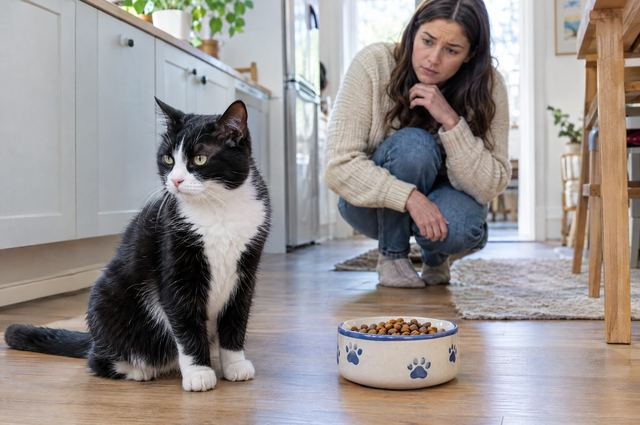
Your cat finishes the bowl, walks away, and then food lands on the rug. It looks like it never reached the stomach. What went wrong? Often the cause is simple: your cat ate too fast. But the timing of the event gives your vet an important clue. This guide helps you read it.
This page gives general information. It does not diagnose your cat. Your vet decides the cause.
Call a vet now if you see any of these signs
If any line fits your cat, call your vet or an emergency clinic now.
- Your cat vomits several times in a few hours, or cannot keep water down. Dial A Vet lists both.
- The vomit has blood in it, or looks like coffee grounds.
- Your cat retches and nothing comes up. Texas A&M says this “could be a sign of an obstruction.”
- The belly looks swollen or painful, or your cat is weak or has collapsed.
- Your cat has not eaten for more than 24 hours.
- You can see string or thread at the mouth or the rear. Do not pull it.
- Your cat may have eaten a lily, a medicine, a chemical or part of a toy.
Webvet says kittens, senior cats, diabetic cats and cats with a known illness need to be seen sooner.
Timing is the first clue
Webvet, medically reviewed by Dr Pippa Elliott, gives a simple rule. Food that comes up within minutes of eating usually points to eating too fast, or to a problem in the esophagus. Webvet says it is “most often not true vomiting at all.” Undigested food that comes up hours after a meal is more concerning. It may mean the stomach is not emptying normally.
| When the food comes up | What it often points to | What to do |
|---|---|---|
| Within minutes, food barely changed | Eating too fast, or an esophagus problem | Write it down. Try a slower way of eating. Tell your vet if it repeats. |
| Hours later, food still undigested | The stomach may not be emptying as it should | Tell your vet. Film it if you can. |
| On an empty stomach, in the morning | Often bile or foam | Write it down. See the note below the table. |
| Often, with weight loss or low energy | Many possible causes | Book a vet visit. |
This table is a guide for what to write down. It is not a diagnosis. Your vet decides. For yellow foam on an empty stomach, see our guide to cat vomiting yellow foam.
Vomiting or regurgitation?
The two look alike on the rug. They are not the same, and your vet needs to know which one you saw.
The Merck Veterinary Manual says vomiting is forceful. Drooling, repeated swallowing, retching and belly contractions come first. The material comes from the stomach and the upper small intestine.
Regurgitation is passive. The cat does not make an effort. The food is usually undigested, and the Merck manual says it may be tube-shaped, because it comes from the esophagus.
Webvet adds the signs of vomiting: drooling, lip-licking, crouching and belly heaving. It says the material is often partly digested and may contain yellow bile.
If you are not sure which one you saw, film the next event. Dial A Vet says a short phone video helps your vet tell vomiting from regurgitation. Use the “what it looks like” page in the Cat Vomiting and Hairball Diary to find the words for what you saw.
Eating too fast: “scarf and barf”
Webvet calls it “scarf and barf.” A cat gulps its food. The food comes back within minutes. CityVet says gulping can make the cat swallow air, which can lead to regurgitation. Both vets say it is common in homes with more than one cat. Competition for food makes it worse. Stress at mealtime can also play a part.
Texas A&M says undigested food from eating too quickly is typically not a concern. But “typically not a concern” does not mean you can ignore it when it happens often. Tell your vet, and write down how often.
Ways to slow your cat down
These ideas come from the vets we read. Ask your own vet which ones suit your cat.
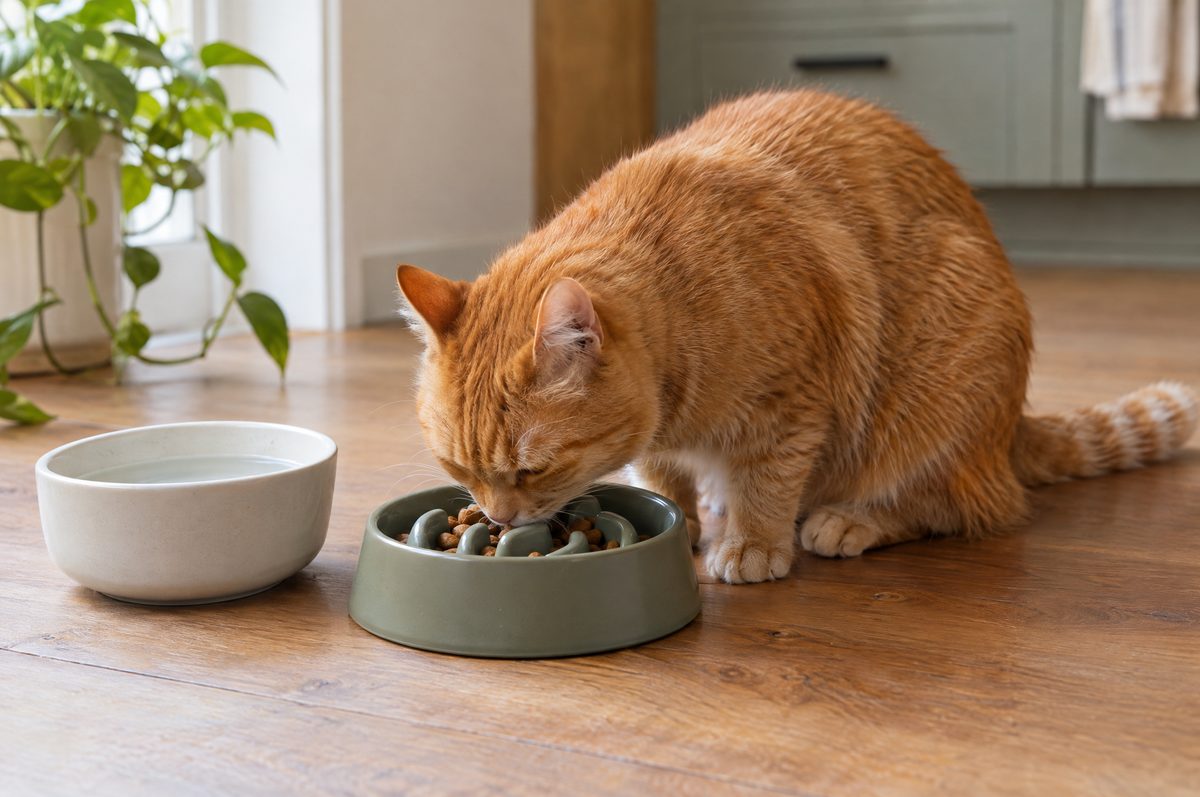
- A slow-feeder bowl. Texas A&M and CityVet both suggest one. It makes gulping harder.
- A puzzle feeder. CityVet says it gives out food in small portions and makes the cat work for its meal.
- Smaller meals, more often. Webvet and CityVet both suggest this.
- A flat plate or a lick mat. Webvet suggests spreading the kibble out.
- Separate feeding places. In a multi-cat home, Webvet suggests keeping the cats apart at mealtime.
- A clean rock in the bowl. CityVet lists this as another way to slow eating.
Webvet says to keep slow feeding going after the signs improve, because the problem often comes back.
Do not change the type or amount of food without asking your vet. Your vet knows your cat’s weight and health.
Other reasons food comes back
CityVet and Webvet list other causes of vomiting after eating:
- Food sensitivity. A reaction to a food may not show right after a meal. CityVet says a food diary can help find the trigger.
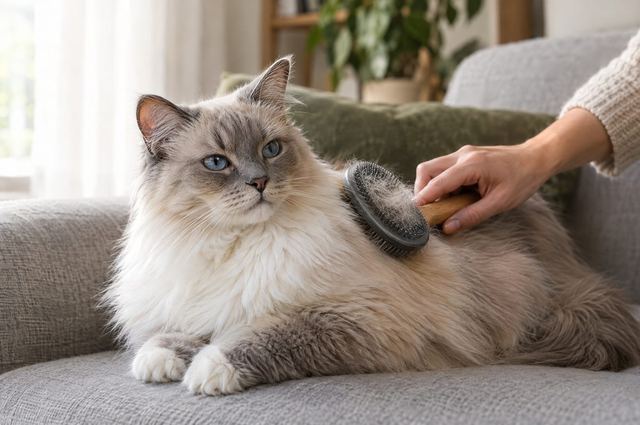
- Hairballs. Swallowed fur can build up in the stomach. It can come up after a meal. See how often cats throw up hairballs.
- A sudden change of food. An abrupt switch can upset the stomach.
- Dry food that swells in the stomach. Webvet lists this as a possible cause.
- Medical problems. CityVet lists gut inflammation, infections, blockages, kidney disease, liver problems and diabetes.
The Cornell Feline Health Center adds parasites, poisons, constipation and thyroid disease to the list of causes of vomiting in cats. A vet can tell these apart. You cannot, and you do not need to. Your job is to record what you see.
When to book a vet visit
Not every event is urgent. But a pattern needs a visit.
- CityVet says to see a vet for vomiting after every meal, or several times a week. Frequent vomiting can lead to dehydration and malnutrition.
- Webvet says to book a visit for vomiting most days or several times a week, for repeated yellow bile, for food that comes up hours after eating, and for vomiting with diarrhoea, low energy or weight loss. It says “Daily vomiting is never normal, even in a cat that otherwise seems fine.”
- Texas A&M says to call for “more than a couple of times per month” or for a sudden change in how often.
- The Cornell Feline Health Center says a cat that vomits more than once a week needs to be seen.
Sources differ on the exact number. Ask your vet for the rule for your cat. Write it on the “When to call the vet” page of your diary.
There is also a reason to take a regular pattern seriously. Two feline vets (St. Denis and O’Brien, 2017) say that cats that vomit more often than every 2 weeks are more likely to have gut disease. Norsworthy and colleagues (JAVMA, 2013) looked at 100 cats with chronic vomiting, diarrhoea or weight loss. They found disease in 99. They say these signs “should not be considered a normal condition and should not be ignored.”
St. Denis and O’Brien also list signs of nausea that an owner can miss: a fussy appetite, a lost appetite now and then, lip licking, gagging, and eating grass to bring food up. Write these down too.
What to write down
Your vet cannot see the event. Your notes are the evidence. For each time, write:
- the date and time
- how long since the last meal (minutes or hours)
- how fast your cat ate, and what it ate
- what came up: food, foam, liquid, hair
- whether your cat retched first, or the food just came back
- how your cat was afterwards
- any change at home: a new food, a new pet, a stressful day
Take a photo or a short video. CityVet and Dial A Vet both say a log of each event shows patterns and helps the vet.
The Cat Vomiting and Hairball Diary has a vomit log with these columns. It also has a meals page for eating speed and a page for anything your cat ate or chewed. A month grid shows the pattern at a glance. The diary never diagnoses. It records.
Before the visit, our free vet visit summary puts your cat’s health notes and questions on one page.
Questions to ask your vet
- Is this vomiting, or regurgitation?
- Could my cat’s eating speed explain it? What can I change?
- Does the timing, minutes or hours, point to a cause?
- Which tests would help?
- How often is too often for my cat?
- Which signs mean I should call at once?
The diary has a page of these questions, with room for the answers.
The short version
- Food back within minutes is often eating too fast. Tell your vet if it repeats.
- Undigested food hours later is more concerning. Tell your vet.
- Daily vomiting, or several times a week, needs a vet visit.
- Retching with nothing coming up, blood, no water kept down, a painful belly: call now.
- Write down the time, the look, the speed of eating and how your cat was after.
For other causes, see cat vomiting yellow foam, and our guide to overgrooming.
If your cat now refuses food, read cat not eating but acting normal.
Questions
Why does my cat throw up right after eating?
Webvet says undigested food that comes up within minutes of eating is most often not true vomiting at all. It is usually regurgitation from eating too fast. An esophagus problem can also cause it. Texas A&M says undigested food from eating too quickly is typically not a concern. If it keeps happening, tell your vet.
Why does my cat throw up undigested food hours after eating?
Webvet says undigested food that comes up hours after a meal is more concerning. It may mean the stomach is not emptying normally. Tell your vet, especially if it repeats. Film it if you can, and write down the time since the meal.
How can I stop my cat eating too fast?
Texas A&M and CityVet both suggest slow-feeder bowls and puzzle toys. Webvet adds smaller, more frequent meals, kibble spread on a flat plate or lick mat, and separate places for each cat in a multi-cat home. Ask your vet before you change the amount or the type of food.
Is it normal for a cat to throw up after every meal?
No. CityVet says to see a vet for vomiting after every meal or several times a week. Webvet says daily vomiting is never normal, even in a cat that seems fine. Write each event down, and take the record to your vet.
How do I tell vomiting from regurgitation?
The Merck Veterinary Manual says vomiting is forceful. Drooling, repeated swallowing, retching and belly heaves come first. Regurgitation takes no effort. The food is usually undigested, and it may be tube-shaped. A short phone video helps your vet decide, says Dial A Vet.
When is it an emergency?
Call a vet or an emergency clinic now if your cat vomits several times in a few hours, cannot keep water down, vomits blood or coffee-ground material, retches with nothing coming up, has a painful or swollen belly, is weak, or has not eaten for more than 24 hours.
Sources
- Webvet (medically reviewed by Dr Pippa Elliott, BVMS MRCVS): Cat throwing up undigested food, 2026
- CityVet (Dr Jerell Guster, DVM): Why is my cat throwing up after eating? 2026
- Texas A&M College of Veterinary Medicine: When to be concerned about feline vomiting, 2021
- Merck Veterinary Manual, owner version: Vomiting in cats
- Dial A Vet: Frequent vomiting in cats
- Cornell Feline Health Center: Vomiting
- St. Denis KA, O'Brien L. Hairballs are not normal: a practical approach to the vomiting cat. OVMA, 2017
- Norsworthy GD and others. Diagnosis of chronic small bowel disease in cats: 100 cases. JAVMA, 2013
This article helps you organise care. It does not replace advice from your vet.