Cat throwing up hairballs: how often is normal, and when is it too often?
Your cat hacks, retches, and a damp cylinder of fur lands on the carpet. Everyone has seen it. But how often is too often? Ask three vets and you get three answers. This guide puts each number side by side, names its source, and shows you what to write down so your own vet can decide.
This page gives general information. It does not diagnose your cat. Your vet decides the cause.
Call a vet now if you see any of these signs
If any line fits your cat, call your vet or an emergency clinic now.
- Your cat retches again and again, and nothing comes up. The Cornell Feline Health Center lists “repeated episodes of unproductive retching” as a sign of blockage.
- Your cat is tired and weak (lethargic).
- Your cat refuses food for more than a day or two.
- Your cat vomits several times in a few hours, or cannot keep water down. Dial A Vet lists both as emergencies.
- The vomit contains blood.
- The belly looks swollen or painful.
Cornell says to have a cat examined “without delay” if it shows the signs of a blockage.
How hairballs form
Cats groom a lot. The Cornell Feline Health Center says hair is mostly keratin, which a cat cannot digest. Some loose hair stays in the stomach and clumps. A 2014 study by Loureiro and colleagues says some cats spend up to one-third of their awake time grooming. It also says hair can join into solid masses, that some cats bring the hairball up, and that a few masses grow large and may cause a dangerous blockage. The authors say few studies measure how common hairballs are.
St. Denis and O’Brien, two feline vets, say cats spend about 25% of their waking hours grooming. They say most of the swallowed hair passes through the gut and leaves in the stool with no harm.
So a hairball is not a fault. But it is a sign that hair stayed in the stomach.
What a hairball looks like
The Cornell Feline Health Center says a hairball is usually a slender, cylinder-shaped mass. It is about an inch long and sometimes up to five inches. A hairball that stays in the stomach is round.
Webvet describes it as “a slim, damp cylinder of tightly matted fur.” People often mistake it for stool. The felted texture sets it apart from stool. It can have some stomach fluid or a little food with it.
Do not confuse a hairball with other vomit. A puddle of foam with a little hair in it is not a hairball. For the vomit that looks yellow, see cat vomiting yellow foam. For food that comes back after meals, see cat throwing up after eating.
How often is normal? Five vet sources, five answers
Here is what each source says. We quote the number, and we name who said it.
| Source | What it says about hairball or vomit frequency |
|---|---|
| Bond Vet (2024) | Most cats throw up hairballs less than once per month. |
| Webvet (Dr Pippa Elliott, 2026) | Healthy cats bring one up only occasionally, roughly once or twice a month or less. Weekly during heavy shedding is a “yellow” sign. More than one a week is a red flag. |
| Texas A&M (Dr Lori Teller, 2021) | No hard rule. See a vet for vomiting more than a couple of times per month, or for a sudden change. |
| Cornell Feline Health Center | A hairball every week or two is common, with no lasting problem. But a cat that vomits more than once a week needs to be seen. |
| St. Denis and O’Brien, OVMA (2017) | “Hairballs are not normal.” Cats that vomit more often than every 2 weeks are significantly more likely to have gut disease. |
The numbers do not match. Some vets set the line at once a month. Others accept one every week or two. Two of the sources say frequent hairballs are a sign to look deeper.
Why the gap? Our reading is this. The sources use different words. “Hairball” can mean a hairball, or any vomit with hair. Cornell speaks about the hairball alone. The OVMA authors speak about vomiting in general. Neither gives a number that fits every cat. A long-haired cat, a heavy shedder and a cat in spring or autumn will all differ.
So do not use a single number. Use your cat’s own pattern. Ask your vet for the rule for your cat, and write it on the “When to call the vet” page of your diary.
Why frequent hairballs matter
Norsworthy and colleagues (JAVMA, 2013) studied 100 cats with chronic vomiting, diarrhoea or weight loss and a thick small bowel. Disease was found in 99. They write that chronic or recurrent vomiting “should not be considered a normal condition and should not be ignored, regardless of common explanations given by owners.”
“It is only a hairball” is a common explanation. St. Denis and O’Brien say that owners and vets often treat vomiting as a regular event, and that this is “particularly common” with hairballs. That is why a count matters. A count shows whether “once in a while” is really “every few days.”
Reasons hairballs rise
When the number goes up, ask why. Bond Vet and Cornell list these:
- Over-grooming. Bond Vet calls it “one of the most common causes of excessive hairballs in cats.”
- Stress or boredom. A change at home, anxiety or lack of play can drive grooming.
- Itchy skin. Allergies or fleas can make a cat groom more. See cat overgrooming and bald patches.
- Pain. Grooming one spot a lot may point to arthritis or an injury.
- Coat and season. Long-haired cats, such as Persians and Maine Coons, may be at higher risk. Cornell says hairballs are more frequent in seasonal shedding. Kittens and young cats are less likely to have them.
- Another gut problem. Cornell says frequent hacking may be unrelated to hairballs. It can point to another gut problem or to a lung problem such as asthma.
Cornell also says excessive grooming may point to a food-related skin problem. Ask your vet before you change food.
What helps: brushing, and your vet
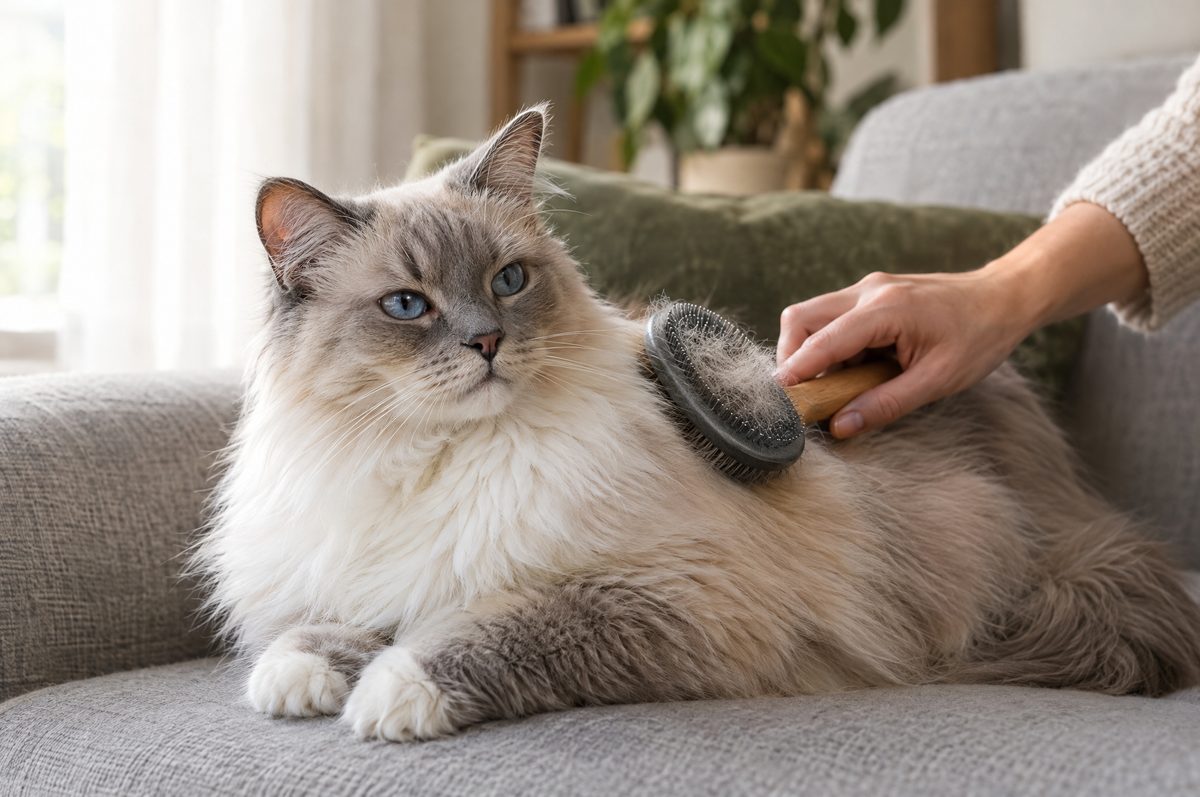
Brushing is the safe first step. It removes loose fur before your cat swallows it. The Cornell Feline Health Center advises brushing and combing daily. Webvet says daily for long-haired cats, a few times a week for short-haired cats, and more in shedding season. It adds that short, steady sessions work better than rare long ones.
Do not give your cat a laxative or a home remedy for hairballs unless your vet says so. Cornell says never to give a cat a laxative without the approval and supervision of a veterinarian. Cornell also says not to rely on commercial products without veterinary advice.
If your cat shows any warning sign, do not try to treat it at home. Call your vet.
What a vet may do
Cornell says the vet looks at the cat’s history of hairballs. Diagnosis may include a physical exam, blood tests, X-rays and sometimes an ultrasound. Treatment is often supportive. Surgery is needed if there is a blockage.
For frequent vomiting, the Cornell Feline Health Center says the vet starts with “a thorough history from the owner.” The Merck Veterinary Manual says a cat may need blood, stool and urine tests, X-rays and an ultrasound. It says a biopsy is often the only way to find the cause in a gut disease.
Your history matters most. A good record can save time and money.
What to write down
St. Denis and O’Brien say a calendar recording system is useful when owners are unsure how often vomiting or hairballs happen. Dial A Vet says a simple vomiting diary helps the vet find the cause faster. Write these for each event:
- the date and time
- what came up: hairball, hair in liquid, food, foam
- the size of the hairball, if you can say
- what came before: grooming, shedding, a stressful day
- how your cat was afterwards: bright, hiding, ate, drank
- a photo, and a short video if there was retching
Also write when you brush, and how often. Weigh your cat on the same scale every month. St. Denis and O’Brien say subtle weight loss can be one of the first signs of disease.
The Cat Vomiting and Hairball Diary has a hairball log, a vomit log, a month grid and a page for hair care and grooming. It shows each source on its page, including the frequency numbers above. It never diagnoses and never names a medicine.
Before the visit, our free vet visit summary puts your cat’s health notes and questions on one page. The diary also has a one-page summary for your vet, with room for the counts.
Questions to ask your vet
- Are these hairballs, or other vomit with hair in it?
- How often is too often for my cat?
- Could grooming, skin, stress or pain explain more hairballs?
- Which tests would help?
- How should I brush, and how often?
- Which signs mean I should call at once?
The diary has a page with these questions and room for the answers.
The short version
- Vets do not agree on one number. The range runs from less than once a month to one every week or two.
- Hairballs that become more frequent are a reason to ask your vet.
- Retching with nothing coming up, lethargy or no food for a day or two: call now.
- Brush often. Do not give a laxative without your vet.
- Count each event. Your own record beats any single number.
Questions
Is it normal for a cat to throw up a hairball every week?
Vets differ. The Cornell Feline Health Center says one every week or two is common and nothing to worry about. Webvet says healthy cats bring one up only occasionally, roughly once or twice a month or less, and more than one a week is a red flag. Ask your vet for the rule for your cat.
Why is my cat throwing up hairballs more often?
Webvet says a clear rise in frequency is the concern. Bond Vet names over-grooming as one of the most common causes, driven by stress, boredom, itchy skin or pain. Seasonal shedding and a long coat also raise the number. A change needs a vet check, so write down each event.
What does a hairball look like?
The Cornell Feline Health Center says a hairball is usually a slender, cylinder-shaped mass, about an inch long and sometimes up to five inches. Webvet says it is a slim, damp tube of matted fur that people often mistake for stool. A hairball that stays in the stomach is round.
What are the signs of a hairball blockage?
Cornell lists lethargy, refusing food for more than a day or two, and repeated unproductive retching or vomiting. It says to see a vet without delay. Without surgery, a hairball lodged in the small intestine can be fatal. This is rare, but it is serious.
Can I give my cat something to pass a hairball?
Not without your vet. The Cornell Feline Health Center says never to give a cat a laxative without the approval and supervision of a veterinarian. Brushing is the safe step. Cornell advises brushing and combing daily. Ask your vet about anything else.
Is my cat coughing up a hairball or does it have asthma?
It is hard to tell at home. Cornell says frequent hacking may not be a hairball. It can mean another gut problem, or a lung problem such as asthma. Film an event and show your vet. Call your vet the same day if your cat gags and nothing comes up.
Sources
- Cornell Feline Health Center: The danger of hairballs
- Cornell Feline Health Center: Vomiting
- St. Denis KA, O'Brien L. Hairballs are not normal: a practical approach to the vomiting cat. OVMA, 2017
- Webvet (medically reviewed by Dr Pippa Elliott, BVMS MRCVS): Cat hairballs, 2026
- Bond Vet: Cat throwing up hairball, 2024
- Texas A&M College of Veterinary Medicine: When to be concerned about feline vomiting, 2021
- Merck Veterinary Manual, owner version: Vomiting in cats
- Loureiro BA and others. Sugarcane fibre may prevent hairball formation in cats. Journal of Nutritional Science, 2014
- Norsworthy GD and others. Diagnosis of chronic small bowel disease in cats: 100 cases. JAVMA, 2013
This article helps you organise care. It does not replace advice from your vet.