Cat vomiting yellow foam or liquid: what it means and when to call the vet
You find a small puddle of yellow foam on the floor. Your cat looks fine. Is it a problem? Often it is minor. But sometimes it is the first sign of something that needs a vet. This guide shows you how to tell the difference, and what to write down so your vet can help.
This page gives general information. It does not diagnose your cat. Your vet decides the cause.
Call a vet now if you see any of these signs
Read this list first. If any line fits your cat, call your vet or an emergency clinic now. Do not wait.
- Your cat vomits several times in a few hours, or cannot keep water down. Dial A Vet lists both as emergencies.
- The vomit contains blood, or looks like coffee grounds.
- Your cat retches again and again, and nothing comes up. Webvet and the Cornell Feline Health Center both list this as urgent.
- You can see string or thread at the mouth or at the rear. Do not pull it.
- Your cat may have eaten a lily, a medicine, a chemical, antifreeze or part of a toy. The ASPCA says lilies are toxic to cats. Its advice is to call a vet or Poison Control as soon as possible.
- Your cat is weak, hiding, or does not respond as usual.
- The belly looks swollen or seems painful.
- A male cat strains in the litter tray. Dial A Vet says a urinary blockage can cause vomiting.
Kittens, senior cats, diabetic cats and cats with a known illness need to be seen sooner. Webvet says so on its page about undigested food.
What is yellow vomit?
The Webvet team, medically reviewed by Dr Pippa Elliott (a vet with nearly 30 years in practice), says yellow vomit is bile. Bile is a digestive fluid. The liver makes it, and the gallbladder stores it. Webvet says bile “turns the vomit yellow when the stomach is empty or mildly irritated.”
The shade can change. It can be pale, bright or greenish. Webvet says the shade and the texture rarely change the diagnosis by themselves. So do not try to work out the cause from the colour alone. Look at the whole picture instead.
The most common reason: an empty stomach
Webvet names bilious vomiting syndrome as the most likely cause when a cat has one yellow episode in the morning, or before a meal, and is otherwise bright and hungry. The stomach has been empty for some hours, and bile comes up.
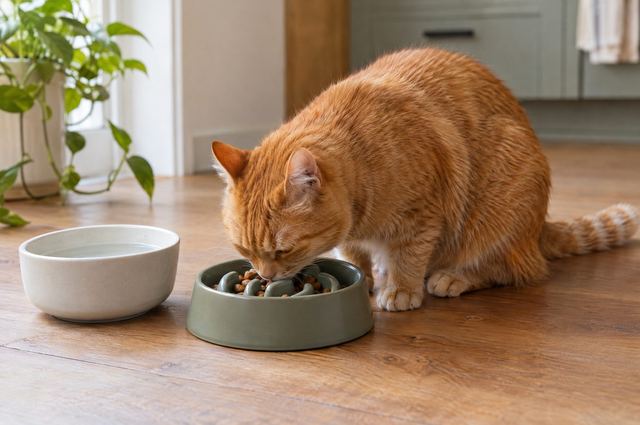
Webvet suggests some feeding changes for this pattern: smaller meals more often, a small snack at bedtime, and possibly a timed feeder. It also says to see a vet if the pattern continues. Your vet knows your cat’s weight and health. Ask what suits your cat before you change anything.
Other causes your vet may look for
Yellow vomit can also come with other problems. Webvet lists:
- hairballs
- eating something that does not agree with the cat
- reflux or an irritated stomach
- an overactive thyroid
- inflammatory bowel disease
- pancreatitis
- kidney or liver disease
- a blockage in the gut
The Cornell Feline Health Center gives a similar list. It also names parasites, poisons, constipation, diabetes and growths. Webvet says frequency, duration and other signs matter more than the colour of the vomit.
A vet cannot tell these causes apart by looking at the puddle. The vet needs your history, an exam, and sometimes tests. Cornell says the vet starts with “a thorough history from the owner.” Then the vet may order blood and stool tests. If those results are normal, the next step may be X-rays and an ultrasound.
When to book a vet visit, even if your cat seems well
Not every case is urgent. But some need a visit soon. Webvet says to call promptly for:
- repeated vomiting in one day
- vomiting that lasts past 24 hours
- refusal of food or water
- lethargy or hiding
- yellow vomit with loss of appetite
Webvet also says that recurrent vomiting in a middle-aged or senior cat needs an exam and blood work. Early kidney disease can look mild. For the age groups, see our guide to when a cat is a senior.
Sources disagree on how often is too often. The Cornell Feline Health Center says a cat that vomits more than once a week needs to be seen. Texas A&M says to see a vet for more than a couple of times a month, or for a sudden change. Dial A Vet suggests a routine visit for more than once or twice a month. Your vet may give you a rule for your cat. Ask for it, and write it down.
A cat that looks well can still have a problem. Two feline vets (St. Denis and O’Brien, 2017) say that cats that vomit more often than every 2 weeks are more likely to have gut disease. Norsworthy and colleagues (JAVMA, 2013) studied 100 cats with chronic vomiting, diarrhoea or weight loss. They found disease in 99. Their conclusion: chronic or recurrent vomiting “should not be considered a normal condition and should not be ignored.”
Why a cat that stops eating is a worry
A cat that is vomiting and not eating needs a call to the vet the same day. Webvet says cats that stop eating for a day or two risk a serious liver condition. Dr Trepanier’s 2010 review in the Journal of Feline Medicine and Surgery says controlling nausea and vomiting matters. It helps to prevent food aversion and anorexia, with weight loss and dehydration, and a liver problem called hepatic lipidosis.
This is why “wait and see” has a limit. Dial A Vet says to book a same-day appointment if your cat has not eaten for 24 hours, or vomits while lethargic. A kitten or a senior cat with vomiting and diarrhoea also needs a same-day visit.
What you can do at home while you wait for the vet
Home care is for a single episode in a cat that is otherwise normal. It is not a replacement for a vet. Keep these points in mind:
- Keep fresh water in easy reach. The Merck Veterinary Manual says not to withhold water unless your vet says so. Dehydration can make things worse.
- Do not give human medicines. Webvet says not to give human medicines, leftover prescriptions, milk or antacids unless a vet directs it. The Cornell Feline Health Center lists human medicines among the things cats vomit from.
- Do not give a home remedy that you found online. Your vet decides what is safe.
- Watch your cat. Note the appetite, energy, the litter tray and the next meal.
- Check the home. Look for string, hair ties, plants, chemicals and toy parts that your cat may chew. See the full list on the diary pages.
Webvet suggests a short food rest of a few hours after a single episode, then a small meal. It says a cat should not go without food for more than about a day. Ask your vet first if your cat is a kitten, a senior, diabetic or has a known illness.
What to write down for your vet
Your vet asks the same questions each time. A written record answers them well.
- When: the date, the time, and how long since the last meal.
- What it looked like: foam, liquid, food, hair. Yellow, white, clear, green or red.
- How it came up: with effort, retching and drooling (vomiting). Or with no effort (regurgitation).
- What came before: a fast meal, grass, a new food, a stressful day, something chewed.
- How your cat was after: bright, hiding, ate again, drank.
- A photo or a short video. Dial A Vet says a short phone video helps your vet tell vomiting from regurgitation.
The Webvet team asks for the same log: the time, how the vomit looked, and whether the cat ate afterwards. St. Denis and O’Brien say that a calendar recording system helps when owners are unsure how often it happens. They also advise weighing the cat at every visit, because subtle weight loss can be one of the first signs.
You can do this on paper, or on a phone. The Whiskever Cat Vomiting and Hairball Diary has a vomit log with a column for each of these points. It also has a page that shows the words vets use for colour and content. Each page names its source. The diary never diagnoses and never names a medicine. It records, and your vet decides.
If you want a one-page summary for the vet, use our free vet visit summary. It puts your cat’s health notes and questions on one page.
Questions to ask your vet
Take these to the visit:
- Could this be an empty-stomach problem, or something more?
- How often is too often for my cat?
- Which tests would help, such as blood tests, a stool test or X-rays?
- Should I change how or when I feed my cat?
- Which signs mean I should call at once?
The cat vomiting diary has a page with these questions and room to write the answers.
Yellow vomit and hairballs
Sometimes a hairball comes up with yellow liquid. A hairball is a slim tube of matted hair. Vomit with some hair in it is not the same thing. If your cat brings up hairballs often, read our guide on how often cats throw up hairballs. If your cat also grooms a lot, see cat overgrooming and bald patches.
If your cat also throws up food soon after meals, read cat throwing up after eating. That pattern has different causes.
The short version
- Yellow vomit is bile. It often shows when the stomach is empty.
- One episode in a bright, hungry cat is often minor.
- Repeated vomiting, no appetite, hiding, blood, retching with nothing coming up, or something eaten means call a vet now.
- Do not give human medicines or home remedies.
- Write down the time, the look and what happened next. Take it to your vet.
A cat cannot say what is wrong. Your notes speak for your cat. The Cat Vomiting and Hairball Diary keeps them in one place.
If your cat has also stopped eating, read cat not eating but acting normal.
Questions
Why is my cat vomiting yellow liquid?
The Webvet vet team says yellow vomit is bile, a digestive fluid made by the liver. It turns the vomit yellow when the stomach is empty or mildly irritated. The shade rarely tells your vet the cause. How often it happens, how long it lasts and your cat's other signs matter more.
Is yellow vomit an emergency?
Not always. A single yellow episode in a bright, hungry cat is often minor. It is urgent if your cat vomits several times in a few hours, cannot keep water down, vomits blood, retches with nothing coming up, or may have eaten string, a lily or a toy. Call your vet or an emergency clinic now.
Why does my cat vomit yellow foam in the morning?
Webvet names an empty stomach as the most likely cause when a cat has a single yellow episode in the morning or before a meal and is otherwise bright and hungry. Do not decide this alone. If it happens more than once in a while, write each time down and ask your vet.
My cat vomits yellow liquid and will not eat. What should I do?
Call your vet the same day. Webvet says yellow vomit with loss of appetite is a warning sign. Cats that stop eating for a day or two risk a serious liver condition. Do not wait to see if it passes.
Can I give my cat a medicine for the vomiting?
No. Webvet says not to give human medicines, leftover prescriptions, milk or antacids unless a vet tells you to. Your vet decides the cause and any medicine. Write down what you see and take it to the visit.
What should I write down?
Webvet advises a simple log of the time, what the vomit looked like and whether your cat ate afterwards. Dial A Vet adds the timing against meals, and photos or a short video. A written record helps your vet find the cause faster.
Sources
- Webvet (medically reviewed by Dr Pippa Elliott, BVMS MRCVS): Cat throwing up yellow, 2026
- Cornell Feline Health Center: Vomiting
- Merck Veterinary Manual, owner version: Vomiting in cats
- Dial A Vet: Frequent vomiting in cats
- Texas A&M College of Veterinary Medicine: When to be concerned about feline vomiting, 2021
- Trepanier L. Acute vomiting in cats: rational treatment selection. Journal of Feline Medicine and Surgery, 2010
- ASPCA Animal Poison Control: Lily
This article helps you organise care. It does not replace advice from your vet.