Indoor cat got out? What to do now, and where to look first
The door was open for a moment, and now your indoor cat is gone. Your cat has never been outside, so it feels like the worst case. The facts are better than the fear. Most indoor cats that get out stay very close and hide. Your job is to search slowly, quietly and close.
This guide is one step in our complete guide on what to do if your pet is lost, for owners and for finders.
First: is your cat really outside?
Search the house before you go outside. A frightened cat can hide in silence and seem to be gone. The Companion Animal Register says a spooked cat can hide in a cupboard or under a bed and be taken for missing.
- Look under beds, in closets and behind large furniture.
- Check inside appliances, such as the washing machine and the tumble dryer. Cats Protection names both.
- Look under duvets, behind curtains and inside the box springs of a sofa or bed.
- Check the basement, the garage and any open cupboard.
Use a flashlight. The light shows your cat’s eyes in a dark space. Then go outside.
Most indoor cats stay very close
A 2018 study collected reports on 1,210 missing cats. Of the 403 cats that went missing from indoors with a known escape route, 74% got out through an open door or garage. Others jumped from a window or got through a damaged screen.
The study also measured how far the found cats were from the place they escaped:
- Indoor-only cats were found a median of 39 metres away. That is about the length of a few gardens.
- Three in four indoor-only cats were within 137 metres.
- Cats that were allowed outside went farther. Three in four were within 1,609 metres, or one mile.
The authors say a search within 200 metres is likely to be enough for an indoor-only cat. So start at the door your cat used. Do not drive around town first.
Where indoor cats hide outside
An indoor cat in a strange place looks for cover. In the study, 89% of escape areas had 7 or more hiding places within about 130 metres. Of the cats found alive outside, owners found them in these places:
- In a yard: 20%
- Waiting outside their own home: 19%
- Under shrubs or other plants: 16%
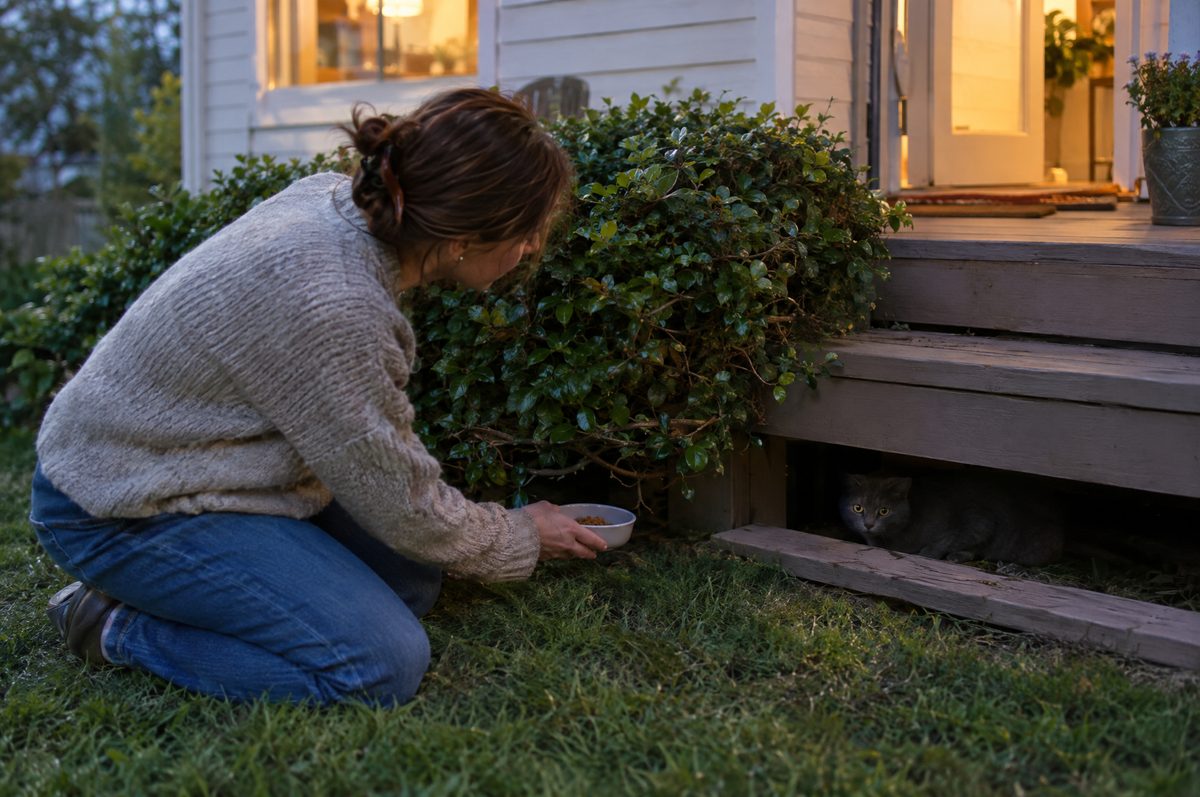
- Under a deck, patio or porch: 10%
- Under a house, a shed or a car, inside a garage or shed, or in a storm drain
About 11% of found cats were inside someone else’s house. Curious cats were more likely to be found there. So ask your neighbours to check inside their homes, too.
Search slowly and quietly
A hiding cat is frightened. It may hear you and still stay silent. The Companion Animal Register says lost cats are often within 5 houses of home, hiding in silence.
- Start at the door your cat used. Search in small circles that grow a little larger each time.
- Get down low. Look “in and under” each hiding place: under decks, porches, steps, cars and thick shrubs.
- Ask your neighbours for permission to search their gardens slowly. Ask them to check their sheds, garages, basements and cars.
- Call softly, then stop and listen for a reply. Do not shout or bang tins of food.
- Search again at night with a flashlight. Cats may come out of a hiding place when the street is quiet.
In the study, some search methods found cats faster than others. These were talking to neighbours, a walk at night with a flashlight, and a slow search of neighbours’ property with their permission.
Use scent and a quiet door
Cats have a strong sense of smell. Cats Protection suggests that you put out items that smell familiar. Use unwashed bedding, a favourite toy, used litter or an unwashed piece of your clothing. Put out strong-smelling food that your cat likes.
Leave the door your cat used in view, and watch it. Many found cats were simply waiting outside their home. Some owners in the study used a camera or a baby monitor to watch the door at night.
Tell people, and make the calls
- Talk to neighbours on both sides of the street and behind you. Give them a photo.
- Ask about delivery vans and tradespeople. A cat can hide in a van and be driven away.
- Call the microchip registry. Report your cat as lost and check that your phone number is current.
- Call local shelters, animal control and vet clinics. Visit the shelters in person with a photo, as the ASPCA advises.
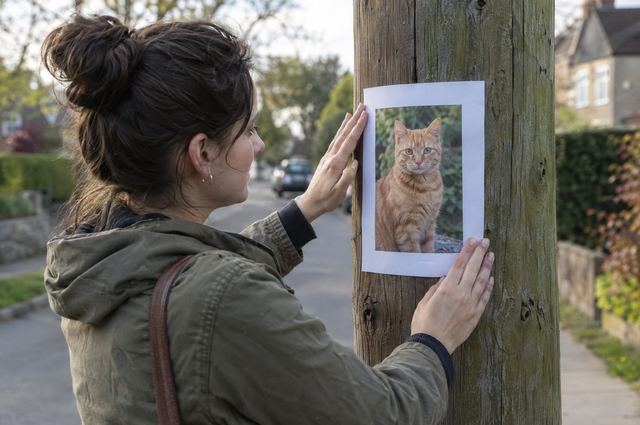
- Put up posters close to home first. Say where your cat may hide and whether people should approach it.
Search again, day after day
Do not stop after the first evening. The Companion Animal Register says a cat often hides for 3 to 10 days before it comes out. It advises a thorough search every 24 to 48 hours for the first 2 weeks. If you know where your cat hides but cannot reach it, read what to do when a cat is missing for 3 days or more, with the safe way to use a humane trap.
Write down each place you search, with the date and time. Then you search new places, not the same bush again.
Get ready before it happens again
When your cat is home, make the next escape shorter:
- Fit a collar with an ID tag, also on an indoor cat.
- Check that the microchip registry has your current phone number.
- Take a clear, recent photo from the side and the front.
- Check door and window screens for damage.
The Lost Cat Kit puts these steps in order. It has a room-by-room search inside, a door-to-door neighbour list, a night and dawn search log, a search map with the indoor-cat distance guide, a LOST CAT poster and a humane trap plan. For the full first-week plan, read where to look for a lost cat.
When you are ready to put up posters, read lost cat flyer: what to put on it, and where to post it.
Questions
Will an indoor cat that got out come back?
Many do. In a US survey, the most common way that lost cats were found was that they came home on their own. Do not wait for that. An indoor cat often hides close to home and stays silent, so search for it in person.
How far do indoor cats go when they get out?
Usually not far. In a 2018 study of 1,210 missing cats, indoor-only cats were found a median of 39 metres from where they escaped. Three in four were within 137 metres. The authors say a 200 metre search radius is likely to be enough for an indoor-only cat.
Should I call my cat's name?
Call softly, then stop and listen. Cats Protection says to call early in the morning or at night, when it is quieter. The Companion Animal Register in New Zealand warns that loud calling and banging tins can frighten a hiding cat even more.
How long will my indoor cat hide?
It can be days. The Companion Animal Register says it is common for a cat to hide for 3 to 10 days before it feels calm and hungry enough to come out. Search the area every 24 to 48 hours for the first 2 weeks.
Does an indoor cat need a collar and ID tag?
Yes. The ASPCA says all pets, even indoor-only pets, should wear a collar with an ID tag that has your current phone number. If your cat has a microchip, keep the registry details current.
Sources
- Huang L, Coradini M, Rand J, et al. Search methods used to locate missing cats and locations where missing cats are found. Animals 2018;8(1):5
- Companion Animal Register (New Zealand): Lost pet advice for cats
- Cats Protection: Lost a cat
- ASPCA: Finding a lost pet
This article helps you organise care. It does not replace advice from your vet.