Dog won't take pills no matter what? A step-by-step plan
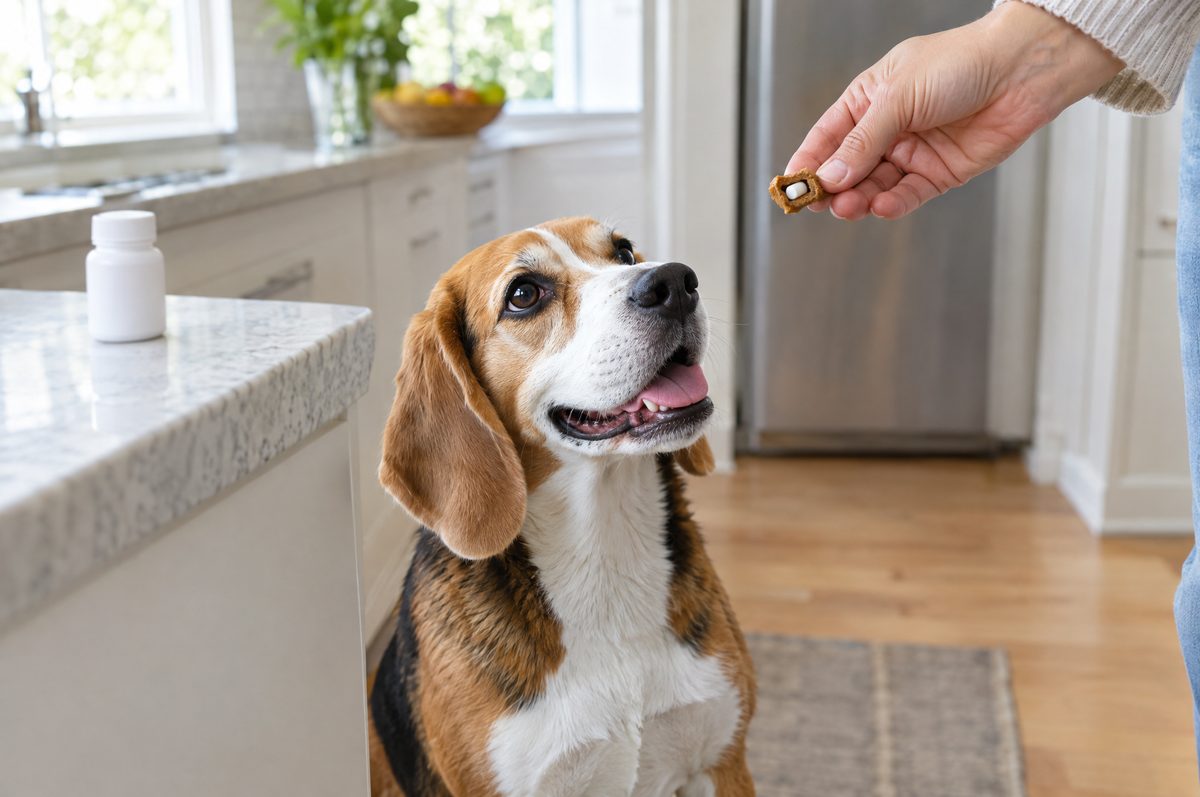
The vet sent you home with a bottle of tablets. Twice a day for two weeks. Your dog eats socks, tissues and anything that falls on the floor. But a pill? Your dog finds it in a ball of cheese, eats the cheese, and spits the pill on the rug.
You are not alone. This guide gives a plan, step by step, from the easiest trick to asking your vet for another form.
This page gives general information. It is not veterinary advice. Always give a medicine exactly as the label and your vet say.
Before you start: two safety checks
1. Read the label. Does it say “give with food” or “give on an empty stomach”? Can it be split? Ask the pharmacist if you are not sure.
2. Check the hiding food for xylitol. Pet Poison Helpline says xylitol can cause life-threatening low blood sugar in dogs, sometimes within 10 to 15 minutes, and liver failure. It lists gum, mints, sweets, jams, syrups, sauces, some supplements and some toothpastes. The AVMA warns that baked goods may contain it too. Some peanut butters and spreads use it. Read the label every time you buy a new jar.
Also, never use a human pill pocket or human medicine. The FDA says a medicine meant for people may not be right for your dog and may hurt it.
Step 1: the three-treat trick
Dogs that gulp food are easy. Dogs that check it are not. This trick makes a dog gulp.
- Cut three or four small pieces of a soft, tasty treat.
- Give one plain piece. Praise.
- Give a second plain piece, fast. Praise.
- Give the third piece, with the pill inside. Do not pause.
- At once, show the fourth piece. Your dog swallows to get it.
Speed matters. Your dog expects the next treat and does not stop to chew.
Step 2: pick a better hiding food
Cornell’s pharmacy guide suggests wrapping a tablet in a small piece of meat, bread or cheese that your dog likes. It says to check with your vet or pharmacist first, because not all medicines can be given with cheese.
Other options:
- A pill pocket made for dogs.
- A small ball of wet dog food.
- A small piece of cooked chicken.
- A small amount of plain cream cheese, if your vet allows it.
Keep the piece small. A big piece gets chewed, and chewing finds the pill. Use your fingers to press the food all the way around the pill, so no corner shows. Wash your hands first, so the pill does not smell of your fingers.
Step 3: change the setting
Some dogs refuse because they have learned what is coming.
- Do not hide the pill in front of your dog.
- Give the treat at a different time than usual, not just before the dose.
- Give a few pill-free treats in the same way through the day.
- Stay relaxed. Dogs read your face and hands.
Step 4: the hands-on method
If hiding fails, Cornell’s pharmacy guide gives these steps:
- Call your dog to you in a happy voice.
- Back your dog into a corner of the room, so it cannot back away.
- With one hand, hold the muzzle from above.
- Gently tip the head back, so the chin points up.
- Quickly place the pill as far back in the mouth as you can, on the back of the tongue. Do not push your hand too far in, or your dog may gag.
- Lower the head and hold the mouth closed by wrapping your fingers around the muzzle.
- Gently rub or blow on the nose to make your dog swallow.
- Praise your dog in a happy voice and give a treat.
Follow with a little water or food if your vet says it is all right, so the pill does not stick in the throat.
If your dog may bite, stop. Ask your vet team to show you, or to suggest another form.
Step 5: liquids
If your vet prescribes a liquid, Cornell says do not tilt the chin up. Put the syringe in the side of the mouth, just behind the lower teeth. Give a little at a time, and pause so your dog can swallow.
Step 6: ask your vet for another form
If nothing works, tell your vet. Do not skip doses quietly. Ask:
- Is there a liquid form?
- Is there a chewable or flavoured form?
- Can a pharmacy make a flavoured version?
- Is there an injection, or a longer-acting option?
- Can the dose be given less often?
Do not crush without asking
Crushing a tablet into food sounds easy. But some tablets are coated or slow-release, and crushing breaks how they work. Some crushed tablets taste so bitter that your dog refuses the meal. Ask your vet or pharmacist before you crush or split any tablet.
Keep a log
Write down each dose as you give it, and what worked. After a week you will know which hiding food and which method suit your dog. It also stops a missed or double dose when two people share the job.
If your dog also fears vet visits, read dog scared of the vet. If your dog is not eating during treatment, read dog not eating after chemo. For cats, read how to give a cat a pill. Our guide to a pet medication schedule helps you plan several medicines.
Track every dose
Our free medicine reminders tool sets a schedule. The Medical and Dosing Tracker records each dose as the label says, with the time, so you can see at a glance what was given.
Questions
Can I crush my dog's pill?
Only if your vet or pharmacist says so. Some tablets have coatings or slow-release designs that crushing breaks. Some taste so bitter that your dog will refuse the food too. Ask first, and ask if a liquid or chewable form exists.
What can I hide a pill in?
Cornell suggests a small piece of meat, bread or cheese, but says to check first, as not all medicines can go with cheese. Pill pockets and soft treats also work. Check any peanut butter or spread for xylitol, which is toxic to dogs.
What if my dog spits it out?
Try the three-treat trick, so your dog gulps without checking. If it still fails, use Cornell's hands-on method: place the pill far back on the tongue, close the mouth gently and stroke the throat. If that fails, ask your vet for another form.
Can I mix the pill into my dog's food?
Sometimes, but your dog may eat around it, or not finish the bowl, and then you cannot know the dose was taken. Ask your vet whether the medicine can go with food. A small meatball given by hand is better than a full bowl.
Is xylitol really that dangerous?
Yes. Pet Poison Helpline says xylitol can cause life-threatening low blood sugar in dogs, even within 10 to 15 minutes, and liver failure. It is in some gums, sweets, spreads and supplements. Read the label of anything you use to hide a pill.
My dog is too sick to eat. What then?
Call your vet. Some medicines must be given with food, and some cannot be given safely by mouth to a dog that vomits. Your vet may change the form or the timing.
Sources
- Cornell University Hospital for Animals pharmacy: Giving your dog oral medications
- Pet Poison Helpline: Xylitol
- AVMA: Winter holiday pet safety
- US Food and Drug Administration: Get the facts about pain relievers for pets (29 September 2022)
This article helps you organise care. It does not replace advice from your vet.