How to pay for vet bills: every option, before, at the desk and after

A vet bill can arrive as a shock: an emergency at night, a lump that needs surgery, a dental estimate twice what you expected. You are not the only one. This guide puts every way to pay in order: before the bill, at the front desk, and after. Each step links to our detailed guide on that step.
This page gives general information. It is not financial, legal or veterinary advice. Check every offer and its terms yourself.
First: if it is an emergency, go now
Do not let money stop you from getting help in an emergency. Go, and talk about money at the desk. Our guides list the signs that mean go now: when to take your cat to the emergency vet and what to do if your dog ate a sock. For a line-by-line view of an emergency bill, read emergency vet cost for dogs.
You are not alone
In a Gallup survey for PetSmart Charities, 52% of US pet owners skipped or declined needed vet care in the past year. Of those, 71% said cost was a reason. Gallup found that 66% of owners could pay $1,000 or less for lifesaving treatment. Gallup also says US vet care costs have risen more than 60% since 2014.
The same survey found a gap. Of owners who declined care because of cost, 73% were not offered a cheaper option. In a second Gallup survey, 81% of vets said they always or often suggest another plan when cost is the problem. So the cheaper option often exists. You may have to ask for it.
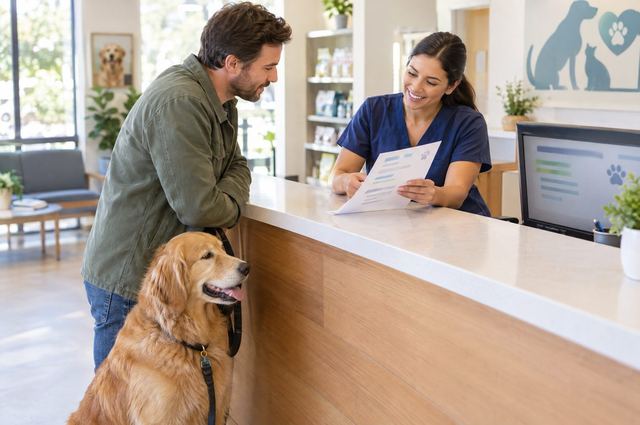
At the front desk: the four questions
1. “Can I have a written estimate?”
Ask before treatment starts, unless it is an emergency. Ask for a low and a high figure. Ask what each line is for.
2. “This is what I can pay. Is there a Plan B?”
Say your number early. The Gallup vet survey found 49% of vets ask about money only after they present their plan. Another 34% ask only if the client raises cost or declines care.
The College of Veterinarians of Ontario says the most advanced care is not a requirement. It supports vets who offer care options “along a spectrum”. This is often called the spectrum of care. A Plan B is not bad care. It is a different plan that fits your pet and your budget.
3. “What must happen today, and what can wait?”
Some tests and treatments can happen in steps. Ask which part is urgent. Ask what signs mean you must come back sooner.
4. “Can I pay over time?”
Ask about an in-house payment plan. In the Gallup vet survey, 19% of vets said they always and 22% often offer payment plans when cost is a problem. In the owner survey, only 23% had ever been offered one. Get the terms in writing.
Our guides on what to do if you cannot afford the vet bill and cannot afford a vet for your cat give the exact words for each question. Read do vets do payment plans for what to ask about a plan.
Paying over time with credit
Many clinics offer a medical credit card or a loan. The Consumer Financial Protection Bureau says these products have largely replaced the low-cost or no-cost payment plans that providers once gave patients. It warns they can make patients pay more than they otherwise would.
Deferred interest: know the date
CareCredit says its offers of six, 12, 18 or 24 months are “no interest if paid in full”. If the promotional balance is not paid in full in time, interest is charged from the purchase date. CareCredit itself advises checking if the minimum payment is enough to clear the balance in time.
Do this sum before you sign:
- Take the bill.
- Divide it by the number of months in the offer.
- Pay at least that each month, not the minimum.
- Set a reminder a month before the end date.
Instalment loans
Scratchpay says its plans run 12 to 24 months, for $200 to $10,000. It says its APRs range from 0% to 36%, with the lowest rates for exceptional credit. It also says checking your eligibility does not affect your credit score.
Our guide to CareCredit vs Scratchpay for vet bills compares the two, line by line.
Charity and low-cost care
Help exists, but it is rarely fast. The Pet Fund, a US nonprofit, helps only with non-basic, non-urgent care, such as cancer treatment or chronic conditions. It says it gets hundreds of requests a day and usually has a wait list. Ask your clinic for an estimate first. Most groups need one.
Humane World for Animals keeps a list of resources for owners who have trouble paying for a pet’s care. Your local shelter may know of low-cost clinics nearby.
Before the next bill
Insurance or a savings pot
NAPHIA, the North American pet insurance trade group, puts the 2025 US average accident and illness premium at $836 a year for dogs and $435 for cats. Insurance helps most when a big bill would be hard to pay. A savings pot has no fine print, but it takes years to grow.
Our guides work through the sums:
- Pet insurance or a savings pot?
- Is pet insurance worth it for dogs?
- Is pet insurance worth it for cats?
Know the common costs
A planned bill is easier than a surprise. Our cost guides break down the bill, line by line:
Keep records
Write down what you see at home, with dates. Keep every estimate and invoice. A clear record helps your vet choose tests, and it helps with insurance claims. Our free vet visit summary puts your notes on one page.
Every guide in this series, in order
- Can’t afford the vet bill? What to do, step by step: the words to use at the desk.
- Can’t afford a vet for your cat?: the same steps, for cats.
- Do vets do payment plans?: what to ask, and what to watch for.
- CareCredit vs Scratchpay: how each one works.
- Emergency vet cost for dogs: each part of the bill.
- Dog dental cleaning cost: what is in the bill.
- Dog euthanasia cost: clinic and home visit.
- Pet insurance or a savings pot?: work it out in 10 minutes.
- Is pet insurance worth it for dogs?: one simple sum.
- Is pet insurance worth it for cats?: indoor and older cats.
One plan for the next bill
If you want the questions on paper, the Dog Vet Bill Plan and the Cat Vet Bill Plan are fillable PDFs. Each has the words to ask for an estimate and a Plan B, insurance in plain English, and a claim tracker. They give no medical or money advice, and never tell you to decline care.
Before the next bill, choose a clinic with care. Read how to find a good vet.
Questions
How do I pay for a vet bill with no money?
Say so at the front desk before treatment starts. Ask for a written estimate, a cheaper Plan B and which part must happen today. Ask if the clinic offers a payment plan. Then look for charity help. Humane World for Animals keeps a list of groups that help with vet costs.
Do vets let you pay in instalments?
Some do, but you usually have to ask. In a 2025 Gallup survey of 933 US vets, 19% said they always and 22% often offer payment plans when cost is a problem. Only 23% of owners in a Gallup owner survey were ever offered one.
Is CareCredit a good way to pay a vet bill?
It can help if you pay the full promotional balance in time. CareCredit says that with deferred interest, interest is charged from the purchase date if you do not. Work out the monthly payment that clears it before the end date, and set a reminder.
Can I get vet financing with bad credit?
Sometimes. Scratchpay says checking your eligibility does not affect your credit score, and that the rate depends on your credit history. Its APRs range from 0% to 36%. Read the full terms before you sign, and ask your clinic for a payment plan first.
Are there charities that help pay vet bills?
Yes, but most have rules and wait lists. The Pet Fund, a US nonprofit, helps only with non-basic, non-urgent care, such as cancer or chronic conditions, and has a wait list. For an emergency, ask your clinic and local shelters first.
Is pet insurance worth it to cover vet bills?
It depends on your savings, your pet's age and health, and the policy. NAPHIA puts the 2025 US average accident and illness premium at $836 a year for dogs and $435 for cats. Do one sum per quote: a sample bill, less the deductible, times the share paid back.
What happens if I decline the treatment my vet recommends?
Tell your vet why. Gallup found 81% of US vets say they always or often suggest another plan when cost is the reason. Ask what the risks are of each option, and what signs mean you must come back.
Sources
- Gallup and PetSmart Charities: Pet owners skipped or declined veterinary care, Hrynowski and Lall, April 2025
- Gallup: Veterinarians say cost is the main driver of declined care, Kemp, January 2026
- College of Veterinarians of Ontario: Balancing available health care options and client access to veterinary care, position statement, December 2022
- CareCredit: Understanding promotional financing (1 May 2026)
- Scratchpay: How Scratch Pay works
- Consumer Financial Protection Bureau: Medical credit cards and financing plans, May 2023
- The Pet Fund: For pet owners
- Humane World for Animals: Resources for pet owners
- North American Pet Health Insurance Association (NAPHIA): State of the Industry Report, highlights, June 2026
This article helps you organise care. It does not replace advice from your vet.