How to trim black dog nails without cutting the quick

Black nails are the hardest nails to trim. In a white nail, you see a pink line inside. That is the quick: the living part with a blood vessel and a nerve. In a black nail, you see nothing. So owners either cut too much and hit the quick, or cut so little that the nails stay long.
This guide shows you a safe method. You cut thin slices and read the cut surface. It gives general information. It does not replace your vet.
When to see a vet instead
Do not trim at home if:
- A nail is broken, split or bleeding.
- A nail or a dewclaw has grown into the pad. VCA Canada says dewclaws can curve around and grow into the paw pad.
- The toe is swollen or red, or your dog cries when you touch it.
- Your dog has bitten during a nail trim before.
Your vet or a groomer can trim the nails safely today.
How to tell if black nails are too long
VCA Canada gives two simple checks:
- The nails touch the ground when your dog stands.
- You hear the nails click on a hard floor.
VCA Canada says most dogs need a trim about once a month. Dogs that walk a lot on concrete may need it less. Inactive dogs may need it every three weeks.
What you need
- Sharp nail clippers made for dogs, or a nail grinder. Blunt clippers crush the nail.
- Styptic powder. VCA Canada says flour or cornstarch also helps if you have none.
- Good light. Daylight or a bright lamp. You need to see the cut surface clearly.
- Small, soft treats that your dog loves.
- A helper, if you can. VCA Canada says a helper can hold the dog gently and give small, frequent treats.
Step by step: the thin-slice method
1. Hold the paw gently
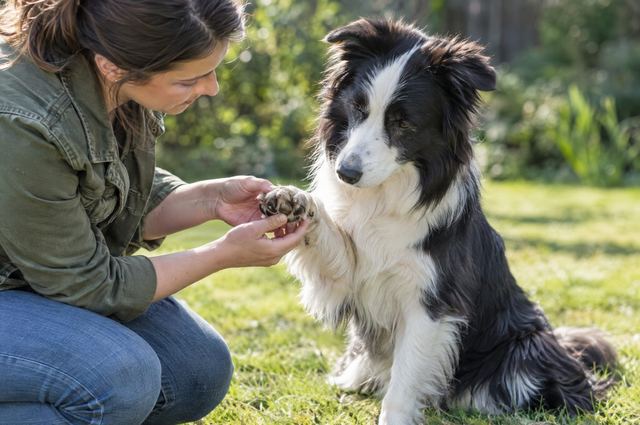
Hold the paw in your open hand. Press gently on the pad to push the nail forward a little. Do not squeeze hard. If your dog pulls away, stop. Go back to paw handling first. Our guide for a dog that won’t let you cut his nails shows how.
2. Cut only the hook
Start with the thin, curved tip of the nail. VCA Canada says that when you cannot see the quick, trim just the very tip.
Chewy’s vet-reviewed guide says to cut at a 45-degree angle, not straight across, so the cut edge runs parallel to the floor.
3. Take 1 to 2 mm at a time
VCA Canada says to remove 1 to 2 mm with each clip. Small cuts are the whole secret. Chewy’s guide agrees: cut little bits at a time, not a big chunk.
4. Look at the cut surface after every cut
This is how you “see” the quick in a black nail. Look straight at the end of the nail.
- Chalky, white or grey and dry: this is dead nail. You can take another thin slice. Chewy’s guide says the inside of the nail looks chalky and white as you get near the quick.
- A small dark dot in the middle of the white: stop. Chewy’s guide says that a black dot in the middle of the white area is the end of the quick.
- Pink, moist or shiny: stop at once. You are at the quick.
The ASPCA gives the same rule in other words. It says to stop when you see a pale circle on the cut surface, because the quick is near.
5. Stop at the curve
VCA Canada says to make the final cut at or near the point where the nail starts to curve. Stop sooner if you see the dot.
6. One nail is a good start
You do not need to do all the nails in one go. VCA Canada says not to set a goal of clipping all the nails in one sitting. Two calm nails beat sixteen nails with a fight.
Using a grinder on black nails
A grinder takes off very thin layers. That makes it easier to stop in time. Touch the nail for 1 to 2 seconds, then look at the end. Watch for the same chalky centre and dark dot.
VCA Canada lists the risks:
- The spinning part can catch long hair. Hold the hair back with your fingers or a stocking.
- If it slips onto the skin, it can cause a burn.
- Nail dust can irritate people. Grind outdoors if you can.
Teach the grinder first. Let your dog hear it from across the room, with treats. Then closer. Then touch the paw with the grinder off. Then on. Only then a nail.
If you cut the quick
It happens to careful owners and to vets. Stay calm. Your dog reads your face.
- Press a little styptic powder onto the end of the nail. VCA Canada says flour or cornstarch also works.
- Hold it there for a short time.
- Give your dog a treat.
- End the session. Next time, go back one step and take smaller slices.
- Call your vet if the bleeding does not stop.
Overgrown black nails
Long nails have a long quick. Chewy’s vet-reviewed guide says the quick can grow longer when nails are not trimmed. VCA Canada says that in overgrown nails, the quick may grow almost to the end of the nail.
So you cannot fix very long nails in one session. Take off the tip, then trim again often, in small cuts. If the nails curl or grow into the pad, see your vet.
Make it calm for next time
A dog that fears nail trims fights harder each time. The Edmonton Humane Society says a poor nail trim can teach a dog to link paw touch with fear or pain. It also says forcing a dog to accept touch can lead to snapping or biting.
So keep it short. Give a treat after each nail. Stop while your dog is still relaxed. Teach paw handling on days when you do not trim at all.
Our program Yes, Paws has a drawn diagram of light and dark nails, with the cut line. It has step-by-step ladders with a photo for each step: paws first, then clippers, then the grinder. Each module has a log page so you can see progress.
Related guides
Questions
How do I find the quick on a black dog nail?
You cannot see it from the outside. Trim a very thin slice and look at the cut end. Chewy's vet-reviewed guide says the inside looks chalky and white as you get near the quick. Stop when a black dot appears in the middle of the white. That dot is the end of the quick.
How much should I cut off a black nail?
VCA Canada says to trim just the very tip when you cannot see the quick. Take 1 to 2 mm with each cut. Make the final cut at or near the point where the nail starts to curve, and stop sooner if you see signs of the quick.
What do I do if a black nail bleeds?
Stay calm. VCA Canada says to press a little styptic powder onto the nail tip. Flour or cornstarch also helps. Give your dog a treat and end the session. Call your vet if the bleeding does not stop.
Is a grinder better for black nails?
It can be. Chewy's vet-reviewed guide says a grinder makes it easier to avoid hitting the quick, because it takes off thin layers. VCA Canada warns that a grinder can catch long hair and can burn the skin if it slips. Teach your dog the sound and the buzz first.
My dog's black nails are very long. Can I cut them short in one go?
No. Chewy's vet-reviewed guide says the quick can grow longer when nails are long. VCA Canada says the quick may grow almost to the end of an overgrown nail. Take the tips off often, in small cuts. Ask your vet or a groomer for help with very long nails.
How do I know when black nails are too long?
VCA Canada says nails are too long if they touch the ground when your dog stands, or if you hear them click on a hard floor. Most dogs need a trim about once a month.
Sources
- VCA Canada (Courtney Barnes, DVM, and Catherine Barnette, DVM): How to Trim a Dog's Nails at Home, March 2025
- Chewy (Jennifer Nelson; reviewed by Dr Jo Cornett, University of Georgia College of Veterinary Medicine): How To Cut a Dog's Nails, June 2025
- ASPCA: Dog Grooming Tips
- Edmonton Humane Society: Dog Behaviour Guide, Touch Sensitivity
This article helps you organise care. It does not replace advice from your vet.