Dog won't let you cut his nails? A calm, step-by-step plan that works
Your dog pulls the paw away. He wriggles, cries or growls when the clippers come out. You are not alone. This is one of the most common problems dog owners have. The good news: most dogs can learn to accept nail trims. VCA Canada says “most dogs can be trained to tolerate and even enjoy nail trims.”
This guide shows you why it happens, what to stop doing, and a step-by-step plan. It gives general information. It does not replace your vet.
See your vet first if the fear is new
Read this before you start any training. The Edmonton Humane Society says that if your dog liked touch before and now suddenly does not, you should see a vet. Pain from illness or injury can cause sudden touch sensitivity.
Call your vet if you see any of these:
- Your dog limps, or licks one paw a lot.
- A nail is broken, split or bleeding.
- A nail or a dewclaw has grown into the pad. VCA Canada says dewclaws can curve around and grow into the paw pad.
- The toe or the nail bed is red, swollen or smells bad.
- Your dog cries when you touch one paw, but not the others.
If a nail is injured or grown in, do not wait for training. Your vet can trim it today. You can start the training plan after.
Why dogs fight nail trims
Most dogs are not being stubborn. They are afraid or uncomfortable. These are the common reasons.
A bad experience
The Edmonton Humane Society says a poor nail trim experience can teach a dog to link paw touch with fear, pain or discomfort. One cut into the quick can be enough. The quick is the living part inside the nail. It bleeds and it hurts when you cut it.
Being held down
Many dogs get pinned down for a trim. The dog learns that the clippers mean “you cannot escape”. The Edmonton Humane Society says forcing a dog to accept touch can lead to snapping or biting. It can also make the fear of that body part worse.
Paws are sensitive
The Edmonton Humane Society notes that petting is a “human” thing. Dogs do not hold each other’s paws. Many dogs find it strange to have a paw held and squeezed.
The warning signs were missed
Dogs warn us before they bite. The Cornell Riney Canine Health Center lists the signs: lip licking, yawning when not tired, freezing, pulling away, and showing the whites of the eyes. If you push on when you see these, the fear grows.
What to stop doing
- Stop forcing it. Do not pin your dog down, sit on him or hold the paw tight while he fights. The Edmonton Humane Society says this can lead to a bite and more fear.
- Stop punishing growls. The Edmonton Humane Society says punishing warning signs such as lip licking, growling or avoiding contact may teach the dog to stop warning you. That makes a bite more likely, with no warning.
- Stop trying to do all nails at once. VCA Canada says not to set a goal of clipping all the nails in one sitting.
The American Veterinary Society of Animal Behavior (AVSAB) says reward-based methods should be used for all dog training. It also says there is no evidence that aversive methods work better than reward-based methods in any context.
The plan: from paw touch to a full trim
This plan uses small steps and good treats. Each step must be easy for your dog. The Cornell Riney Canine Health Center says to start “well below your dog’s stress threshold” and to keep sessions short and predictable.
Before you start
- Pick the best treats. Small, soft and fast to eat. Keep them only for nail practice.
- Pick a calm place. A mat or a towel on the floor works well. Practise when your dog is already tired, after a walk.
- Check peanut butter labels. VCA Canada suggests smearing a little peanut butter on a wall or a door while you trim. Check the label first. Some peanut butter contains xylitol, which is dangerous to dogs.
Teach a “yes” signal first
Give your dog a way to say “I am ready” or “stop”. Pat Miller, writing in the Whole Dog Journal, describes the bucket game by trainer Deborah Jones. Your dog looks at a bowl of treats 2 to 4 feet away. Looking at the bowl means “go on”. If your dog looks away, you stop. Miller says: “If your dog looks away from the bucket, stop the game.”
A chin rest works the same way. The dog rests the chin in your hand. Chin down means yes. Chin up means stop. The Cornell Riney Canine Health Center says many dogs can learn to offer a chin rest by choice.
When your dog knows the stop signal will be respected, trust grows fast.
Step 1: hand near the paw
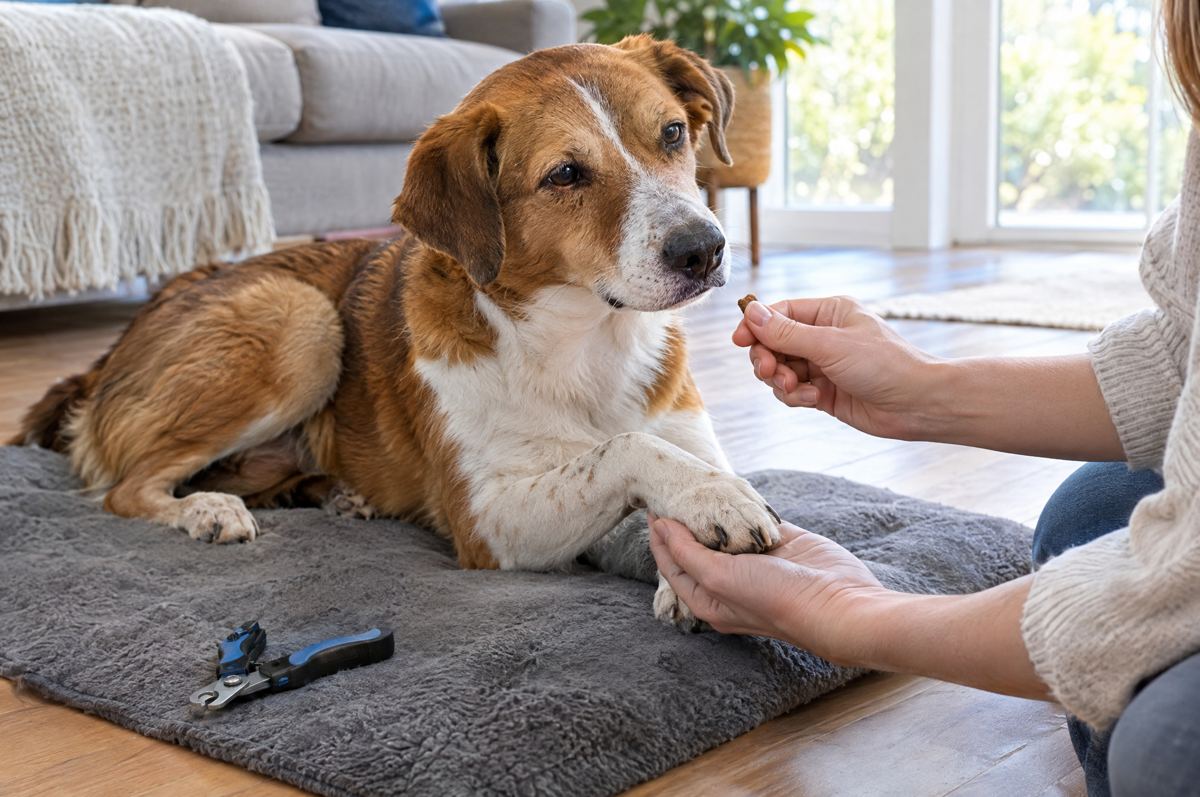
The Edmonton Humane Society describes this step. Reach your hand toward the paw. If your dog does not react, give a treat. If the paw moves away, do not punish. Move your hand away and try again, a little less close. Move closer only when your dog stays relaxed.
Step 2: touch the paw
Touch the top of the paw for one second. Treat. Then two seconds. Then hold the paw in your open palm with relaxed fingers.
Step 3: hold and spread the toes
Lift the paw a few centimetres. Touch each toe. Gently spread two toes. Treat after each touch.
Step 4: meet the clippers
Put the clippers on the mat. Treat when your dog looks at them. Put them away. Repeat in a few short sessions.
Step 5: clippers touch the paw
Touch the closed clippers to the top of the paw. Then to one nail. Do not cut. Treat after each touch.
Step 6: cut one nail tip
Cut only the very tip of one nail. Give a big treat at once. End the session. VCA Canada says to continue trimming one nail per sitting until your dog seems calm, then build up to more.
Step 7: more nails, then a whole paw
Two nails a day. Then a whole front paw. Then the other front paw on another day. Back paws and dewclaws come last.
Move up, stay or go back
After each session, give it a colour.
- Green: your dog is relaxed and takes treats gently. After three green sessions, try the next step.
- Amber: you see a lip lick, a yawn or a freeze. Go back one step and make the next step smaller.
- Red: a growl, a snap, or your dog leaves. Stop calmly. Next time, start two steps back.
The Cornell Riney Canine Health Center says that stopping early, while things are still going well, is a success.
How much to cut
Cut too short and you hit the quick. VCA Canada gives these rules:
- Light nails: you can see the pink quick. Cut about 2 to 3 mm in front of it.
- Dark nails: you cannot see the quick. Cut only the very tip.
- Small cuts: take 1 to 2 mm with each cut.
- Where to stop: make the final cut at or near the point where the nail starts to curve. Stop sooner if you see the quick.
For dark nails, read our guide on how to trim black dog nails.
Clippers or a grinder?
Both work. Use the one you and your dog like. VCA Canada notes three risks with a grinder:
- The spinning part can catch long hair. Hold the hair back.
- If it slips onto the skin, it can cause a burn.
- The dust can irritate people. Grind outdoors if you can.
A grinder makes a buzz and a vibration. Teach those first, at a distance, before it touches a nail.
When the nails cannot wait
Training takes weeks. Sometimes the nails need a trim now. VCA Canada says that if the nails truly need to be clipped right away, take your dog to a vet or a groomer. Vet clinics can offer sedation if a dog is very upset by the procedure.
That is not a failure. One calm trim at the clinic is better than a fight at home. Keep training for next time.
If your groomer handles your dog, ask them to follow the same stop signal. Pat Miller notes that if another person handles your dog, they must also stop when the dog looks away. The Cornell Riney Canine Health Center suggests a Fear Free certified groomer where one is near you.
When to get help
Ask your vet, a veterinary behaviourist or a qualified reward-based trainer for help if:
- Your dog has bitten, or you see two red sessions in a row.
- The fear gets worse after a few weeks of small steps.
- Nail care is stressful for you or for your dog.
The Cornell Riney Canine Health Center recommends this same group of professionals when grooming has become stressful.
Keep a short record
Write one line after each session: the date, the step, the number of nails, and the colour. A record shows real progress when it feels slow. It also helps your vet or trainer see where your dog gets stuck.
Our program Yes, Paws has this full plan with a photo for each step. It has a paws ladder, a clippers ladder and a grinder ladder, a drawn diagram of the nail and the quick, and a log page for each. It also covers teeth, ears, brushing, baths, the harness and vet visits with the same calm method.
Related guides
Questions
Why won't my dog let me cut his nails?
Usually fear. The Edmonton Humane Society says a bad experience, such as a painful nail trim, can teach a dog to link paw touch with fear or pain. A dog that was held down, or had the quick cut, remembers it. Pain in the paw or leg can also cause it, so a sudden change needs a vet visit.
Should I hold my dog down to cut his nails?
No. The Edmonton Humane Society says forcing a dog to accept touch can lead to snapping or biting and can make the fear worse. If the nails need a trim today, ask your vet or a groomer. Then start a slow training plan at home for next time.
How often should I trim my dog's nails?
VCA Canada says most dogs need a trim about once a month. Dogs that walk a lot on concrete may need it less often. Inactive dogs may need it every three weeks. If the nails touch the ground or click on hard floors, they are too long.
How long does it take to train a dog to accept nail trims?
It depends on the dog. VCA Canada describes building up from paw touch to one nail per sitting, then more nails as the dog stays calm. Some dogs move up a step each day. A very fearful dog can need weeks on paw handling alone. Short, daily sessions work better than long ones.
What if I cut the quick?
Stay calm. VCA Canada says to press a little styptic powder onto the nail tip. Flour or cornstarch also helps if you have no powder. Give a treat and end the session. If the bleeding does not stop, call your vet.
Can a vet sedate my dog for a nail trim?
Yes. VCA Canada says vet clinics can offer sedation if a dog is very upset by nail trims, and a vet may prescribe a mild sedative for home trims. Ask your vet about this. Training at home can then make future trims easier.
Sources
- VCA Canada (Courtney Barnes, DVM, and Catherine Barnette, DVM): How to Trim a Dog's Nails at Home, March 2025
- Edmonton Humane Society: Dog Behaviour Guide, Touch Sensitivity
- Cornell Richard P. Riney Canine Health Center (Dr Aly Cohen): Grooming - Cooperative Care, February 2026
- Pat Miller, Whole Dog Journal: Cooperative Care for Dogs, January 2021
- American Veterinary Society of Animal Behavior (AVSAB): Humane Dog Training Position Statement, 2021
This article helps you organise care. It does not replace advice from your vet.