Dog scared of fireworks: a plan for this season and next
Bonfire Night, New Year’s Eve, the Fourth of July, Diwali, a neighbour’s party. For many dogs, these nights mean shaking, panting and hiding behind the sofa. Some try to dig through the door.
This guide gives a plan for the night, what to do in the days before, when to talk to your vet, and how to start training for next year.
This page gives general information. It is not veterinary advice.
Signs your dog is afraid
Cornell lists signs that range from mild to severe:
- Trembling.
- Barking, whining or howling.
- Panting.
- Pacing.
- Drooling.
- Hiding.
- Digging at doors.
- Trying to escape.
Blue Cross adds yawning and a tail tucked between the legs.
The RSPCA says fireworks can reach 120 to 175 decibels, and that dogs’ ears are more sensitive than ours.
If your dog is in real distress, or hurts itself trying to get out, call your vet.
In the days before
- Check ID. Cornell says to make sure the ID tag and microchip details are current. Frightened dogs may try hard to escape. Blue Cross says to keep a collar and tag on, even indoors.
- Check the home and garden. Fix gaps in fences and loose gate latches.
- Talk to your vet now. Cornell says to ask about anti-anxiety medicine well in advance. If medicine is prescribed, Cornell says to try it first on a quiet day, to see how your dog copes.
- Set up the safe room. See below. Let your dog use it for a few days before the noise starts.
- Plan to be home. Cornell advises staying home. Many noise-phobic dogs also have separation anxiety, so being alone can make it worse.
Make a safe room
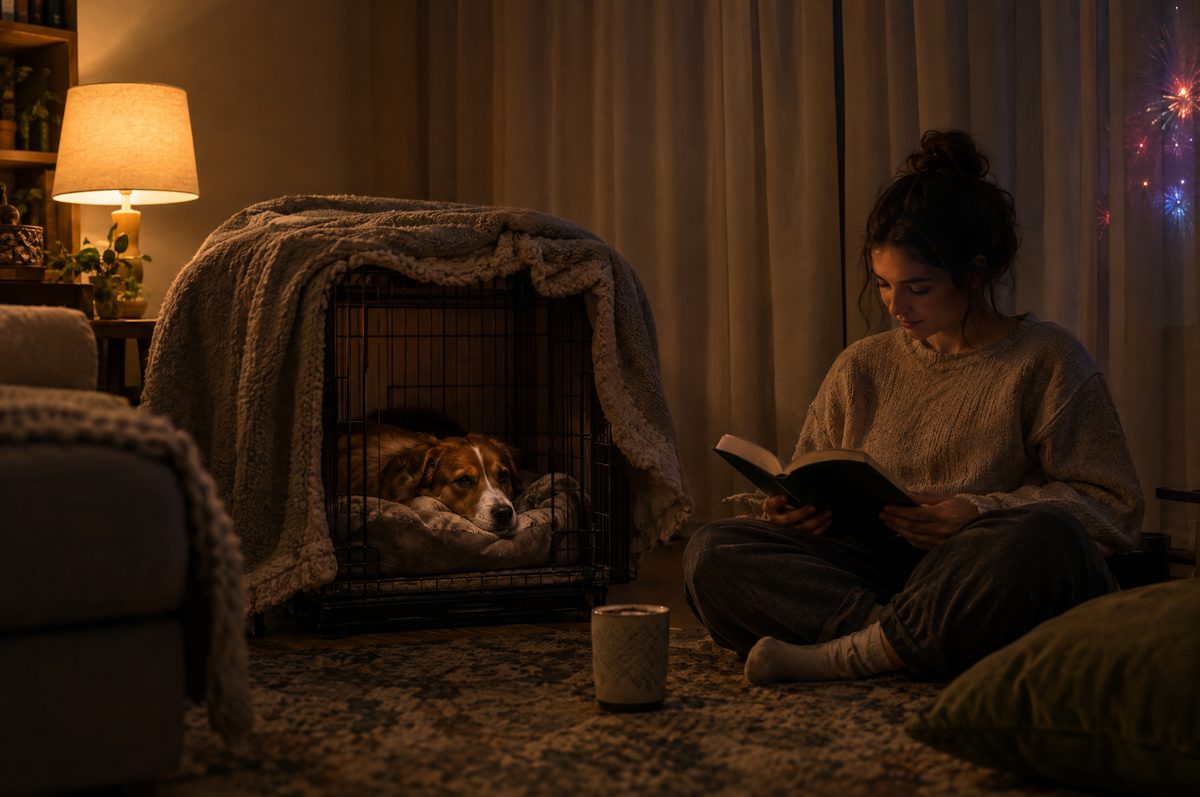
Cornell suggests a room farthest from the noise, with few or no windows. Blue Cross suggests a den where your dog feels safe, such as under a bed or behind the sofa.
- Close curtains and blinds to block flashes.
- Add a bed, a blanket and some of your worn clothes.
- Cover a crate with a blanket if your dog likes it. Leave the door open.
- Fill the water bowl. Blue Cross says worried dogs tend to drink more.
- Add sound cover. Cornell suggests white noise and music, and says layering two different sounds can help drown out the bangs. Blue Cross says to keep the TV or radio only slightly louder than usual, and only if your dog is used to it.
The AVMA says all pets should have a quiet place indoors where they can retreat from noise and parties.
On the night
- Walk early. Cornell and Blue Cross both say to exercise your dog earlier in the day, before dark.
- Use a lead. Cornell says if you must go out, keep your dog on a lead, even in a fenced garden.
- Never leave your dog outside, tied up, or alone in a car. Blue Cross says to go into the garden with your dog.
- Never take your dog to a display. Blue Cross says there is a high risk of panic and escape.
- Give medicine early, if your vet prescribed it. Cornell says it must be given early enough before the noise starts.
- Stay calm and act normally.
- Let your dog choose. Blue Cross says it is fine to cuddle and stroke your dog if it helps, but if your dog prefers to hide, let it. Do not pull it out.
- Do not punish. Cornell says punishment must never be used, because it only increases distress. Blue Cross says not to be angry about mess or damage after.
Calming products and medicine
Cornell says pheromones or other supplements may help as additions in some cases. Blue Cross mentions dog appeasing pheromone products and says to speak to your vet.
For moderate or severe fear, ask your vet about medicine. Cornell’s page on anxious behaviour quotes a vet behaviourist who says anti-anxiety medicines are a solid option when the dog, the owner or their bond is suffering. Do not give any human medicine.
Training for next year
Sound training uses recordings of fireworks, played very quietly at first, paired with food and play. Over weeks, the volume goes up slowly while the dog stays relaxed.
Blue Cross says any such training must start three to six months before fireworks season, and to ask your vet or a qualified behaviourist for help. It says never to start during fireworks season, as this may make the problem much worse.
So for New Year’s Eve, it is already too late to start this year. Mark your calendar for next spring.
Keep a record
After each night, write down:
- The date, and when the noise started and stopped.
- What your dog did, and for how long.
- What helped: the room, sound cover, medicine, your presence.
- How long your dog took to recover.
This shows your vet and trainer how severe the fear is, and whether it is getting better or worse. Cornell’s anxious behaviour page also notes that a sound-sensitive dog may not recover from its first reaction, so early help matters.
Related problems
Some dogs that fear bangs are also reactive on walks or anxious when alone. Read how to walk a reactive dog, why a dog is reactive on the leash, and a dog barking when left alone. If your dog shakes at night with no fireworks around, read dog shaking at night.
Track triggers over the year
The Reactive Dog Trigger and Walk Log has trigger log pages you can use for noises too, so you can see patterns and share them with your vet or trainer.
Questions
Should I stay home with my dog?
Yes, if you can. Cornell advises staying home to comfort your dog, because many noise-phobic dogs also have separation anxiety, so being alone can make it worse. If you must go out, ask a trusted sitter to stay.
Is it OK to comfort my dog?
Yes. Blue Cross says it is fine to cuddle and stroke your dog if it helps, but to let your dog hide if it prefers. Stay calm and act normally. Comfort does not reward fear. Punishment makes it worse, Cornell says.
Do calming products work?
Some help some dogs. Cornell says pheromones or other supplements may be useful additions. Blue Cross mentions pheromone products and says to speak to your vet. For severe fear, a vet may prescribe medicine. Try any product on a quiet day first.
Can I walk my dog before the fireworks start?
Yes. Cornell and Blue Cross both advise walking or playing earlier in the day, before dark. Keep your dog on a lead, even in a fenced garden, in case a bang makes it bolt.
Will my dog get over it?
Many dogs do not improve on their own, and some get worse each year. Cornell says a sound-sensitive dog may not recover from its first reaction. Training with recorded sounds can help, but Blue Cross says to start three to six months ahead, with a vet or behaviourist.
What if my dog escapes?
Cornell says frightened dogs may try hard to get out. Check that your dog's ID tag and microchip details are up to date before the season. Blue Cross says to keep a collar and tag on, even indoors.
Sources
- Cornell Riney Canine Health Center: Fear of fireworks and thunderstorms
- Blue Cross: Dogs and fireworks (reviewed 26 November 2025)
- AVMA: Winter holiday pet safety
- Cornell Riney Canine Health Center: Anxious behavior, how to help your dog cope with unsettling situations (updated 23 December 2025)
- RSPCA: Fireworks
This article helps you organise care. It does not replace advice from your vet.