How long can a dog be left alone? Hours by age, and the signs to watch
You have to go out, and your dog stays home. How long is too long? The honest answer has two numbers, and this page explains both.
This page gives general information. It is not veterinary advice. Your vet knows your dog.
The short answer
For a healthy adult dog, four hours is the figure to plan around. Three UK animal welfare charities give it:
- The RSPCA says dogs should be left for no longer than four hours, so they can exercise, toilet and spend time with people.
- PDSA says four hours is the longest that dogs should routinely be left alone.
- Dogs Trust says a relaxed adult dog can manage a maximum of four hours, and that you should arrange for someone to pop in during longer absences.
A US source gives a higher outer limit. The American Kennel Club quotes Dr. Vint Virga, a board-certified veterinary behaviourist. He recommends no more than six to eight hours alone, and says the dog must have a chance to relieve itself in that time.
So the two figures do not clash. Four hours is the routine. Six to eight hours is the ceiling, for a dog that copes well and can toilet. Use the ceiling on rare days, not every day.
Why the number is not the same for every dog
PDSA says every dog differs. Age and habit matter. Four hours is likely too long for a very active young puppy. It may suit an older dog that is used to it.
The RSPCA says the right limit “depends on the individual dog”. The AKC adds that social and alone-time needs vary by dog and are not set by breed, age or health alone.
Three things change the limit for your dog:
- Age. Puppies need much less. Older dogs may need more toilet breaks.
- Experience. A dog that learned to be alone slowly copes better than a dog that never practised.
- Health. A dog with a medical problem can need more checks. Ask your vet.
How long can a puppy be left alone?
The AKC gives a simple list for puppies, from a trainer it quotes:
| Puppy age | Time alone |
|---|---|
| Under 10 weeks | 1 hour |
| 10 to 12 weeks | 2 hours |
| 3 months | 3 hours |
| 4 months | 4 hours |
| 5 months | 5 hours |
| 6 months | 6 hours |
| Over 6 months | 6 to 8 hours at most |
The same article explains why. Puppies up to 10 weeks usually cannot hold their bladder for more than an hour. From 3 months, a puppy can usually hold it about one hour for each month of age.
Treat the table as an upper limit. Dogs Trust says to start with a few minutes, not hours. Our guide new puppy checklist: the first weeks shows how to set up the first days.
What your dog needs before you leave
The RSPCA gives a short routine:
- Toilet first. Make sure your dog goes to the toilet before you leave.
- Exercise first. The RSPCA says to walk your dog and be back about half an hour before you go.
- Calm exits. PDSA says to leave calmly, without fuss, and to prepare so you are not rushing.
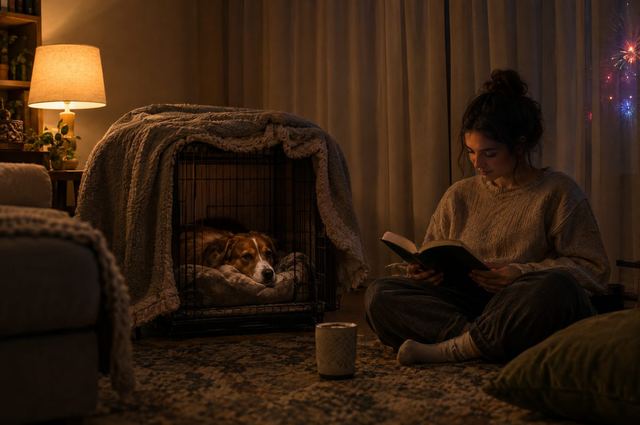
- A safe space. PDSA says to give a comfortable, temperature-appropriate space with a bed.
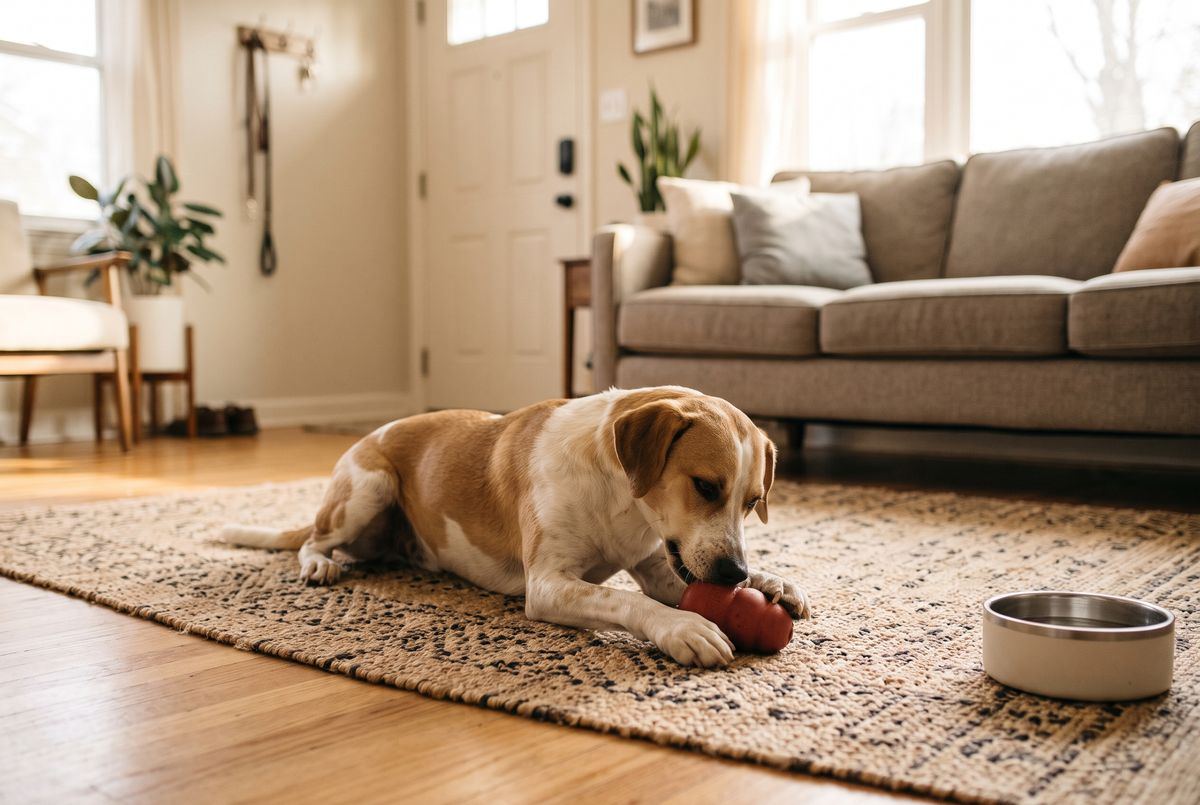
- Something to do. PDSA says puzzle feeders, chew toys and brain games help. Use only items that are safe to leave with your dog.
The AKC adds one more point. It says dogs need at least two hours a day of dedicated social time with people or other dogs. You can split it into parts.
Signs that your dog is not coping
Some signs are easy to see. The RSPCA says an affected dog may bark, howl, toilet indoors or be destructive.
Other signs are hidden. The RSPCA lists trembling, pacing and whining. Dogs Trust lists panting, yawning when not tired and lip-licking. The RSPCA also says a dog that will not eat a long-lasting treat it normally enjoys may be worried.
You cannot see these signs from the office. So film your dog. Both the RSPCA and Dogs Trust advise this. A film shows if your dog sleeps, or paces for two hours.
Do not punish your dog for a mess or for damage. The RSPCA says to let your dog outside first and then clean up. Dogs Trust says a “guilty” look is a reaction to your body language. A dog does not link a telling-off with something it did hours before.
When it is more than a long day
Some dogs panic when alone, even for a short time. Dogs Trust says the most common cause is separation anxiety. It usually develops because the dog has not learned that being alone is safe.
Dogs Trust also says medical problems can look the same. It lists sensory loss, thyroid or adrenal conditions and urinary tract infections. PDSA says to have your dog checked by a vet whenever it seems to struggle.
Our guides cover each step:
- Dog barking when left alone
- Why does my dog destroy the house when I leave?
- How to help a dog with separation anxiety
PDSA says severe cases need professional help. If there is no medical cause, your vet can refer you to an accredited behaviourist.
How to build up time alone
Dogs learn this in small steps. Dogs Trust gives a clear order:
- Start with a few minutes.
- Pair each absence with something good, such as a long-lasting chew.
- First stay in the house, behind a baby gate or a door. Then go out of the house.
- Make the time longer in small steps.
- If your dog shows worry, make the time shorter and go slower.
PDSA says an adult dog can take longer to learn than a puppy. Be patient. Keep each step short. Stop on a good note.
When you must be out for longer
Some days are long. Plan for them before they happen:
- Ask a neighbour, friend or dog walker to visit at midday.
- Book day care for the longest days.
- For a trip away, compare a sitter with boarding. See pet sitter vs boarding.
- Write down your dog’s routine, food and medicine for the helper. See what to leave your pet sitter.
Our free sitter sheet puts feeding times, medicine, contacts and your vet on one page.
Track it on paper
If your dog finds time alone hard, a log shows what changes and what helps. The Dog Separation Anxiety Log is a fillable PDF. It has a list of signs when alone, a way to tell separation problems from other causes, an alone-time log built from your videos, a step ladder with a session log, a cover plan and a summary page for your vet.
Questions
Can I leave my dog alone for 8 hours?
Only as a limit, not as a routine. The RSPCA, PDSA and Dogs Trust say four hours is the most a dog should routinely be alone. Dr. Vint Virga, a board-certified veterinary behaviourist quoted by the American Kennel Club, says no more than six to eight hours, and the dog must be able to toilet. If you work a full day, arrange a midday visit.
How long can a puppy be left alone?
Much less than an adult dog. The American Kennel Club gives about 1 hour for puppies under 10 weeks, 2 hours at 10 to 12 weeks, then one more hour for each month of age up to 6 months. Puppies cannot hold their bladder for long. They also need to learn that being alone is safe, in small steps.
How do I know if my dog is coping when I am out?
Film your dog while you are out. Dogs Trust says this tells you whether the dog is calm, bored or anxious. Signs of worry include panting, pacing, yawning when not tired, lip-licking, whining, toileting indoors and destructive chewing. A relaxed dog sleeps, or settles with a chew.
Does a crate make it safe to leave my dog longer?
No. A crate does not make a long absence safe. Dogs Trust says crate training alone does not fix separation anxiety, and that a panicking dog can hurt itself in a crate. The American Kennel Club says a crate should be a safe, calm place and never a punishment, and that a dog still needs toilet breaks.
Can a dog be left alone all day while I am at work?
Not safely on its own. A full work day is longer than every source on this page allows. Arrange a dog walker, a neighbour, a friend or day care for the middle of the day. Dogs Trust advises someone to pop in to give the dog a comfort break when you are out for more than four hours.
My dog howls or chews things when I leave. What should I do?
See your vet first. PDSA says pain and medical problems can cause anxiety when a dog is alone. If there is no medical cause, ask your vet about an accredited behaviourist. Never punish. Dogs Trust says a dog that looks guilty is reacting to your body language, not to what it did hours before.
Sources
- RSPCA: Leaving your dog alone
- PDSA: Home alone, preventing separation anxiety in dogs
- Dogs Trust: How to help your dog get used to spending time alone
- Dogs Trust: Separation anxiety in dogs, signs, causes and how to help
- American Kennel Club: Alone time for dogs, how much is too much?
- American Kennel Club: How long can a puppy be left alone?
This article helps you organise care. It does not replace advice from your vet.