Why does my dog destroy the house when I leave? Causes, signs and what to do
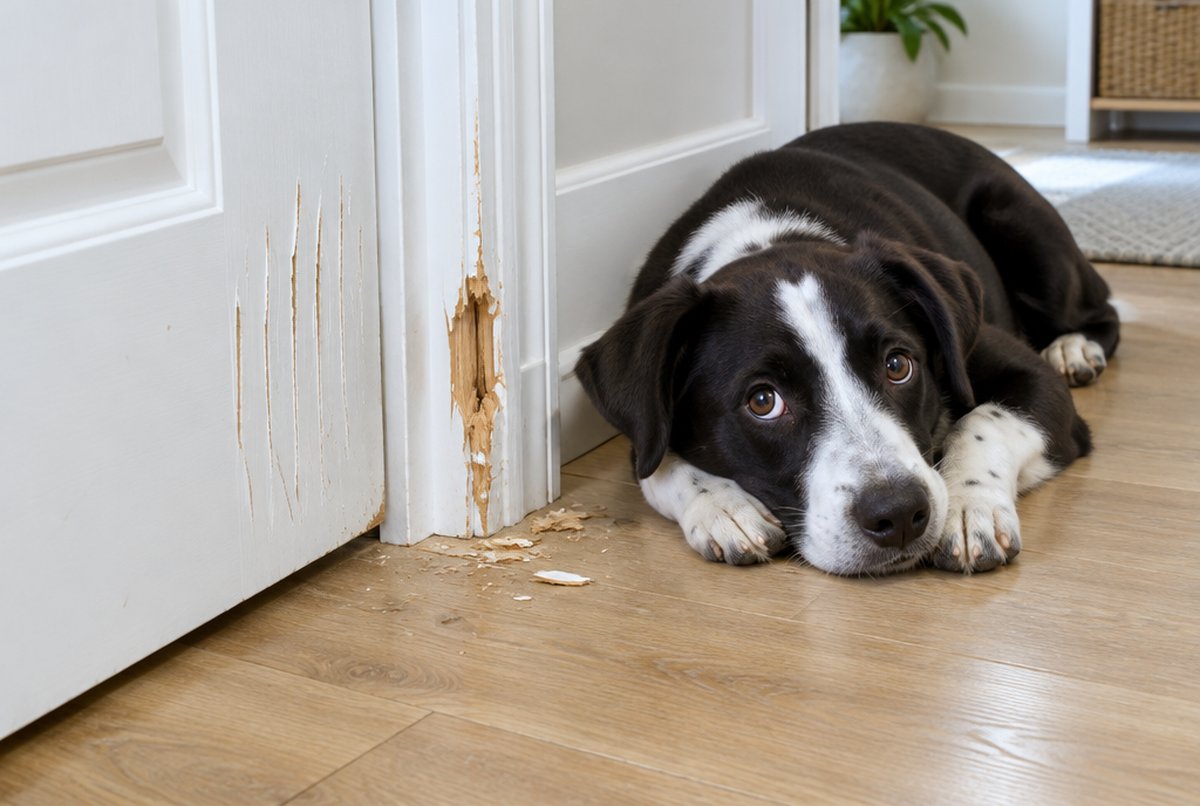
You open the door to a shredded cushion, a scratched door, or a hole in the wall. Your dog greets you as if nothing happened. It is easy to think the dog did it to punish you for leaving. It did not. Destruction when alone has a cause, and the place of the damage is a strong clue.
First: check your dog for injuries
The ASPCA says escape attempts by dogs with separation anxiety can be extreme. They can cause self-injury, such as broken teeth and scraped paws. Check your dog’s mouth and paws. Call your vet if you find an injury, or if your dog chewed something that could be harmful.
Where is the damage? The pattern tells you a lot
Damage at doors, door frames and windows
This is the classic sign of separation distress. The ASPCA says the destruction is often around exit points, such as windows and doors. The Merck Veterinary Manual says confined dogs commonly destroy kennels, walls or doors in an attempt to reunite with their owners.
A study of 762 dogs with separation-related problems found a group of signs the authors called “exit frustration” (de Assis and others, 2020). It included damage to the main exit door, the door frame, the area around the handle and the floor near the door. About a third of all the dogs in the study (33.6%) caused damage with their claws.
In other words, the dog is not angry. It is trying to get out, or to get to you.
Chewing all over the house
Chewed shoes, cushions and table legs in many rooms can have other causes. The ASPCA lists look-alikes of separation anxiety:
- Juvenile destruction. Young dogs explore and chew.
- Boredom. The ASPCA says bored dogs usually do not seem anxious.
- Incomplete house training, if the problem is toileting.
- Urine marking.
Ask one question: does it also happen when you are home? The ASPCA says that if it does, separation anxiety is less likely.
Other signs that point to separation distress
The RSPCA lists signs that often come with the damage:
- Barking, howling or whining.
- Toileting indoors.
- Worry when you get ready to leave.
- A very excited greeting.
- Hidden signs: trembling, panting, drooling, pacing, and not eating food or food toys while you are out.
Cornell University’s Dr Katherine Houpt describes dogs with separation anxiety that want to be in the same room as their owner. They become stressed when the owner gets ready to go out.
Film your dog
The RSPCA says about half of dogs who struggle alone show no obvious signs, and it suggests a camera. A video answers what the damage cannot:
- When did it start? Signs often start before you leave or within a few minutes to 30 minutes after (RSPCA). The Merck Veterinary Manual says they are often worst in the first 15 to 30 minutes.
- How did your dog act? Frantic scratching at the door is not the same as a relaxed chew session.
- Did it settle? A dog that sleeps after 20 minutes is in a different place from a dog that paces for an hour.
Watch the first 30 minutes closely. Write the minute of the first worried sign.
What to do now
Never punish the damage
The ASPCA says: “Do not scold or punish your dog.” These behaviours are distress responses, and punishment can make the problem much worse. The RSPCA says dogs that are told off do not connect your anger with what they did. They only become more anxious about the next time you leave.
The RSPCA gives a practical step. When you come home to a mess, let your dog outside first. Then clean up, out of its sight.
Make the house safe
- Remove things that could hurt your dog if chewed.
- Use a room with no access to the front door, if your dog is calm there.
- The ASPCA says a crate helps some dogs but stresses others. Heavy panting, drooling, escape attempts and barking are signs of distress in a crate. If you see them, try a room with a baby gate.
Do not leave your dog alone longer than it can cope with
While you train, the ASPCA says not to leave a dog with separation anxiety alone outside short training sessions. Use family, a friend, a sitter or day care. The RSPCA says an adult dog should not be alone more than four hours.
Build alone time in tiny steps
The ASPCA plan starts with 1 to 2 seconds behind an inside door, with a food toy just before you step out. You wait a few minutes between absences. You build up a few seconds at a time, and you go back a step at any sign of stress. The RSPCA says: “Never leave your dog so long that they start to become distressed.” Read how to help a dog with separation anxiety for the full plan.
Meet your dog’s needs
- At least 30 minutes of aerobic exercise a day, best before you leave (ASPCA).
- Food puzzles, hidden kibble and safe chews (ASPCA).
- A long-lasting food toy that your dog gets only when alone (RSPCA).
These steps help a bored dog a lot. They help an anxious dog too, but they do not replace the step-by-step plan.
See your vet
The RSPCA says health problems can cause or worsen separation problems, and your vet can refer you to a clinical animal behaviourist. For moderate or severe cases, the ASPCA recommends a board-certified veterinary behaviourist or a certified applied animal behaviourist. Cornell’s Dr Houpt says there is no quick fix, and to avoid trainers who use harsh methods.
Bring your videos, photos of the damage, and dates.
What to record
A simple record after each absence shows the pattern:
| Record | Why it helps |
|---|---|
| Minutes away | Shows how long your dog can cope |
| Where the damage is | Doors and exits point to separation distress |
| Food toy eaten? | An untouched toy can mean worry (RSPCA) |
| Minute of the first sign on video | Shows if the start moves later as you train |
| What you changed | You see what helped |
The Dog Separation Anxiety Log has these pages ready: signs when alone, a “separation or something else?” check, an alone-time log, a coming-home page for the damage you find, and a summary for your vet.
Related: dog barking when left alone.
How long is too long? Read how long can a dog be left alone.
Questions
How do I stop my dog destroying the house when I leave?
First find the cause with a video. For separation distress, the ASPCA plan is to build alone time in very short steps, give a food toy only for alone time, and not leave the dog alone longer than it can cope with. For boredom, add exercise and food puzzles. Never punish the dog afterwards.
Is my dog destroying things out of spite?
No. The ASPCA says these behaviours are distress responses, not disobedience or spite. The RSPCA says dogs that are told off do not link it to what they did earlier, and become more anxious about the next departure.
How do I discipline a destructive dog?
Do not punish damage you find later. The ASPCA says punishment can make separation anxiety much worse. The RSPCA says to let your dog outside first, then clean up out of its sight, so it does not see you annoyed. Prevent the damage instead: shorter absences, a safe room, and the right chews.
At what age do dogs stop being destructive?
Young dogs chew more as they explore and teethe, and the ASPCA lists juvenile destruction as a look-alike of separation anxiety. Most dogs chew less as they mature, if they have the right chews and enough exercise. Damage at exits that starts when you leave is a different problem, at any age.
Should I crate my dog so it cannot destroy things?
Only if your dog is calm in the crate. The ASPCA says crates help some dogs but stress others, and signs of distress include heavy panting, drooling, escape attempts and barking. The Merck Veterinary Manual says confined dogs with separation anxiety can destroy kennels, walls or doors. A gated room may suit them better.
Can a medical problem cause destruction when alone?
Pain and illness can add to anxiety, and the RSPCA says health problems can cause or worsen separation problems. Toileting indoors can also be a medical problem, such as a bladder infection. See your vet before you start training, and bring a video of your dog alone.
Sources
- ASPCA: Separation Anxiety
- RSPCA: Separation anxiety in dogs (signs, prevention and treatment)
- Merck Veterinary Manual, pet owner version: Behavior Problems in Dogs (Gary M. Landsberg, DACVB)
- de Assis LS and others: Developing Diagnostic Frameworks in Veterinary Behavioral Medicine: Disambiguating Separation Related Problems in Dogs. Frontiers in Veterinary Science, 2020
- Cornell University College of Veterinary Medicine, Riney Canine Health Center: Anxious behavior (Dr Katherine Houpt)
This article helps you organise care. It does not replace advice from your vet.