Why is my dog reactive to other dogs on a leash? Causes and what to do
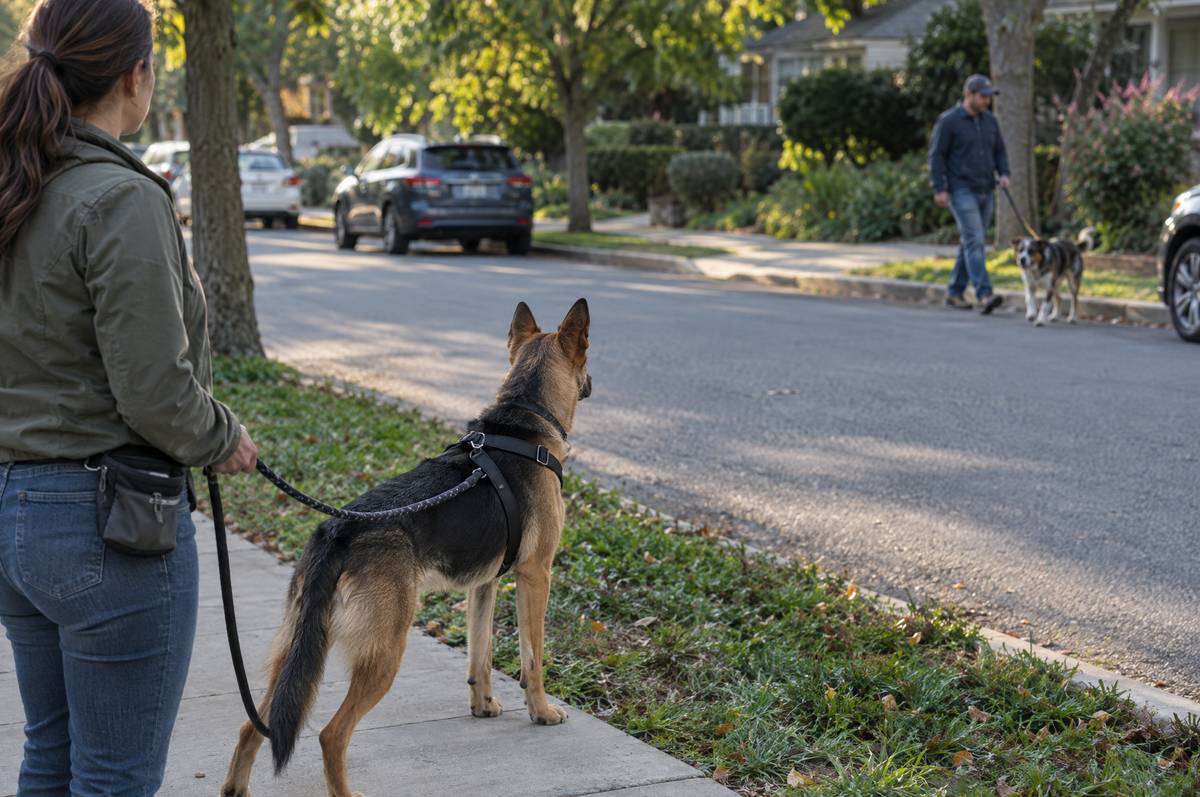
Your dog is friendly at home and plays well with dogs it knows. But on the leash, the sight of another dog changes everything. Your dog stiffens, stares, then barks and lunges. Other owners cross the road. You start to walk at 6 in the morning. This is called leash reactivity, and it is common. There is usually a clear reason for it, and a record helps you find it.
When to see a vet first
See your vet before you start any training plan. Book soon if:
- Your dog suddenly started to react, and did not before.
- Your dog seems stiff, slower on walks, or falls behind.
- Your dog limps, or moves in a new way.
- Your dog growls when you touch or move it.
- Your dog has bitten, or nearly bitten, a dog or a person.
Dogs Trust says pain and poor health lower a dog’s tolerance of others. Some medical problems are subtle or come on slowly. So even attentive owners can miss them. A review of referral cases by Mills and others (2020) found a painful condition in about a third of dog behaviour cases. Joint pain, stomach pain and skin problems were all common. The authors advise vets to treat suspected pain first.
If your dog has bitten someone, get professional help now. ASPCApro says this is important for safety.
What leash reactivity looks like
Dogs Trust describes a reactive dog as one that barks, lunges and pulls towards other dogs, people or things outside. It is a strong emotional response. Your dog may:
- Lunge, bark, growl or snarl at another dog.
- Bounce around, or try to back out of the collar or harness.
- Grab the leash and shake it.
- Grab your clothing, or nip a dog it walks with.
- Hide behind you, or try to jump into your arms.
Reactions rarely come without warning. Dogs Trust lists the early signs: lip-licking, yawning, ears back, the head turned away, stiffening, freezing and staring. Your dog may also stop taking treats or stop responding to you. These signs tell you to move away now, before the bark.
The main causes
Fear: “go away”
Some dogs fear other dogs. ASPCApro says this can follow a bad experience, or too little contact with other dogs in puppyhood. For these dogs, barking and lunging has a purpose: it keeps the other dog away.
Dogs Trust explains why this grows. When your dog barks, the other owner often crosses the road. Your dog learns that barking works. So next time it barks sooner.
Frustration: “let me say hello”
Other dogs love dogs. ASPCApro says some enjoy greeting so much that they become very frustrated when the leash holds them back. Dogs Trust says these dogs may jump, bark and pull towards the other dog. Some grab the leash or mouth the owner. Off the leash, many of these dogs do not bite.
Some dogs feel both. A worried dog that cannot get away may also feel frustrated, Dogs Trust says.
Overarousal
Some dogs get overwhelmed by everything on a walk. Dogs Trust lists the body signs: dilated pupils, fast breathing and panting, drooling, a tense body and face, and teeth chattering. An over-aroused dog finds it hard to listen or calm down.
Pain or illness
Pain makes a dog less tolerant, and more likely to react to things that did not worry it before. Dogs Trust lists signs to watch for. These include a slower pace on walks, less interest in sniffing, a change in gait, and a long time to settle after a walk. Mills and others (2020) also note slow progress in training, or a relapse with no clear reason. Both can point to pain.
Why the leash makes it worse
Think about how dogs meet off the leash. ASPCApro says socially skilled dogs approach in a curve. They come together slowly, with soft eyes, and sniff before they decide to move on or play.
On a sidewalk, two dogs on leashes must walk straight at each other. ASPCApro says this head-on approach means more direct eye contact, which is a threat in dog body language. Both dogs pull, so the leashes are tight. The owners get tense and may jerk the leash.
Dogs Trust adds that a tight leash can make a dog feel trapped. When an owner wraps the leash around a hand, the collar tightens or the harness squeezes the chest. The dog may link that feeling with the dog in front of it. So keep the leash secure but loose.
The leash also takes away choice. A worried dog off the leash can walk away. On the leash, it cannot. Dogs Trust says that is why some fearful dogs feel they must scare the other dog away instead.
Trigger stacking: why it “makes no sense” some days
Some days your dog passes a dog calmly. Other days it explodes at a dog far away. This is often trigger stacking.
Dogs Trust says that after a strong reaction, stress hormone levels can take 48 to 72 hours to drop. During that time, your dog may be more sensitive and react to less. A bad walk, a delivery van, then a dog at the corner can add up to one big reaction.
So plan an easier day or two after a big reaction. Give more rest, play and sniffing games at home, and only short, quiet walks.
What does not help
- Telling your dog off. Dogs Trust says this can make your dog more afraid of the trigger. It can also stop the growl, which is your warning. Then your dog may bite without a warning.
- Pain, force or fear. AVSAB, the American Veterinary Society of Animal Behavior, says training should use rewards only. It lists choke chains, prong collars, shock collars, leash jerks, shouting and flooding as things to avoid.
- Forcing a meeting. Dogs Trust says making a dog “face its fear” can make it worse.
- Letting your dog practise. Every reaction makes the next one more likely, Dogs Trust says.
What helps
Dogs Trust gives three first steps:
- Understand your dog. Learn its early signs, so you can act before the bark.
- Find the triggers. Note what your dog reacts to, and where. Dogs Trust suggests a diary of incidents to spot patterns.
- Avoid the triggers for now. This keeps everyone safe and stops the practice.
Cornell University says that for the long term, you change how your dog feels about other dogs. Reward your dog as soon as another dog appears. Start far away, where your dog stays calm. Move closer only while your dog stays relaxed. A veterinary behaviourist or a reward-based trainer can set the plan for your dog.
For practical walking steps, read how to walk a reactive dog.
What to record before the vet or trainer visit
A short visit shows little of what happens on your walks. Write down:
- The trigger. Big dogs, small dogs, all dogs, people, bikes.
- The distance. Where your dog first notices, gets tense, and reacts.
- The angle. Head-on, from the side, or from behind.
- What your dog did. A score from 0 (calm) to 5 (cannot move away).
- How long to calm down. Minutes until your dog takes food again.
- Other stress that day. Visitors, noise, a bad night, a previous reaction.
- Health signs. Limping, stiffness, slower walks, licking one spot.
- When it started. Slowly, suddenly, or after an attack.
Take a short video of your dog walking, and one of a reaction from a safe distance. Bring both to the visit.
The Reactive Dog Trigger and Walk Log has pages for all of this: trigger distances, a walk log with distance and angle, a reaction report, a pain and health checklist, and a summary for the vet. It records only. Your vet and a qualified behaviour professional set the plan.
Before the appointment, our free vet visit summary puts your dog’s health notes and questions on one page.
Questions
Why is my dog only reactive on the leash?
Dogs Trust gives two common reasons. A fearful dog on a leash cannot move away from what scares it, so it barks and lunges to make the other dog leave. An excited dog that expects to greet cannot reach the other dog, so it gets frustrated. Off the leash, both dogs have choices, so they may be calm.
Why did my dog suddenly become reactive?
A sudden change is a reason to see your vet. Dogs Trust says pain and illness lower a dog's tolerance of others, and some medical problems are hard to see. A review by Mills and others (2020) found a painful condition in about a third of referred dog behaviour cases. A bad meeting with another dog can also start it.
Is my dog's reactivity my fault?
Dogs Trust says it is not your fault. Many things shape behaviour, some before a dog is born. A lack of early socialisation, a bad experience and genetics all play a part. What you can change is what happens next: the distance you keep, the methods you use, and the help you get.
Is a reactive dog an aggressive dog?
Not always. Cornell University says reactive dogs are not necessarily aggressive, but reactivity can turn into aggression, so take it seriously. Dogs Trust says some excited or frustrated dogs bark and lunge but do not bite when they reach the other dog. A dog that feels trapped may escalate to a snap or a bite.
Will my dog grow out of it?
Dogs Trust says reactivity is very unlikely to go away by itself. Avoiding triggers stops the practice, but it does not change how the dog feels. Behaviour change needs reward-based training at a distance your dog can cope with, best with a qualified professional. Many dogs improve a lot. Some still need some management.
Should I tell my dog off when it barks at other dogs?
No. Dogs Trust says telling a reactive dog off can make it more afraid of the trigger, damage your bond, and teach it to stop growling as a warning. Then it may lunge or bite without a warning. AVSAB, the veterinary behaviour society, advises against leash jerks, shouting and prong or choke collars.
Sources
- Dogs Trust: Reactive dogs, why it happens and how to help (reviewed by the Dogs Trust Behaviour team)
- ASPCApro: Managing and Training Leash-Reactive Dogs
- Cornell University College of Veterinary Medicine, Riney Canine Health Center: Managing reactive behavior (Dr Katherine Houpt)
- Mills DS and others. Pain and Problem Behavior in Cats and Dogs. Animals 2020;10(2):318
- American Veterinary Society of Animal Behavior (AVSAB): Position Statement on Humane Dog Training, 2021
This article helps you organise care. It does not replace advice from your vet.