How to walk a reactive dog: routes, distance and what to do when a dog appears
You check the street before you open the door. You walk at 6 in the morning, hide behind parked cars, and turn around when a dog appears. A walk with a reactive dog takes planning. Good planning makes walks calmer now, and it is also the base for training later.
First: safety and a vet check
See your vet before you start a training plan. Dogs Trust says pain and illness can cause or add to reactivity, and some signs are easy to miss. Go soon if your dog suddenly started to react, or seems stiff or slower on walks. Read why your dog is reactive on a leash for the causes and the signs.
Get help from a qualified professional now if your dog has bitten a dog or a person. ASPCApro says this is important. Dogs Trust suggests muzzle training as an extra safety measure for dogs that may lunge or bite.
Before the walk: plan the route
Dogs Trust and the Toronto Humane Society give the same advice: avoid the triggers while you work on a plan. Every reaction is practice. Cornell University says to walk your dog when others are not out, and to avoid the dog park.
Choose routes with:
- Quiet times. Early morning, late evening, or off-peak hours.
- Good visibility. You need to see a dog coming from far away.
- Wide paths and many exits. Dogs Trust says to avoid narrow paths, such as canal towpaths.
- Barriers. Parked cars, trees and fences can block your dog’s view.
- Leashed dogs only. Places where dogs must be on a leash lower the risk of a dog running up.
Dogs Trust suggests an industrial estate after hours. It also suggests that you walk a new route without your dog first, at different times of day. You learn when bin day is and when the post comes.
Hiring a secure dog field lets your dog run off the leash with no other dogs about, Dogs Trust says.
Before the walk: the right equipment
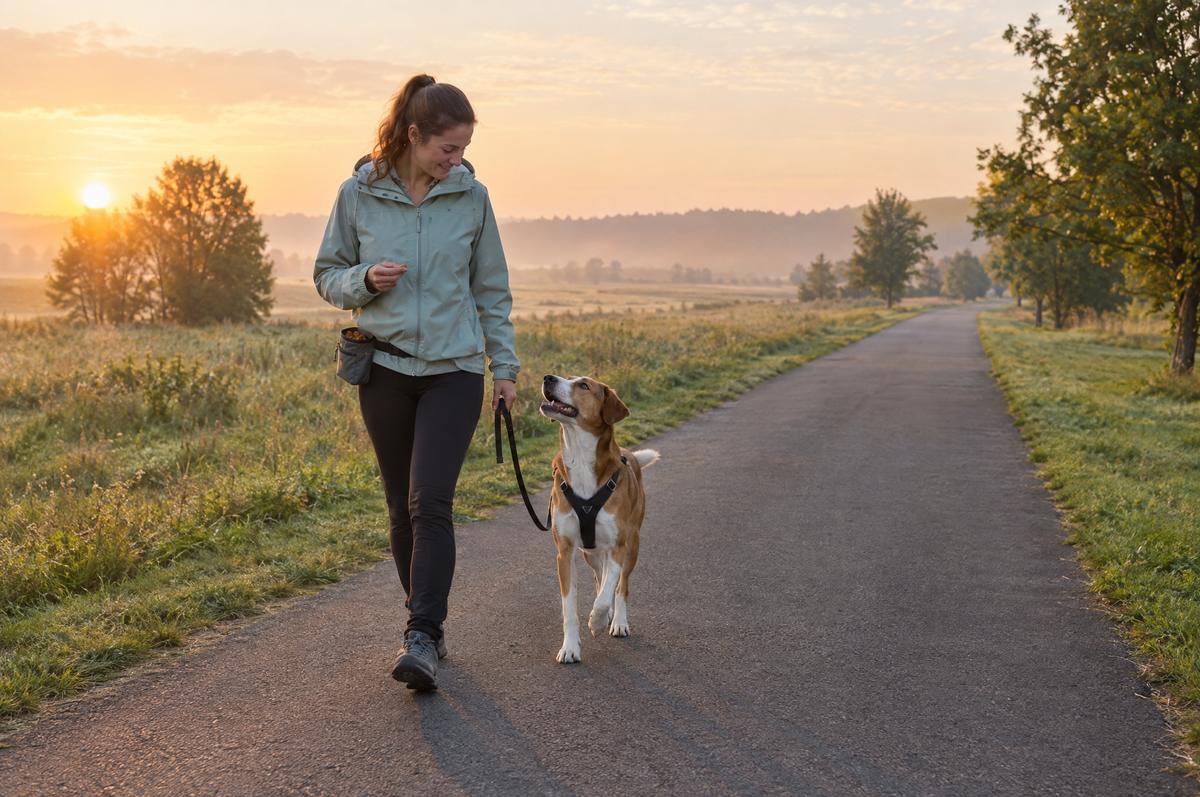
- A harness that fits. Dogs Trust suggests a Y-shaped, fixed-size harness. A harness with a back ring and a front ring gives more control with a double-ended lead.
- A head halter, if your professional suggests one. The Toronto Humane Society says a head halter or a front-clip harness helps you stay in control. Introduce it slowly, with treats.
- No pain tools. The Toronto Humane Society says to avoid choke chains, prong collars, extendable leads and pull harnesses. AVSAB, the American Veterinary Society of Animal Behavior, says aversive tools increase fear and fear-based aggression.
- High-value treats. Small, soft pieces your dog loves, such as cheese or chicken. ASPCApro suggests pea-sized pieces of something your dog does not usually get.
- A basket muzzle, if needed. It must let your dog pant, drink and take treats. Train it at home first.
Dogs Trust says new equipment needs training too. A dog that is worried about its harness is more likely to react.
On the walk: when a dog appears
Act early. The goal is to move away before your dog reacts, not after.
- Watch for the early signs. Dogs Trust lists lip-licking, yawning, ears back, stiffening, freezing and staring. If your dog stops taking treats, you are too close.
- Keep the leash loose. Dogs Trust says a tight leash can make a dog feel trapped. Do not wrap it around your hand.
- Make space. Turn around, cross the road if it is safe, or step behind a parked car. The Toronto Humane Society calls this the emergency U-turn.
- Keep moving calmly. Dogs Trust says stopping can sometimes make things worse.
- Reward calm. As soon as your dog looks at the other dog and stays calm, give a treat. Cornell University says to reward the dog as soon as the trigger appears.
- Use “find it”. Scatter a few treats on the ground away from the trigger. Dogs Trust says sniffing keeps your dog busy and shows the other dog it is not interested.
- Stay calm yourself. ASPCApro says to breathe deeply, use a calm voice, and keep the leash relaxed.
Do not tell your dog off. Dogs Trust says it can make your dog more afraid and stop the warning growl.
Teach “find it” first
Dogs Trust gives these steps:
- At home, scatter a handful of treats and say “find it”.
- Repeat until your dog puts its nose down when it hears the cue.
- Practise in the garden and on quiet streets.
- Then use it when a dog or person is far away.
- Keep practising when no triggers are around. If you only use it near triggers, your dog learns that “find it” means a dog is coming.
If an off-leash dog runs up
Ask the owner to call their dog back. Dogs Trust says to advocate for your dog, even if it feels awkward. Put a barrier between the dogs if you can, and throw treats away from the other dog to move your dog away.
Training walks: distance, angle and short sessions
Management keeps walks calm. Training changes how your dog feels. Ask a veterinary behaviourist or a reward-based trainer to set the plan. These are the principles the experts use.
Start at the right distance. ASPCApro calls the threshold the distance where your dog first notices other dogs but does not yet growl, bark or lunge. It gives an example: if the threshold is 40 feet, start at about 50 feet. The Toronto Humane Society says that if your dog reacts, you are too close.
Pair dogs with treats. ASPCApro describes a set-up with a friend and a calm dog. The helper dog comes into view for a few seconds. You feed treats one after another, then stop when the dog goes out of sight. Over time, your dog looks at the other dog and then looks to you for a treat.
Watch how your dog takes food. ASPCApro says that if your dog snatches treats or bites your fingers, it is too aroused. Add more distance.
Mind the angle. The Toronto Humane Society says head-on approaches are harder than angled ones. Its example log starts at 100 feet with the other dog at 90 degrees. Only later does it try head-on approaches, from a bigger distance again.
Keep sessions short. The Toronto Humane Society suggests 15 minutes or less, though it varies by dog. End the session if you see out-of-context panting, more watchfulness, the whites of the eyes, raised hackles, leaning forward, or long stares.
Go slower than you think. ASPCApro says most dogs need many sessions over days or weeks. You risk a setback each time you push your dog too far.
After a big reaction
Dogs Trust says stress hormone levels can take 48 to 72 hours to drop after a big reaction. In that time, your dog may react to less. This is called trigger stacking.
Plan two or three calmer days:
- Short toilet walks at the quietest times.
- More rest, play and sniffing games at home.
- No training sessions near triggers.
Write down what happened before the reaction. Often it was not just one dog. It was a noisy morning, a van, and then the dog at the corner.
Keep a walk log
Progress with a reactive dog is slow, and one bad walk can hide weeks of gains. The Toronto Humane Society suggests a log of distance and direction of approach, updated each day. Dogs Trust suggests a diary of incidents to spot patterns.
The Reactive Dog Trigger and Walk Log has a walk planner for routes and U-turn spots, and a walk log with distance, angle, a 0 to 5 score and recovery time. It also has a 3-day plan after a big reaction, a session plan for your trainer to fill in, and a 12-week distance chart. It records only. Your vet and a qualified behaviour professional set the plan.
If your dog fears loud bangs, read dog scared of fireworks.
Questions
Should I stop walking my reactive dog?
Not for good. Dogs Trust says short walks and more play and sniffing games at home are fine in the short term, especially after a hard day. Some days a toilet walk is enough. Hiring a secure dog field lets your dog run without meeting other dogs. Keep meeting your dog's needs for exercise and mental work, or frustration grows.
What do I do when an off-leash dog runs up to my reactive dog?
Move away early if you can, and put a car or a fence between the dogs. Dogs Trust says to ask the other owner to call their dog back. Scatter treats on the ground away from the other dog, so your dog sniffs and moves away. Keep your own leash loose. Write it down, because your dog may be more sensitive for a few days.
Should my reactive dog wear a muzzle?
Dogs Trust suggests muzzle training as an extra safety measure for dogs that may lunge or bite. A basket muzzle lets the dog pant, drink and take treats. Train it slowly, so your dog is happy to wear it. A muzzle does not change how your dog feels, so you still need distance and training.
What is the best harness or lead for a reactive dog?
Dogs Trust suggests a well-fitted Y-shaped harness, or one with front and back clips and a double-ended lead. The Toronto Humane Society suggests a front-clip harness or a head halter, introduced slowly. Both advise against tools that cause pain. Avoid choke chains, prong collars and extendable leads.
How long does it take to walk a reactive dog calmly?
It depends on the dog. ASPCApro says most dogs need many training sessions over days or weeks to change for good. Some mildly reactive dogs improve in a few sessions. Very reactive dogs may move only a few steps closer at a time. A distance log shows progress that is hard to feel day to day.
Should I keep walking or stop when my dog sees another dog?
Dogs Trust says that calmly and quietly moving on can help, because stopping can sometimes make things worse. Move away until your dog can relax, then reward it. The Toronto Humane Society calls this the emergency U-turn. Practise the U-turn on quiet walks first, so your dog follows you easily when it matters.
Sources
- Dogs Trust: Reactive dogs, why it happens and how to help (reviewed by the Dogs Trust Behaviour team)
- Toronto Humane Society: Leash Reactivity Management and Behaviour Modification (2023)
- ASPCApro: Managing and Training Leash-Reactive Dogs
- Cornell University College of Veterinary Medicine, Riney Canine Health Center: Managing reactive behavior (Dr Katherine Houpt)
- American Veterinary Society of Animal Behavior (AVSAB): Position Statement on Humane Dog Training, 2021
This article helps you organise care. It does not replace advice from your vet.