Dog limping but not crying out? What to check today
Your dog is limping. But there is no yelp, no whine, and the tail still wags. So it cannot hurt much. Right?
Not so fast. Dogs often stay quiet when they hurt. This guide explains why a quiet limp still matters, how to check the paw, how to judge a sudden limp from a slow one, and when to see a vet.
This page gives general information. It is not veterinary advice. Your vet knows your dog.
See a vet today if
- Your dog will not put any weight on the leg.
- The leg is swollen, hot, or at an odd angle.
- There is a wound, heavy bleeding, or bone showing.
- The limp started after a fall, a jump or a car accident.
- Your dog also seems ill: no appetite, vomiting, fever or low energy.
- Your dog drags a leg, knuckles the toes over, or is weak in both back legs.
- Your dog cries out when touched, or will not let you near the leg.
Cornell lists sudden loss of use of a leg, trauma and severe pain among reasons to go to the ER. Weakness in both back legs, or dragging a leg, can be a spine problem. Go now.
Why “not crying” does not mean “not hurting”
VCA defines lameness, or limping, as not using a limb properly because of pain or weakness. So a limp is a sign of pain or weakness by its definition.
Cornell’s list of pain signs in dogs includes:
- Stiffness or limping, or favouring one leg.
- Trouble sitting, climbing stairs or getting up.
- Lying down more, or a low head or arched back.
- Licking or chewing one area.
- Slower walks, or not wanting to play.
- Vocal sounds such as whimpering or groaning. But many dogs make none.
Cornell also says fear at the clinic can hide pain, so what you see at home is important. A quiet dog with a limp is a dog with a limp. Read our guide on how to tell if your dog is in pain.
Check the paw first
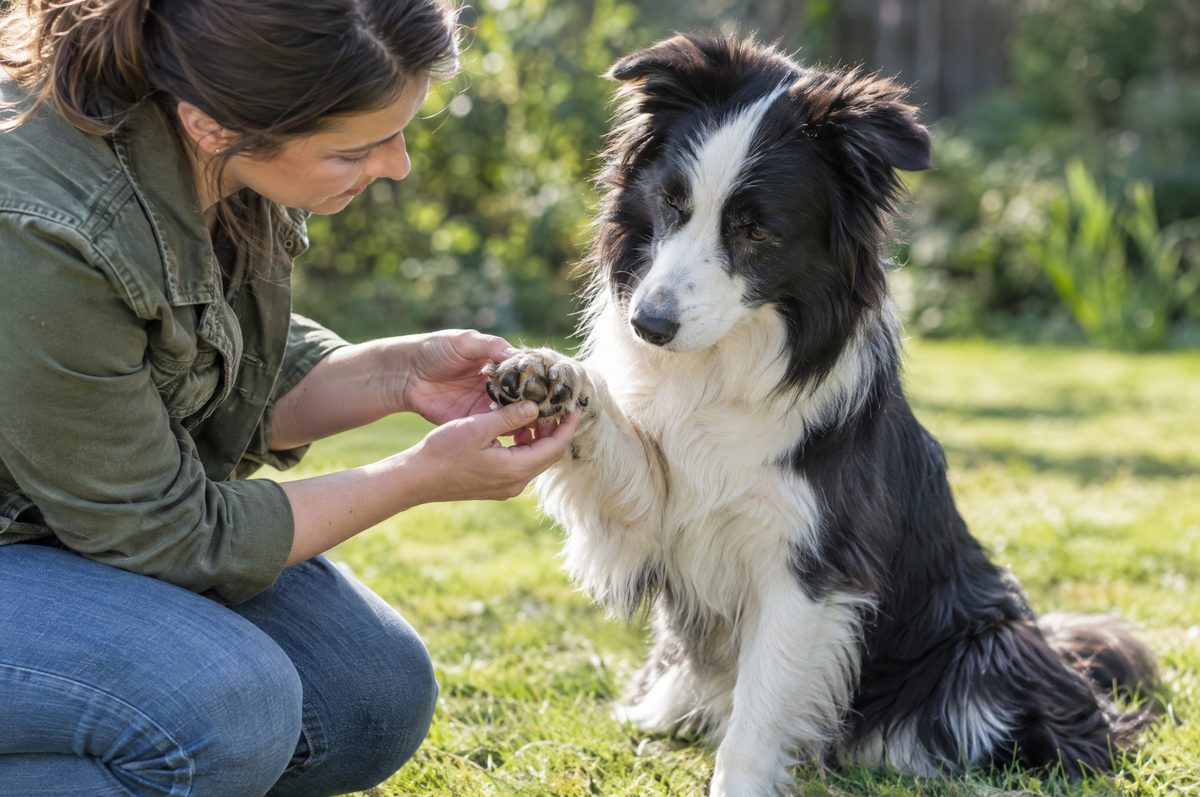
Many sudden limps start in the foot. Do this in good light. If your dog may bite, stop and call the vet.
- Nails. Look for a broken, split or torn nail. VCA lists broken nails among the most common causes of sudden limping.
- Pads. Look for cuts, burns, cracks or blisters. Hot pavement and ice can hurt pads.
- Between the toes. Spread the toes. Look for thorns, grass seeds, glass, burrs or a swelling.
- Smell. A bad smell can mean infection.
- The leg. Run your hands gently down the leg. Compare it with the other leg. Note any heat, swelling or a spot your dog pulls away from.
If you find a thorn that comes out easily, remove it. If anything is deep, bleeding or swollen, see your vet.
Sudden limp vs slow limp
VCA splits limps into two groups.
Sudden (acute). VCA lists the most common causes:
- Broken nails.
- Soft tissue injuries, such as a sprain or strain.
- Joint injuries.
- Broken bones.
- Dislocated joints.
Slow or on-and-off (chronic). VCA lists:
- Osteoarthritis.
- Limb and spine deformities.
- Nerve problems.
- Old soft tissue injuries.
- Cancer.
A limp that is worse after rest, or after hard play, and that slowly gets worse over weeks, is more often in the second group. Older dogs are more at risk. See our guide to when a dog is a senior.
Rest rules while you wait
If your dog has no emergency signs:
- Keep your dog quiet for 24 to 48 hours. Short leash walks for the toilet only.
- No running, jumping, stairs or rough play.
- Block access to the sofa and bed if your dog jumps.
- Use rugs or runners on slippery floors. Our guide to an old dog slipping on floors has ideas.
- Watch: is the limp better, the same or worse?
Book a vet visit if the limp is not clearly better in a day or two, if it gets worse, or if it keeps coming back.
Do not give human pain medicine
This is important. The FDA says a medicine meant for people may not be right for your dog, and may hurt it. It says an NSAID made for people may not be safe or effective in dogs.
If your vet prescribes a pain reliever for dogs, the FDA lists side effects to watch for: vomiting, diarrhoea, bloody or black stool, less appetite, less activity, and yellow eyes or gums. Stop and call your vet if you see them.
What to tell the vet
Bring these facts:
- Which leg, and when the limp started.
- What happened just before: play, a fall, a long walk.
- Is it worse after rest, after exercise, or the same all day?
- Can your dog put weight on it? Some, all, none?
- Anything you found on the paw.
- Any other changes: appetite, energy, stairs, getting up.
- Every medicine and supplement your dog takes.
Film your dog walking toward you and away from you on a flat surface, for 20 seconds. Many dogs walk normally at the clinic because they are excited or afraid. The video shows the real limp.
What the vet may do
VCA says the vet will ask questions, then do a full physical exam with an orthopaedic exam. Tests may include X-rays, lab tests and a test of joint fluid. VCA says a diagnosis may not be possible without them.
If no cause is found, VCA says the vet may suggest pain medicine with rest or limited exercise, and to have your dog checked again.
Keep the records
Our free vet summary tool turns your notes into one page for the visit. The Medical and Dosing Tracker records each dose as the label says, and tracks vet visits and results over time. For an older dog, the Senior Dog Comfort & Cognition Journal adds weekly movement scores. If you keep your dog’s papers in many places, read our guide to organising pet medical records.
This guide is one step in our complete guide on how to care for a senior dog: vet visits, weight, joints, mind and nights, in order.
Questions
Can a dog limp and not be in pain?
Rarely. VCA defines lameness as not using a limb properly because of pain or weakness. Cornell lists limping and stiffness as pain signs. A dog that does not yelp may still hurt. Treat a limp as pain until a vet says otherwise.
Can a limp go away on its own?
A mild limp from a small strain may get better with rest in a day or two. But do not wait long. See a vet if it lasts more than a day or two, gets worse, or keeps coming back. A broken nail or thorn may need care too.
Should I give my dog pain medicine?
Not human medicine. The FDA says a pain reliever meant for people may not be safe for dogs and may hurt them. Ask your vet. If your vet prescribes a dog pain reliever, the FDA lists vomiting, black stool and less appetite as side effects to watch for.
Why does my dog's limp come and go?
VCA lists osteoarthritis, limb and spine problems, nerve problems, old soft tissue injuries and cancer among causes of chronic or on-and-off lameness. A limp that is worse after rest or after hard play is common with arthritis. Your vet will want to know the pattern.
Is it a sprain?
It may be. VCA lists soft tissue injury among the most common causes of sudden limping. So are broken nails, joint injuries, fractures and dislocations. Only an exam, and often an X-ray, can tell them apart.
What will the vet do?
VCA says the vet asks questions, then does a full physical and orthopaedic exam. Tests may include X-rays, blood tests and a joint fluid test. If no cause is found, the vet may suggest pain medicine and rest.
Sources
- VCA Animal Hospitals: Lameness in dogs, Weir, Williams, Hunter and Ward (updated 23 October 2026)
- Cornell Riney Canine Health Center: Recognizing pain in dogs (updated 21 October 2025)
- US Food and Drug Administration: Get the facts about pain relievers for pets (29 September 2022)
- Cornell Riney Canine Health Center: When to go to the ER, Dr. Aly Cohen (June 2025)
This article helps you organise care. It does not replace advice from your vet.