Dog drinking a lot of water at night? What to check and when to call the vet
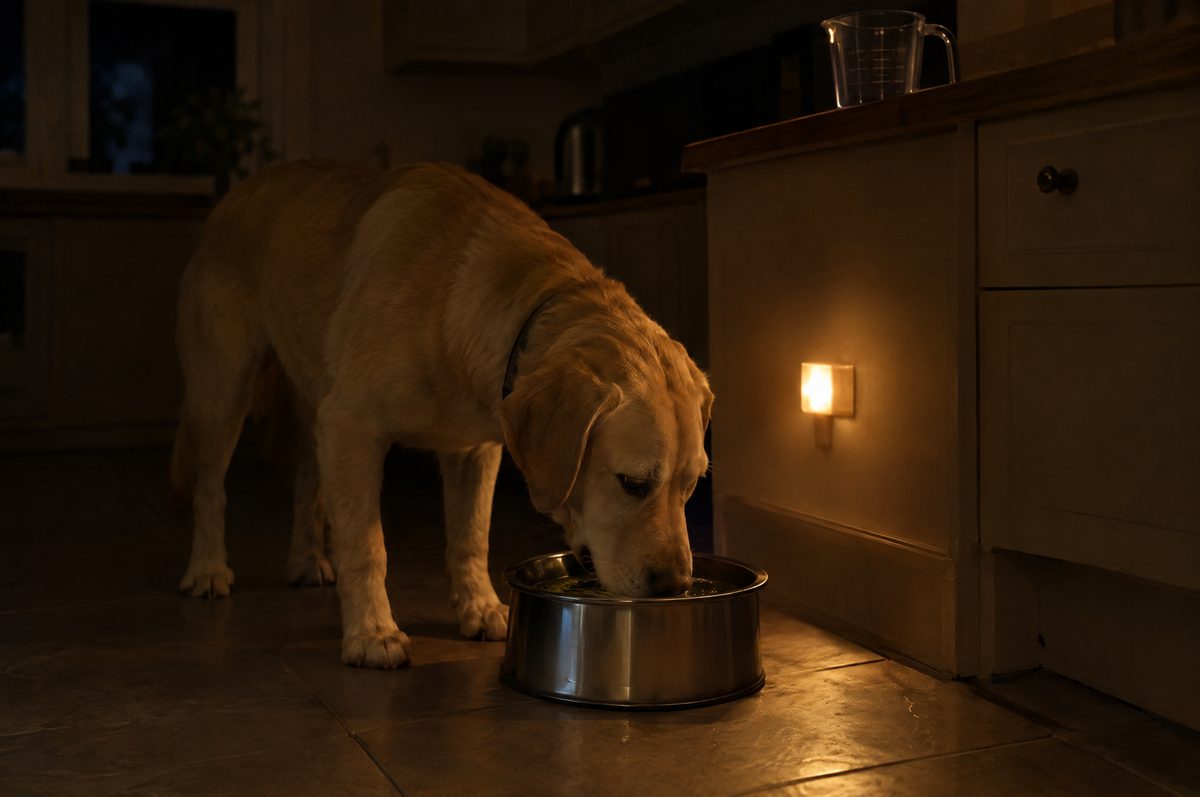
It is 2 a.m. You hear the water bowl again. Your dog drank an hour ago. Is this normal? This guide shows how much is normal, how to measure it, and what extra thirst can mean.
This page gives general information. It is not medical advice. A dog that drinks much more than before needs a vet check.
Call a vet now if
Go to an emergency vet, or call one, if your dog:
- cannot pass urine or strains to pass it,
- vomits again and again, especially with blood, weakness or refusing food,
- collapses or is very weak, or
- has trouble breathing.
Cornell’s ER list includes these signs. Call ahead and tell the clinic you are on your way.
How much water is normal?
Cornell says healthy dogs, including puppies, drink about 40 to 60 mL of water per kilogram of body weight per day. Heat and exercise raise that figure.
Cornell gives one example. A 9 kg (20 lb) Beagle drinks about 360 to 540 mL a day. That is about 1.5 to 2.25 cups.
We worked out these figures from Cornell’s range. They are our sums, so treat them as a guide:
- 5 kg (11 lb): about 200 to 300 mL.
- 20 kg (44 lb): about 800 to 1,200 mL.
- 40 kg (88 lb): about 1,600 to 2,400 mL.
How much is too much?
Cornell says that “officially” a dog is polydipsic when it drinks more than 100 mL per kilogram a day. “Polydipsia” means drinking more than normal. “Polyuria” means passing more urine. Vets write both as PU/PD.
At 100 mL per kilogram, our sums give:
- 5 kg (11 lb): about 500 mL.
- 20 kg (44 lb): about 2,000 mL.
- 40 kg (88 lb): about 4,000 mL.
If your dog drinks near these amounts, call your vet. If it is hot, or your dog has been very active, take that into account.
How to measure a day of drinking
Cornell does not give a set method. Here is a simple one that fits its advice:
- Pick a normal day, not a hot day or a day after a long hike.
- Fill the bowl from a jug with marks on the side, or from a measuring cup. Write down the amount.
- At the end of 24 hours, measure what is left. Take that from the total.
- Do this for three days. Write down the amounts.
- Note how often your dog goes out, and any accidents indoors.
If you have more than one pet, they may share the bowl. Then it is hard to count. Give your dog his own bowl for the test, or ask your vet for help.
Cornell lists other clues that your dog is drinking more:
- You refill the bowl more often.
- Your dog asks to go out more, or takes longer to pass urine.
- Your dog has accidents indoors or leaks urine in sleep.
- Your dog looks for other water, such as in the bathroom or in puddles.
What can cause extra thirst?
Cornell groups the causes in two lists.
Disease that makes a dog pass more urine, so he drinks more:
- Urinary tract infection.
- Diabetes mellitus.
- Kidney disease.
- Adrenal gland disease (Cushing syndrome or Addison disease).
- Womb infection (pyometra) in unspayed females.
- Some cancers, such as lymphoma.
- Liver disease.
- Leptospirosis.
Causes where the extra drinking is the main problem:
- Pain.
- Stress.
- Heat.
- A rare behaviour problem called psychogenic polydipsia.
The Merck Veterinary Manual adds detail on two of these. In dogs with diabetes, extra thirst and urination come with more appetite and weight loss. Cataracts are common in poorly controlled diabetes. In Cushing syndrome, thirst and urination come with more appetite, panting, a pot belly, muscle loss and skin or hair changes. Dogs are usually middle-aged to older.
Cornell says the vet will ask about diet and current medicines. Some medicines raise thirst. Tell the vet about every medicine, supplement and treat.
Do not cut off the water
This point is important. Cornell says to give your dog water until the vet has seen him. Limiting water risks dehydration and dangerous salt imbalances.
Instead, Cornell suggests:
- Keep bowls clean and fresh.
- Put out extra bowls if you have several pets.
- Take your dog out more often, to cut indoor accidents.
At night, give a last trip outside before bed, and a first trip when you wake. Use washable bedding.
What the vet will do
Cornell lists these steps:
- A physical exam.
- Questions about diet and medicines.
- A urine test.
- A complete blood count and a chemistry panel.
- X-rays or an ultrasound scan, when needed.
The Merck Veterinary Manual names tests for specific causes. These include screening tests for Cushing syndrome. Some diagnoses are simple. Others need more tests, Cornell says.
What to bring to the visit
Write down:
- The daily water amounts for three days.
- The times of night waking and accidents.
- Appetite, weight and energy changes.
- Every medicine and supplement.
- Any vomiting, diarrhoea, panting or pacing.
Our free vet visit summary tool turns these notes into a one-page sheet. Our post on old dog pacing at night covers other night changes. If your cat is the one drinking, read why is my cat drinking so much water.
A journal for the changes
The Senior Dog Comfort & Cognition Journal has a night and sleep log, a comfort check, movement and mind scores, a medicine page and vet visit notes. It helps you see a pattern over weeks, and it gives your vet clear facts.
This guide is one step in our complete guide on how to care for a senior dog: vet visits, weight, joints, mind and nights, in order.
Questions
How much water should a dog drink a day?
Cornell says healthy dogs, including puppies, drink about 40 to 60 mL per kilogram of body weight a day. A 9 kg (20 lb) dog drinks about 360 to 540 mL. Heat and exercise raise this. Ask your vet if your dog's drinking has changed.
When is a dog drinking too much?
Cornell says a dog is polydipsic when intake is above 100 mL per kilogram a day. For a 9 kg (20 lb) dog, that is about 900 mL. Measure for a full day before you decide, and tell your vet what you find.
Should I take the water bowl away at night?
No. Cornell says to give your dog water until a vet has checked him. Limiting water can cause dehydration and dangerous salt imbalances. Take your dog out more often instead, to cut accidents.
Is drinking a lot a sign of diabetes?
It can be. The Merck Veterinary Manual lists extra thirst and urination as signs of diabetes in dogs, with more appetite and weight loss. Cushing disease and kidney disease also cause it. Only tests can tell them apart.
Why does my old dog drink more at night?
Cornell does not single out night-time. The causes are the same at any hour: infection, diabetes, kidney disease, adrenal disease, liver disease, pain, stress and heat. Night may be when you notice, because the house is quiet.
What will the vet do?
Cornell says the vet will ask about diet and medicines and examine your dog. Tests usually include urine, a blood count and a chemistry panel. Some dogs also need X-rays or an ultrasound scan.
Sources
- Cornell Riney Canine Health Center: Canine Polyuria and Polydipsia (PU/PD), Dr. Brian Collins, April 2024
- Merck Veterinary Manual: Diabetes mellitus in dogs and cats (updated May 2026)
- Merck Veterinary Manual: Cushing syndrome (hyperadrenocorticism) in animals (updated July 2024)
- Cornell Riney Canine Health Center: When to go to the ER, Dr. Aly Cohen, June 2025
This article helps you organise care. It does not replace advice from your vet.