How long can a cat be left alone? Hours, days and what to set up first
You need to be out for a day, or away for a weekend. Your cat does not need a walk. So how long is it safe to go? The answer depends on your cat, and on whether the trip is hours or days.
This page gives general information. It is not veterinary advice. Your vet knows your cat.
The short answer
For a healthy adult cat, 8 to 12 hours is the usual window. Two sources agree.
- Cats Protection, a UK charity, says most cats are fine for a day or overnight. It sets the maximum at around 12 hours. It says not to do this regularly, but that it is acceptable now and then.
- PetMD, in an article reviewed by Hannah Hart, DVM, says a healthy adult cat can generally be alone for eight to 12 hours at a time. It says time alone depends on age, health, behaviour and home.
After that, the advice changes. PetMD says to arrange a pet sitter for any absence over 24 hours. Cats Protection says that if you will be away more than 12 hours, you should ask a sitter, friend, family member or neighbour to look after your cat at home, or book a cattery.
How often must a sitter visit?
The sources give two answers. Choose the safer one.
- PetMD says a sitter should visit at least once a day. The sitter gives fresh food and water, cleans the litter tray, checks health and behaviour, and plays with your cat.
- PDSA, a UK vet charity, says a cat should never be left without someone checking at least a couple of times a day. It says your cat should have company overnight and at least two visits a day.
PDSA gives a reason. It says an ill or hurt cat could be in pain, or feel unwell, for hours before the sitter comes back. PDSA also says this holds even when you have an automatic feeder or cameras. They help. They do not replace a person.
PetMD gives a firm limit for a long trip: do not leave a cat alone for a week without daily care. Even with food and water, it says, cats can become sick, stressed, bored, lonely or destructive over several days.
Kittens
Kittens need much more care. The sources agree.
- Cats Protection says kittens should be left for a maximum of a few hours at a time. It says to feed them little and often, and to check on them at least every few hours until they are fully grown.
- PetMD says weaned, healthy kittens should not be alone for more than four hours. It says kittens that still need kitten milk replacer should not be alone for more than two to three hours.
Cats Protection gives a way to prepare a kitten. Start with five to 10 minutes alone, a few times a day. Then make it longer in small steps. Our guide new kitten checklist covers the first weeks.
Older cats and cats with health problems
Older cats and sick cats cannot manage as long. Cats Protection says they need checking on more often. PetMD says cats with medical conditions may need more monitoring, medicine or vet care, which shortens the time they can be alone.
A cat on medicine needs a person who can give it on time. Our guide pet medication schedule shows how to write down each dose and time for a sitter. If your cat is a senior, see when is a cat a senior.
What to set up before you leave
Cats Protection gives a clear list. Check each item the day before.
Food and water
- Leave enough food for the whole time, and plenty of fresh water.
- Wet food spoils after a few hours. Leave only what your cat will eat. Replace dry food at least every 12 hours.
Litter tray
- Remove waste before you leave. Keep the litter about 3 cm deep.
- Make sure your cat can always reach the tray.
- Cats Protection says to scoop at least twice a day. If you will be gone, you need a sitter for this. See our guide on cats peeing outside the litter box if your cat avoids the tray.
Doors, flaps and windows
- Test a cat flap before you go, so your cat cannot be trapped inside or outside.
- Do not shut an outdoor cat in. A sudden loss of territory can cause stress.
- Keep an indoor cat’s doors and windows closed. Read indoor cat got out to plan for escapes.
A safe home
- Put away wires, string toys, human food, medicine, cleaning products and poisonous plants.
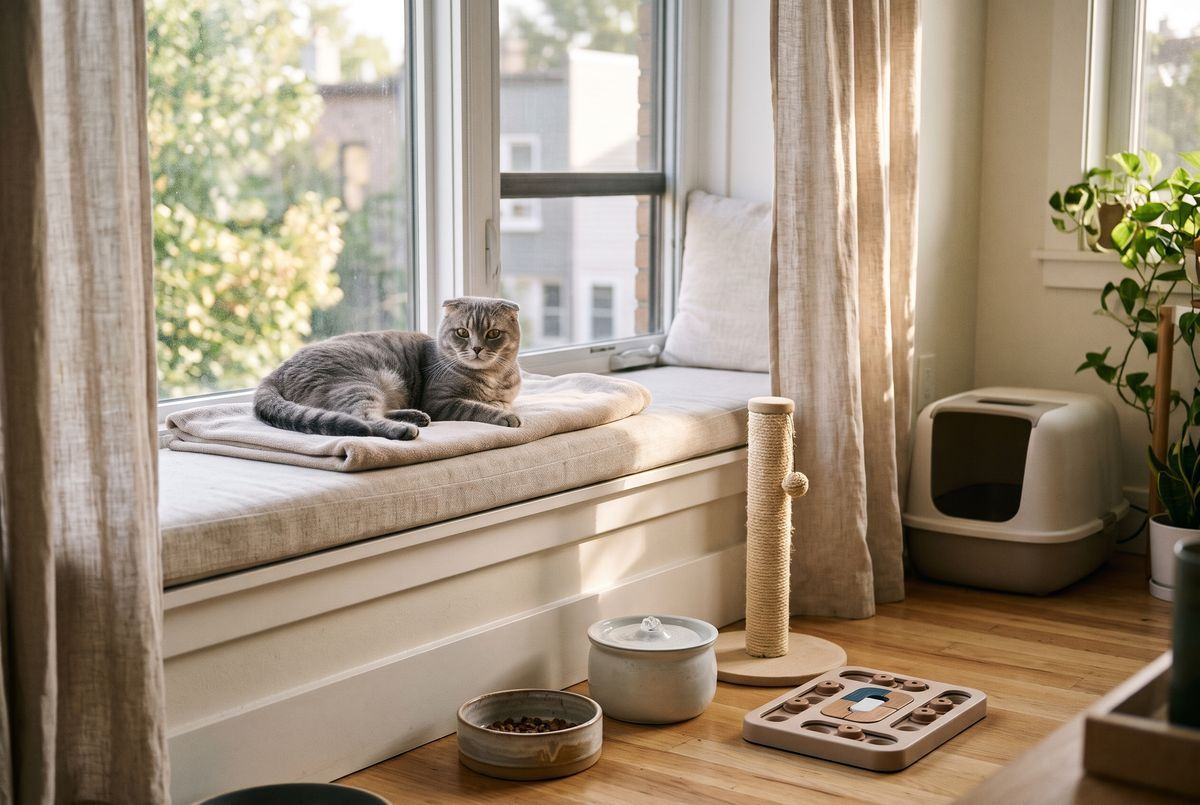
- Leave safe toys and puzzle feeders. Give hiding places and high perches.
- Cats Protection says to microchip your cat and keep your contact details up to date.
PDSA adds three tips for a sitter. Test the doors with the sitter. Give a spare key to a friend or relative. Leave written instructions for feeding times, emergency contacts, your vet’s details and any special needs.
Boarding
PDSA says to pick a local council licensed cattery, and the same for home-from-home boarding. It suggests getting a cat used to a cattery early, ideally as a kitten, if you travel a lot.
Not sure which is right for your cat? Our guide pet sitter vs boarding compares the two.
What to leave your sitter
A good sitter needs the facts on one page. PetMD says the sitter should have the feeding schedule and portions, medicine instructions, your contact details, your vet’s details and the details of a local emergency vet hospital.
Our free sitter sheet collects all of this on a single page. Our guide what to leave your pet sitter explains each item. Our pet emergency card guide shows what to put on a card for the fridge. If you need to give a sitter the right to authorise care, read vet release form for pet sitters.
Put it all in one kit
The Sitter Handover and Vet Release Kit has a fridge sheet, a sitter guide that leaves out door codes, and a signed vet release. It works for a cat that stays home while you travel.
Questions
Can I leave my cat alone for a weekend?
Not without help. Both PetMD and PDSA say a cat needs a visitor on a weekend trip. PetMD says arrange a sitter for any absence over 24 hours, with at least one visit a day. PDSA says two visits a day and company overnight. Feeders and cameras do not replace a person.
How long can a kitten be left alone?
For a few hours only. Cats Protection says kittens should be left for a maximum of a few hours at a time. PetMD says weaned kittens should not be alone for more than four hours, and kittens that still need milk replacer for no more than two to three hours.
Can I leave my cat alone for 2 days?
Do not leave a cat alone for 2 days with no visits. PetMD says some adult cats may occasionally manage up to 24 hours, but strongly recommends daily check-ins. PDSA says an ill or hurt cat can be in pain for hours before the next visit. Arrange a sitter or a licensed cattery.
Is an automatic feeder enough?
No. PDSA says a cat still needs visits at least twice a day, even with an automatic feeder or cameras in the house. A feeder helps with meals. It cannot spot a sick cat, clean the litter tray, or give company. Cats Protection says wet food spoils after a few hours.
How long can an older or sick cat be left alone?
Less time than a healthy adult. Cats Protection says older cats and cats with medical or complex needs need checking more often. PetMD says cats with medical conditions may need more monitoring, medicine or vet care. Ask your vet what limit is safe for your cat.
Should I leave a cat flap open when I travel?
Test it first. Cats Protection says to check that a cat flap works before you leave, so your cat cannot be trapped inside or outside. It says not to shut an outdoor cat in, because a sudden loss of territory can cause stress. Keep an indoor cat's doors and windows closed.
Sources
- Cats Protection: How long can you leave a cat alone?
- PetMD: How long can you leave a cat alone? (reviewed by Hannah Hart, DVM, 8 June 2026)
- PDSA: What to do with your cat when you go on holiday
This article helps you organise care. It does not replace advice from your vet.