How to take a cat in the car without the crying and the stress
Your cat cries from the moment the engine starts. By the time you reach the vet, you are both upset. For many cats, the car is the worst part of the trip. This guide shows where the carrier goes, how to teach the car in small steps, and what to do at home afterwards.
This guide is one step in our complete guide on how to take a cat to the vet, before, during and after.
This page gives general information. It is not medical advice. If your cat is ill, drive to the vet now and train later.
Why the car matters
In a 2014 study in the Journal of the American Veterinary Medical Association, 58% of cat owners said their cat hates going to the vet. The authors said most cats fear the carrier and the car ride, so many owners avoid the visit. A calmer car ride makes every vet visit easier.
Start with the carrier
The Edmonton Humane Society says the first step to calm travel is a cat that likes its carrier. Our guide to getting a cat into a carrier shows the 8 training steps. Do those first, or at the same time.
Where the carrier goes in the car
The Edmonton Humane Society advises:
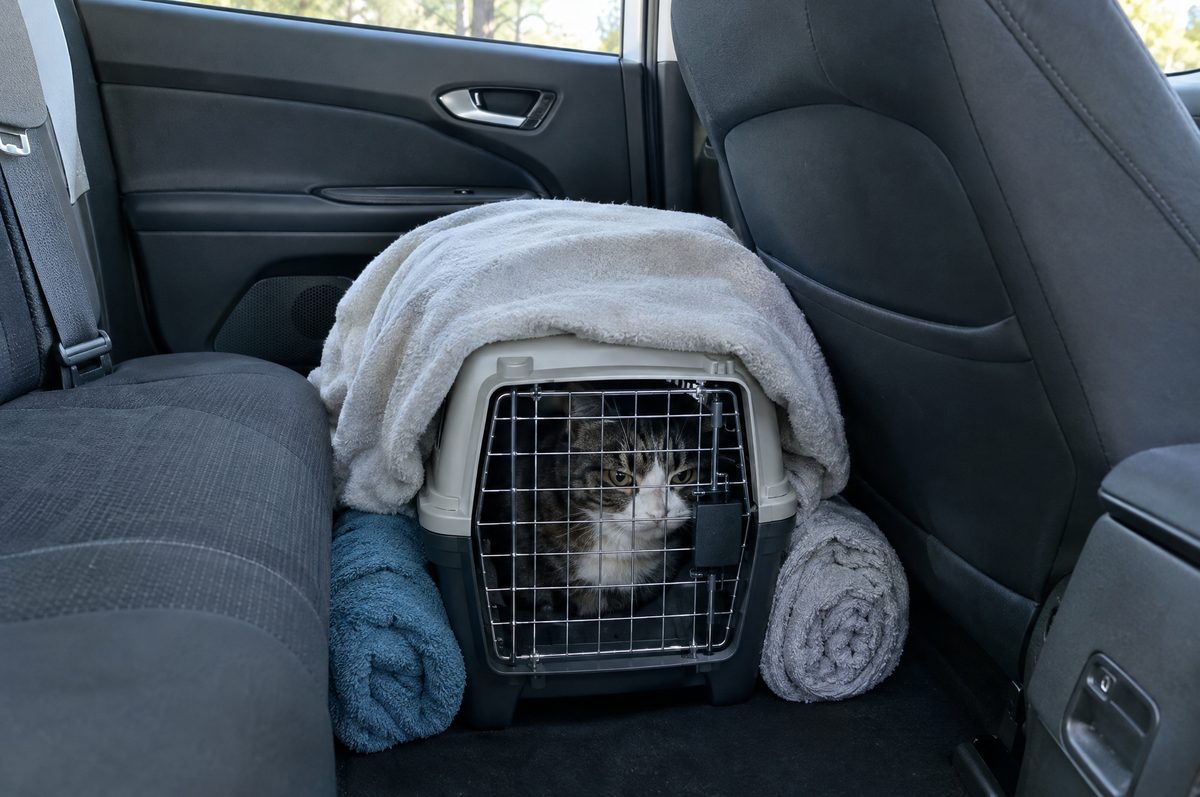
- Always in a carrier. The safest place is inside a hard-sided, secured and covered carrier. It stops your cat hiding under the pedals and helps your cat feel more secure.
- One cat, one carrier. If you have more than one cat, each needs its own.
- On the floor. The best place is on the floor behind the front passenger or driver’s seat.
- Keep it steady. Put rolled blankets or towels around the carrier, so it stays upright and does not wobble.
- Seat belts. If you use one, make sure the carrier is designed to take the pressure.
VCA also says cats should always travel in a carrier in the car.
Teach the car in small steps
The Edmonton Humane Society guide sets out these steps:
- Comfortable car. Make sure the car is not too hot or too cold before your cat goes in.
- Engine on, engine off. Cats are sensitive to vibration and noise. Turn the engine on and off. Build up the time as your cat relaxes.
- A short drive. When your cat is calm with the engine running, drive round the block. A second person can watch your cat and give treats.
- Not always the vet. Do not make every car ride a trip to the vet. Take short trips that end somewhere calm.
VCA advises at least 10 good car trips for every scary one. Keep sessions short. Stop and go back a step if your cat stops taking treats, freezes, or cries more.
You can also ask your vet about “happy visits”. The Edmonton Humane Society describes these as short visits where the staff give treats and attention, with no exam.
Car sickness
Some cats are not only scared, they are sick. The Edmonton Humane Society lists these signs of nausea:
- Refusing treats.
- Drooling.
- Licking the lips.
- Swallowing or gulping a lot.
- Vomiting.
If you see them, talk to your vet. The guide suggests no food for a few hours before a ride for a cat that gets carsick, and using rewards that are not food, such as toys or petting. Do not give any medicine unless your vet prescribes it.
When you get home
In a home with more than one cat, the trip is not over at the front door. The cat that went out can smell like a stranger. The Edmonton Humane Society calls this non-recognition aggression, and gives these steps:
- Never let the cats “sort it out”. One bad fight can damage their relationship for good.
- A quiet room first. Put the carrier in a room with food, water, a litter box, a bed and places to hide. Let your cat leave the carrier on its own.
- Swap bedding. Swap blankets between your cats, so they learn each other’s smell again.
- Reintroduce slowly.
- Clean the carrier. Wash it with unscented soap, add familiar bedding, and put it back in its usual place.
The guide also suggests taking both cats to the vet together, if you can, so both come home smelling the same.
Our guide on when your cat hates going to the vet covers the clinic part of the trip. Before any visit, our free vet visit summary helps you write down what you have seen.
A step-by-step program for the whole trip
Vet Days Without the Fight, Cat Edition is a 51-page fillable PDF program. It has a car ladder and a carrier ladder with a picture for each step, an exam practice ladder, a pills ladder, a page for the return home, logs and a handling card for your vet team.
It teaches with rewards only and never names a medicine or a dose. See every page of Vet Days Without the Fight.
Cat hides at home after the trip? Read cat hiding after the vet. For medicine your vet may suggest, read gabapentin for cats before a vet visit.
Questions
Where should a cat carrier go in the car?
The Edmonton Humane Society says the best place is on the floor behind the front passenger or driver's seat. Put rolled blankets or towels around it to keep it upright and stable. If you use a seat belt, make sure the carrier is designed for it.
Should my cat ride loose in the car?
No. The Edmonton Humane Society says the safest place is inside a hard-sided, secured and covered carrier, which stops your cat hiding under the pedals. VCA also says cats should always travel in a carrier. Each cat needs its own carrier.
How do I get my cat used to the car?
In small steps. Make the car a comfortable temperature. Turn the engine on and off, and build up the time. Then take a short drive round the block, with a second person giving treats. VCA advises at least 10 good car trips for every scary one.
Why does my cat cry or drool in the car?
It may be fear or car sickness. The Edmonton Humane Society lists signs of nausea: refusing treats, drooling, licking lips, swallowing or gulping a lot, and vomiting. Ask your vet. The guide suggests no food for a few hours before a ride if your cat gets carsick.
Why do my cats fight after one comes back from the vet?
The cat that went out may smell like a stranger. The Edmonton Humane Society calls this non-recognition aggression. Put the returning cat in a quiet room, let it leave the carrier on its own, swap bedding between the cats, and reintroduce them slowly.
Can I take my cat on car trips that are not to the vet?
Yes, and you should. The Edmonton Humane Society says not to make every car ride a trip to the vet. Short trips that end somewhere calm, or back at home, teach your cat that the car is safe.
Sources
- Edmonton Humane Society: Cat Behaviour Guide, Traveling in a Car with Your Cat, 2024
- VCA Canada: Cat Behavior and Training, Crate Training and Travel, Lindell, Horwitz and Landsberg, 2023
- Bayer Veterinary Care Usage Study: Feline Findings, Volk, Thomas and Colleran, JAVMA 2014 (press release)
- Edmonton Humane Society: Cat Behaviour Guide, Cat Carrier Training, 2024
This article helps you organise care. It does not replace advice from your vet.