How to get a cat into a carrier, today and every time after
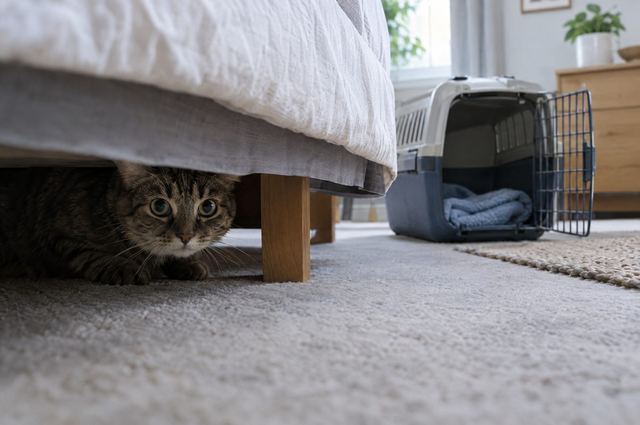
The vet appointment is in an hour. The carrier is out. Your cat has gone under the bed. You are not alone. This guide shows what to do today, and how to train your cat so the next trip is calm.
This guide is one step in our complete guide on how to take a cat to the vet, before, during and after.
This page gives general information. It is not medical advice. If your cat is ill, go to the vet first and train later.
Why cats fight the carrier
For many cats, the carrier means one thing: a car ride and a vet visit. In a 2014 study in the Journal of the American Veterinary Medical Association, 58% of cat owners said their cat hates going to the vet. The authors said most cats fear the carrier and the car, so many owners avoid the visit.
The good news: a carrier can become a place your cat likes. The training is short, regular and kind.
If the vet visit is today
You do not have time to train. Do this instead:
- Close doors early. Shut the room you need before your cat sees the carrier.
- Take the top off. With a top-opening carrier, you can lower your cat in. That is easier than pushing it through a small door.
- Lift with support. Put one hand under the chest and one under the hindquarters. International Cat Care says never scruff a cat, never let it hang, and never hold it only under the belly.
- Use a towel. Some cats feel safer in a towel. Lower cat and towel in together.
- Stay calm. Move slowly and speak softly.
If your cat is very upset, call the clinic. Ask if you can come later, or what they advise. Do not chase your cat around the house.
Make the carrier part of the furniture
International Cat Care says the carrier should be “part of the furniture” at home. VCA advises:
- Put the carrier where your cat already sleeps or rests.
- Put a soft blanket or bedding from home inside.
- Put treats, toys or food inside, so good things happen there.
- Never force your cat in.
Leave it out every day, not just before a vet visit. If the carrier only appears on vet days, your cat learns what it means.
The 8-step carrier ladder
The Edmonton Humane Society carrier guide uses short sessions of up to 5 minutes and these steps:
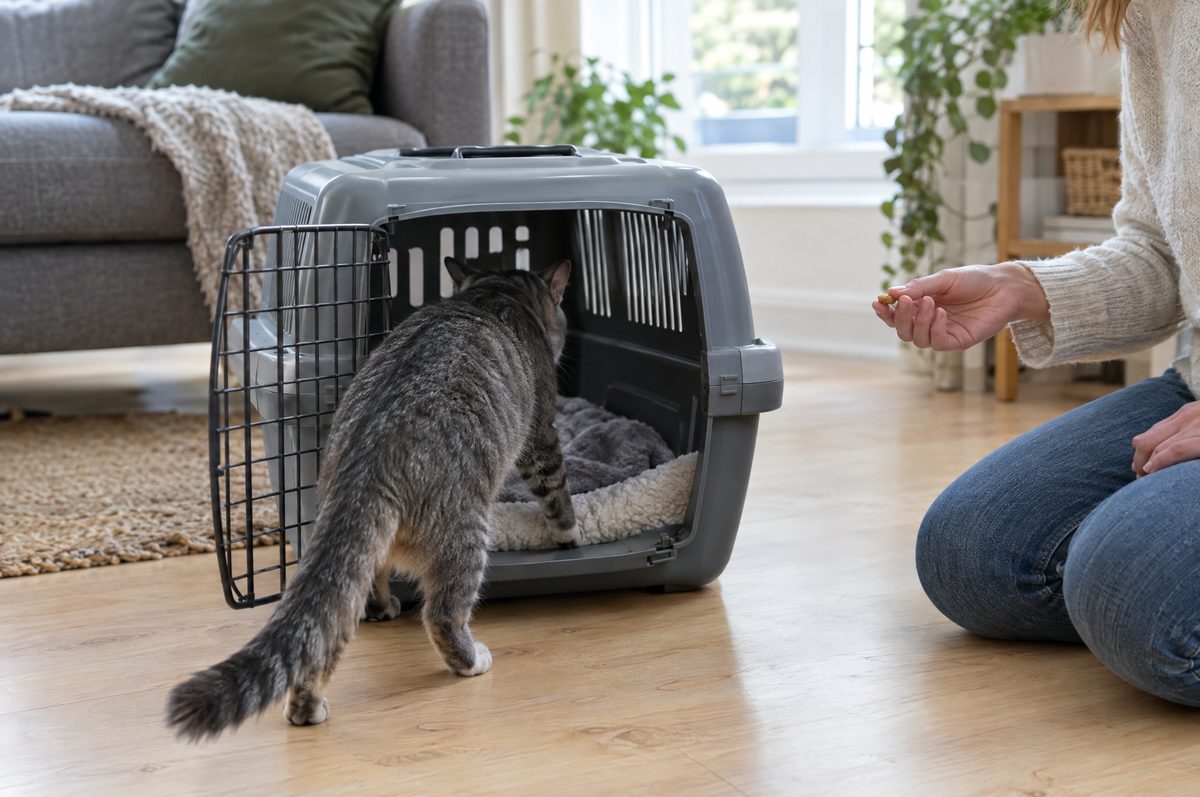
- Feed near the carrier. Take the top off. Feed treats or meals next to the bottom half.
- Feed inside. Move the food into the bottom half, a little further in each time.
- Add a cue word. Say a word, such as “carrier”, as your cat steps in. Give a treat when it is inside.
- Put the top back on. Leave the door open. Repeat steps 2 and 3.
- Move the door. Touch the door, then close it for a second, then open it. Treat.
- Add time inside. Keep the door closed a little longer each time, with treats.
- Lift the carrier. Lift it a few centimetres, put it down, treat.
- Walk a step. Carry it a few steps, put it down, open the door, treat.
Move up only when your cat is relaxed at the current step. If your cat stops eating, go back one step. The guide also says to practise the latch sound when your cat is not inside, and not to swing or bump the carrier.
Signs to slow down
Stop and go back a step if your cat:
- Walks away, or turns its head away.
- Turns or lowers its ears, or stares with wide eyes.
- Freezes, or makes its body small.
- Hisses, growls, spits or swats. Stop the session. Do not punish it.
These are warnings. A warning keeps you both safe.
On the vet day, after training
- Put the carrier in its usual place. Your cat may walk in by itself.
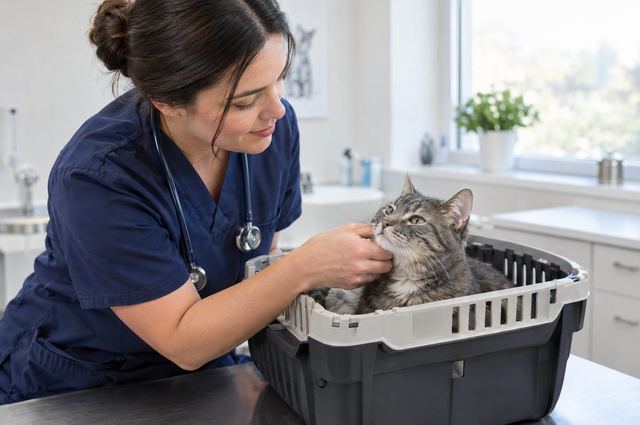
- VCA says a carrier with a top that comes off lets the vet examine your cat in the bottom half.
- Do not tip or pull your cat out at the clinic. Take the top off instead.
- At home, put the carrier back in its usual place, with clean bedding.
For an urgent trip before training is done, VCA suggests using an old carrier, not the one you train with. That keeps the training carrier a good place.
Our guides to taking a cat in the car, making vet visits less stressful for your cat and how to give a cat a pill cover the next parts of the trip. Before the visit, our free vet visit summary helps you write down what you have seen.
A full program, a picture for each step
Vet Days Without the Fight, Cat Edition is a 51-page fillable PDF program. It has the 8-step carrier ladder with a picture for each step, a car ladder, an exam practice ladder, a pills ladder with treats only, logs, and a handling card for your vet team.
It teaches with rewards only. It never names a medicine or a dose. See every page of Vet Days Without the Fight.
If your cat hides after the trip, read cat hiding after the vet. For vet-prescribed calming medicine, read gabapentin for cats before a vet visit.
Questions
How do I get my cat into a carrier when it hides?
Do not chase it. Close the doors of the room you need early, before your cat sees the carrier. Take the top off a top-opening carrier, and lower your cat in gently with one hand under the chest and one under the hindquarters. Then start carrier training, so the next trip is easier.
How long does carrier training take?
It depends on your cat. The Edmonton Humane Society guide uses sessions of up to 5 minutes and 8 small steps. Do not move up a step until your cat is relaxed at the current one. Some cats move up each day; others need a week on one step.
Should I leave the cat carrier out all the time?
Yes. International Cat Care says the carrier should be part of the furniture at home. VCA suggests putting it where your cat sleeps, with a soft blanket, and treats, toys or food inside.
Can I push my cat into the carrier?
Try not to. The Edmonton Humane Society says never to force a cat into a carrier, and VCA says the same. Forcing teaches your cat that the carrier is scary, so the next trip is harder. Do not tip or pull your cat out at the vet either.
What kind of carrier is best?
A carrier with a top that comes off is useful. VCA says the vet can then examine your cat in the bottom half, which many cats find easier. Choose one that is sturdy and easy to clean.
What if I need to go to the vet before training is done?
Go. Your cat's health comes first. VCA suggests using an old carrier for an urgent trip, not the one you train with, so the training carrier stays a good place.
Sources
- Edmonton Humane Society: Cat Behaviour Guide, Cat Carrier Training, 2024
- International Cat Care: Taking your cat to the vet
- VCA Canada: Cat Behavior and Training, Crate Training and Travel, Lindell, Horwitz and Landsberg, 2023
- Bayer Veterinary Care Usage Study: Feline Findings, Volk, Thomas and Colleran, JAVMA 2014 (press release)
This article helps you organise care. It does not replace advice from your vet.