How to take a cat to the vet: the complete guide, before, during and after
Taking a cat to the vet is one trip in many small parts. Each part can go wrong. Each part can also be trained. This guide walks through the whole trip in order: before, during and after. Each step links to our detailed guide on that step.
This page gives general information. It is not medical advice. If your cat is ill or in pain, go to the vet now. Train later.
First: does it need to be today?
Some signs cannot wait for training. Cornell Feline Health Center says a blocked urethra is “an absolute emergency”. A blocked cat strains to pee and passes little or no urine. Cornell says death can follow in less than 24 to 48 hours. Also go now for trouble breathing, collapse, a seizure or a possible poison.
Our guide on when to take your cat to the emergency vet lists all the signs. If money is the worry, read what to do if you cannot afford the vet for your cat. Then go.
Why the trip is hard for cats
In a 2014 study in JAVMA, 58% of cat owners said their cat hates going to the vet. The authors found most cats fear the carrier and the car. For 38% of owners, just thinking about the trip was stressful. The same study found 52% of US cats did not get regular vet care.
International Cat Care explains why. Cats are territorial. They need to control their surroundings. They are sensitive to smells. A vet trip takes all of that away at once.
So most cats do not fear the vet as a person. They fear a chain of events. Our guide for when your cat hates going to the vet explains the chain, part by part.
How often should you take a cat to the vet?
Cat Friendly Homes, from the Feline Veterinary Medical Association, gives these intervals:
- Adult cats: a checkup at least once a year.
- Senior cats, 10 to 15 years: at least every 6 months.
- Cats over 15 years: every 4 months.
- Cats with ongoing health problems: they may need more checkups.
International Cat Care also says all cats need at least one check a year. A checkup can find a problem before your cat shows it. Not sure if your cat is a senior? Read when is a cat a senior.
Before the visit
Step 1: make the carrier part of home
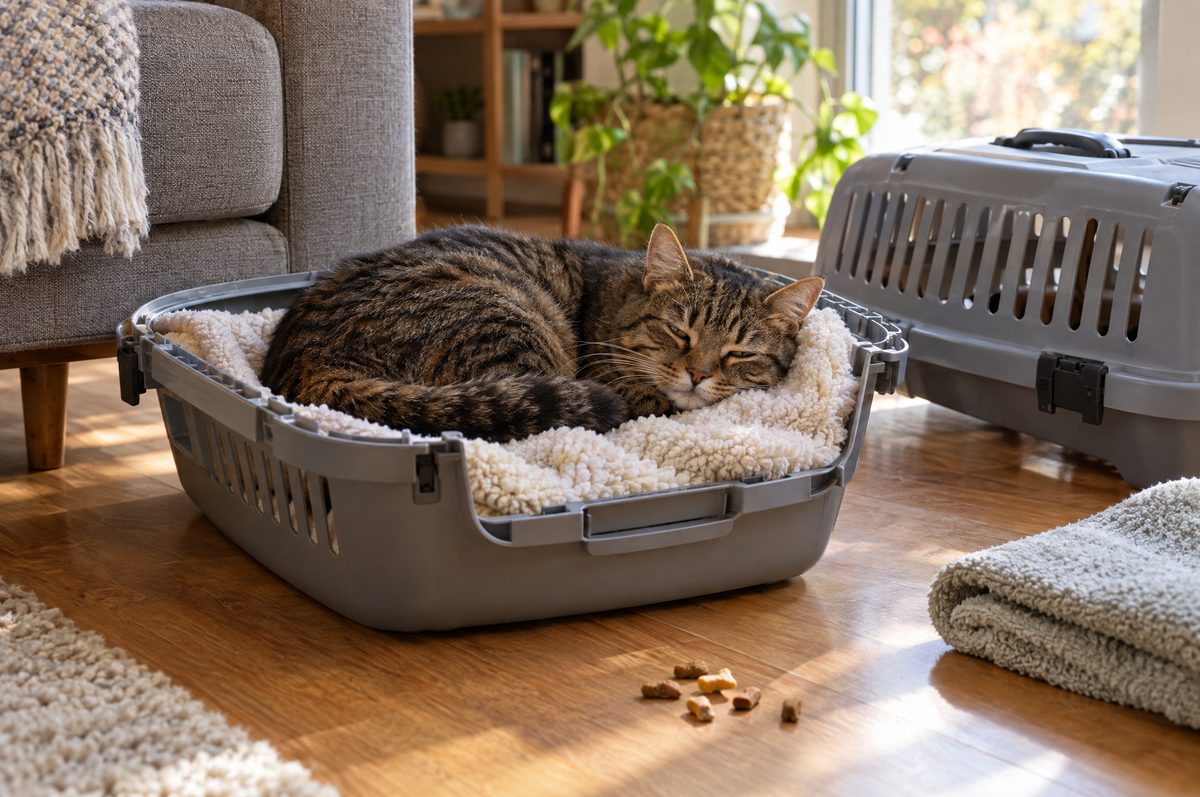
Start weeks before the visit. Cat Friendly Homes says it can take weeks or even months. Keep the carrier out in a room your cat uses. Put soft bedding inside, with treats or toys. Do not coax your cat in. Let it explore by itself.
Choose the carrier with care. International Cat Care says a carrier that opens at the top is much easier to use. VCA says a vet may examine a cat in the bottom half of a carrier with a top that comes off.
Our guide on how to get a cat into a carrier has an 8-step ladder from “carrier in the room” to “door closed, carrier lifted”.
Step 2: practise short car trips
VCA advises at least 10 good car trips for every scary one. Start with the engine off. Then drive to the end of the street and back. Give treats. Not every trip should end at the vet. Our guide on how to take a cat in the car has the steps and the signs of car sickness.
Step 3: talk to your vet if your cat is very afraid
Cat Friendly Homes says to call your vet before the visit if your cat gets very stressed. Ask what the team can do. Your vet may suggest a medicine before the trip. Only your vet can choose it and set the dose. VCA says medicines are not a substitute for training. Read gabapentin for cats before a vet visit for the questions to ask.
Step 4: get ready the day before
- Ask your vet if your cat should skip a meal before the visit.
- Write down what you have seen at home, with dates.
- List your questions and your cat’s medicines.
- Put clean bedding from home in the carrier.
- Pack a spare towel in case your cat is sick.
Our free vet visit summary puts your notes on one page for the vet.
On the day
Getting your cat into the carrier
Do not chase your cat. Cat Friendly Homes says the chase makes a cat more scared and you more likely to be bitten. If your cat is carrier trained, toss a few treats in. Your cat may walk right in.
If not, Cat Friendly Homes advises these steps:
- Put the carrier in a small room with few hiding places.
- Bring your cat in and close the door.
- Move slowly and calmly.
- Lower your cat in through the top opening.
- Or take the top off, put your cat in the bottom half, and put the top back on.
A towel around your cat can keep the legs from getting in the way. One cat per carrier.
In the car
Cover the carrier with a towel to block the view. Carry it with both arms, from underneath, not by the handle. Cat Friendly Homes says most carriers should go on the floor behind a front seat. International Cat Care says to drive carefully and keep the radio low.
In the waiting room
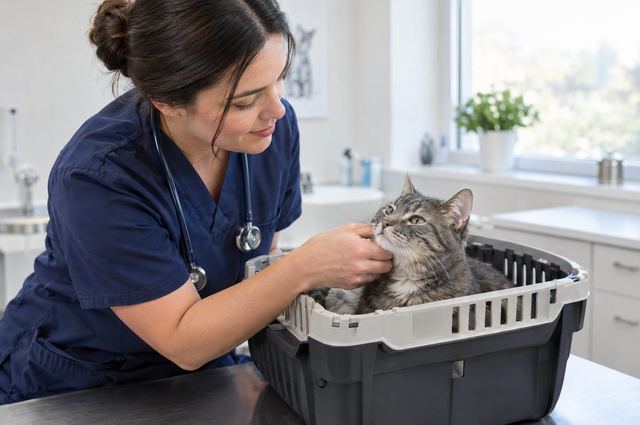
Ask at the desk where cats should wait. International Cat Care says to look for a cat-only area and a raised shelf for the carrier. If dogs are there, Cat Friendly Homes suggests asking to go straight to an exam room. Both sources say you can also wait in the car until the team calls you.
In the exam room
Cat Friendly Homes gives these tips:
- Do not take your cat out of the carrier until the team asks.
- Talk softly, in a low voice.
- Do not say “shhh”. It may sound like a hiss to your cat.
- Do not clutch your cat or stare into its face.
- Reward calm behaviour with treats or slow stroking.
- Never punish your cat.
If you do not understand what the vet says, ask again. International Cat Care says to ask the team to show you how to give any medicine.
After the visit
Home again
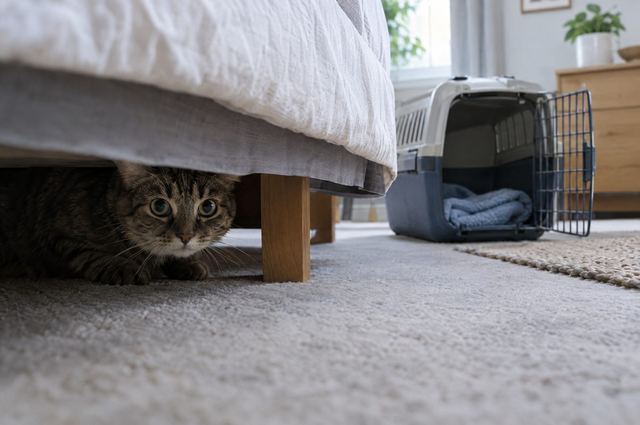
International Cat Care says cats can be nervous and disorientated when they come home. Give a quiet, warm room with food, water and a litter tray. Let your cat come to you. Our guide to a cat hiding after the vet says how long is normal and when to call.
If you have other cats
Your cat now smells of the clinic. Cat Friendly Homes says the other cats may not recognise it. Leave it in the carrier for a few minutes and watch the others. If there is hissing, keep the cats apart. Swap bedding between them. Bring them back together slowly.
Medicine at home
Give medicine exactly as your vet says. Finish the full course. Our guide on how to give a cat a pill shows the steps, and why water after the pill matters.
Put the carrier back out
Cat Friendly Homes says to clean the carrier with a cleaner that has no scent. Then put it back in its usual place. The next trip starts now.
The hardest visit
Some day, a vet visit may be about the end of your cat’s life. Our guides on how to know when to put your cat down and cat euthanasia, what to expect explain each step, at your own pace.
Every guide in this series, in order
- My cat hates going to the vet: why, and the four parts of the trip.
- How to get a cat into a carrier: the 8-step ladder.
- How to take a cat in the car: carrier place, small steps, car sickness.
- Gabapentin before a vet visit: what to ask your vet.
- Cat hiding after the vet: how long, and when to call.
- How to give a cat a pill: step by step.
- When to take a cat to the emergency vet: the signs that mean go now.
- Cat euthanasia: what to expect: step by step, for the last visit.
One plan for the whole trip
If you want every step on paper, Vet Days Without the Fight, Cat Edition is a 51-page fillable PDF program. It has ladders for the carrier, the car, the exam and medicine, a picture for each step, logs and a handling card for your vet team. It uses rewards only and never names a medicine or a dose.
Not yet sure which clinic to use? Read how to find a good vet.
Questions
How often should I take my cat to the vet?
Cat Friendly Homes, from the Feline Veterinary Medical Association, says at least once a year. Senior cats of 10 to 15 years need a checkup at least every 6 months. Cats over 15 should go every 4 months. Cats with ongoing health problems may need more.
How do I take a cat to the vet without a carrier?
Do not. International Cat Care says never travel with a cat loose in the car. VCA says a cat in a car should always be in a safe carrier. A loose cat can get hurt, distract the driver or escape. If you have no carrier, ask your vet or a shelter to lend one.
How do I catch a scared cat to take it to the vet?
Do not chase it. Cat Friendly Homes advises putting the carrier in a small room with few hiding places, closing the door and moving slowly. Lower your cat in through the top, or into the bottom half with the top off. A towel can help.
Should I feed my cat before a vet visit?
Ask your vet, because some tests and procedures need an empty stomach. Cat Friendly Homes says holding food back for several hours before the visit can help avoid car sickness. It also lets your cat walk into the carrier for a treat.
What should I bring to my cat's vet visit?
Bring the carrier with bedding from home, a spare towel, favourite treats and a list of questions. Bring any medicines and past records. Write what you have seen at home, with dates. A short handling card helps the team know your cat.
Can I stay with my cat during the exam?
Usually, yes. Ask the team. Cat Friendly Homes says to talk softly in a low voice and to avoid clutching your cat or staring into its face. It also says not to take your cat out of the carrier until a team member asks.
Is it normal for a cat to hide after the vet?
Yes, many cats hide for a while. International Cat Care says cats can be nervous and disorientated when they come home. Give a quiet room and let your cat come to you. Call the vet if your cat stops eating or cannot pass urine.
Sources
- Cat Friendly Homes (Feline Veterinary Medical Association): Getting Your Cat to the Veterinarian
- Cat Friendly Homes (Feline Veterinary Medical Association): Importance of Routine Veterinary Care for Your Cat
- Cat Friendly Homes (Feline Veterinary Medical Association): Your Role in Veterinary Visits
- International Cat Care: Taking your cat to the vet
- VCA Canada: Cat Behavior and Training, Crate Training and Travel, Lindell, Horwitz and Landsberg, 2023
- Bayer Veterinary Care Usage Study: Feline Findings, Volk, Thomas and Colleran, JAVMA 2014 (press release)
- Cornell Feline Health Center: Feline lower urinary tract disease
This article helps you organise care. It does not replace advice from your vet.