Dog dementia stages: mild, moderate and severe signs (2026 vet guidelines)
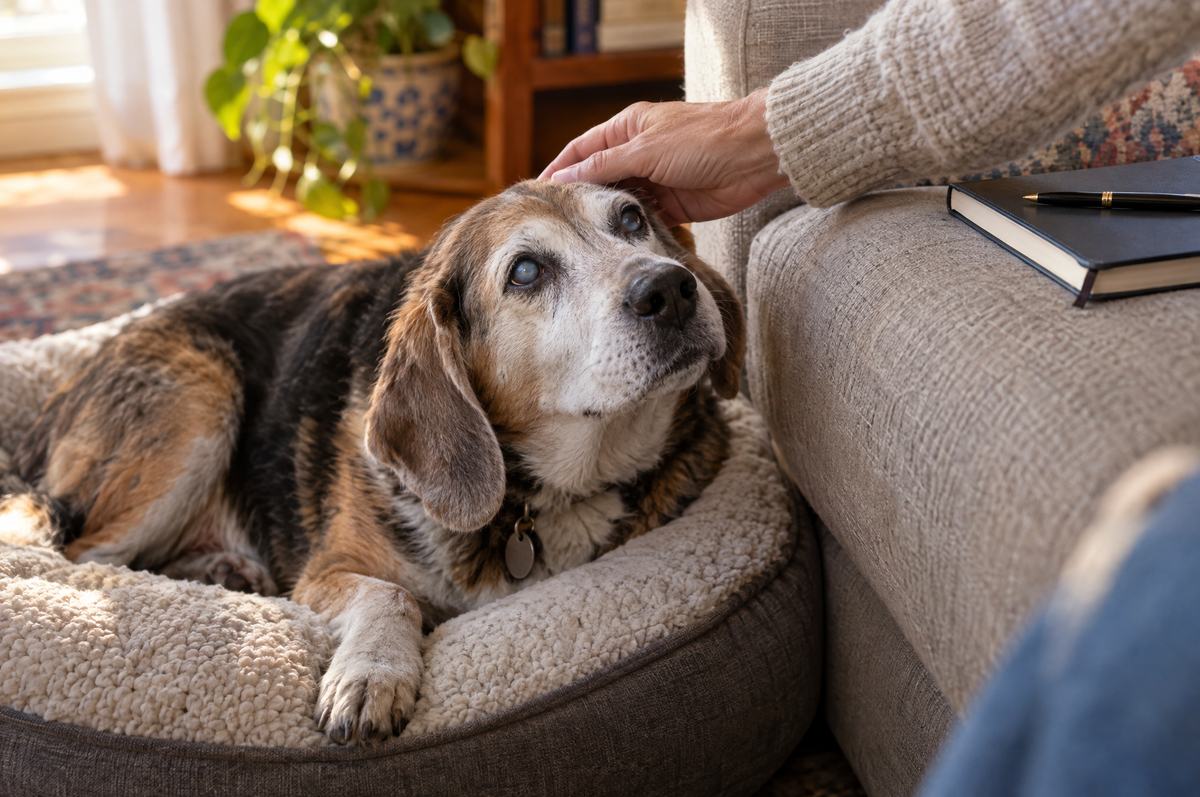
Your old dog stares at the wall. It stands in a corner and does not know how to back out. It wakes at night and paces. You have read the words “dog dementia”, and now you want to know what comes next.
This guide uses the first formal guidelines on the subject. In 2026, an international group of experts wrote them. The group is the Canine Cognitive Dysfunction Syndrome Working Group. Its work appears in the Journal of the American Veterinary Medical Association (JAVMA). Below you find the three stages, the seven signs, how vets diagnose the problem, and what you can track at home.
Dementia in dogs is not “just old age”
Vets call it canine cognitive dysfunction syndrome (CCDS). The working group defines it as a chronic, progressive, age-associated brain disease. It brings changes in thinking and behaviour that affect daily life. The group says it is “diagnosed with increasing frequency”, but until 2026 no standard diagnostic guideline existed.
The 2023 American Animal Hospital Association (AAHA) senior care guidelines say that ageing is not a disease. A new sign in an old dog is a reason to call your vet. It is not a reason to wait.
A 2024 study says dementia is common but underdiagnosed. Treatment works best when it starts early. So the first job is to notice the early signs.
The 7 signs of dementia: DISHAA
The working group groups the signs in seven areas. The short name is DISHAA. Cornell University’s Riney Canine Health Center gives these examples.
| Area | What you may see |
|---|---|
| Disorientation | Stuck in a corner, does not know how to back out, seems lost at home, does not know familiar people or animals |
| Interaction (social) | Ignores family or pets, reacts with anger, hides from visitors |
| Sleep | Night pacing, calling out, whining, barking or howling; Cornell says this is often the first sign |
| House soiling | Accidents on beds or floors, poo without a signal to go out |
| Activity | More or less activity, such as pacing at night and little wish to walk by day |
| Anxiety | New fear in new places or with new people |
| Learning and memory | The working group’s seventh area: the dog forgets cues, routines or people |
You do not need to see all seven. Many dogs show only one or two at first.
The 3 stages of dog dementia
The working group proposes three stages. They describe what the dog can do. They do not give months or years.
Stage 1: mild
Signs are subtle. They happen rarely or they are slight. The dog’s function is preserved. It still does its daily tasks. Typical examples are a restless night now and then, or a dog that sometimes seems lost for a moment.
At this stage, a record is your best tool. Write each sign, the date and the time.
Stage 2: moderate
The changes are more clear and have more effect. You must adjust how you care for your dog. For example, you may need to take your dog out more often, block the stairs, or keep a strict routine. Accidents, night waking and new fears become part of the week.
Stage 3: severe
The group describes “debilitating deficits” that are overt. They impair basic functions, and the dog needs comprehensive support. At this stage, daily comfort and safety are the main goals. Talk with your vet early about quality of life. You do not have to decide alone.
How long does each stage last?
We did not find a source that gives a reliable timeline, so this guide does not give one. The working group describes stages by function, not by time. Pain, arthritis or other illness can change how a dog looks from week to week. A written record is the best way to see how fast your own dog is changing.
How vets diagnose dementia
The working group proposes two levels of diagnosis.
Level 1 needs all of these:
- a consistent history of progressive DISHAA signs;
- other causes ruled out by a physical exam, an orthopaedic exam, a neurologic exam and lab work;
- a normal neurologic exam, or signs of symmetrical, diffuse forebrain dysfunction;
- signs that continue after the vet manages related conditions.
Level 2 adds a brain MRI that shows cortical atrophy, with normal spinal fluid cell counts.
Definite confirmation comes only after death, by examining the brain. The group says that blood tests and cognitive test batteries are priorities for the future.
This is why your vet asks so many questions. Cornell University says the vet uses blood and urine tests to rule out pain, arthritis, and loss of sight or hearing. Cornell also says to test for a bladder infection when accidents start. A sudden balance problem, with a head tilt, circling and fast eye movements, is a different condition (vestibular syndrome) and needs prompt care.
Can an owner score the signs at home?
Owners can use a screening questionnaire. These questionnaires do not diagnose. A 2024 study asked owners of 597 elderly dogs to fill in three of them. The scores matched each other well. But one questionnaire (the Canine Dementia Scale) found mild to moderate impairment in dogs that the others called normal ageing. The study says that the choice of questionnaire changes the result, and that the cut-off values differ a lot.
The study also found that scores rose with age. A sense of place and direction (spatial orientation) was a key feature. As the signs rose, trainability fell and pain sensitivity rose.
So a score from the internet is a start. It is not an answer. Use it to show trends, and bring it to your vet. The Senior Dog Comfort and Cognition Journal has a DISHAA checklist and a weekly mind check. The journal uses its own wording and says on the page that it is not a vet test.
How common is dementia?
In the Dog Aging Project, 15,019 owners filled in surveys. Probable dementia showed in 1.4% of all the dogs. But the average age was only 6.9 years, so the number for old dogs is much higher. The odds of dementia rose by 52% for each added year of age. Cornell University says dogs may start to show it from about 9 years of age.
Sleep may be an early target. A 2023 study of 28 senior dogs found that dogs with higher dementia scores spent less time in non-REM sleep and REM sleep. Read our guide on an old dog pacing at night for causes and what to do tonight.
What helps at home
Cornell University suggests these steps. None replaces your vet’s plan.
- Routine. Keep the same times for meals, walks and bed. Keep the bed and bowls in the same places. Do not move the furniture.
- Safety. Block stairs and gaps behind furniture. Keep the microchip and the collar tag up to date.
- Night. Use a night light. Take a longer walk before bed. Ask your vet before you use melatonin or any supplement.
- Brain games. Try sniff walks, food puzzles, snuffle mats and scent games. Teach easy new tricks.
- Body care. Trim the nails and foot hair. Cornell advises a vet exam at least every six months.
- Accidents. Test for a bladder infection first. Then think about more trips outside, and washable pads.
- Hearing. Stamp a foot or speak before you touch a sleeping dog.
Ask your vet about senior diets, and about prescription medicines for dementia. Your vet decides which is right for your dog.
What to write down each week
A weekly record turns “he seems worse” into facts. Once a week, on the same day, score each area from 0 (none) to 3 (severe) for the last seven days. Compare with your dog’s normal. Also keep:
- a night log: bed time, wake time, pacing, what helped;
- an accident log: date, time, place, and the last time out;
- short videos of the odd behaviour;
- a list of your questions for the next vet visit.
The 2023 AAHA senior care guidelines advise videos, pictures and pre-visit questionnaires. The free vet visit summary lists your dog’s medicines and changes for the visit. The Senior Dog Comfort and Cognition Journal has the weekly mind check, a night and sleep log, an accident log, and a “what else could it be” page to fill in with your vet. If pain is also on your mind, read how to tell if your dog is in pain.
When to call the vet
Call your own vet this week if you see a new sign, or if a sign gets worse. Call a vet or an emergency clinic at once if your dog has a seizure, cannot stand, has trouble breathing, or shows a sudden loss of balance.
If your dog is 8 years or older, read when is a dog a senior. When quality of life is the main worry, our guide on how to know when to put your dog down has the questions vets suggest. The Dog End-of-Life and Memory Book has pages for the last weeks.
If your dog has died at home, read what to do when your dog dies at home.
Night panting and shaking have other causes too. Read dog panting at night when it is not hot and dog shaking at night. For cats, read old cat yowling at night.
This guide is one step in our complete guide on how to care for a senior dog: vet visits, weight, joints, mind and nights, in order.
Questions
What are the stages of dementia in dogs?
The 2026 Canine Cognitive Dysfunction Syndrome Working Group proposes 3 stages. Mild: signs are subtle, of low frequency or severity, and the dog keeps its function. Moderate: behaviour changes are more apparent and need management changes. Severe: debilitating deficits are overt and the dog needs comprehensive support.
What are the first signs of dementia in a dog?
Cornell University says signs build slowly and are easy to miss. Night pacing, getting stuck, calling out and whining are often the first signs families notice. Other early signs are standing stuck in a corner, accidents indoors, and less interest in family. Tell your vet about each new sign.
How long do the stages of dog dementia last?
No source we found gives a reliable timeline. The working group describes stages by what the dog can do, not by months. Each dog is different, and pain or other illness can change the picture. Your vet can say how your own dog is doing. A weekly record shows how fast the signs change.
How do vets diagnose dementia in dogs?
The working group proposes two levels. Level 1 needs a consistent history of progressive signs, other causes ruled out by physical, orthopaedic and neurologic exams and lab work, and signs that continue after other conditions are managed. Level 2 adds a brain MRI that shows cortical atrophy. Definite proof comes only after death.
Can pain look like dementia?
Yes. Cornell University says a vet rules out pain, arthritis, and loss of sight or hearing before the vet diagnoses dementia. In a 2024 study of 597 dogs, pain sensitivity rose as dementia signs rose. Always ask your vet to check for pain first.
Is there a test I can do at home?
Owners can use a screening questionnaire, but they do not diagnose. A 2024 study compared three of them in 597 dogs. The scores matched each other well, but one questionnaire found mild to moderate impairment that the others called normal ageing. The result depends on the questionnaire. Bring your results to your vet.
Sources
- Olby NJ and others, Canine Cognitive Dysfunction Syndrome Working Group (2026). Guidelines for diagnosis and monitoring of canine cognitive dysfunction syndrome. JAVMA, pages 498-505
- Cornell University College of Veterinary Medicine, Riney Canine Health Center: Senior dog dementia
- Comparing standard screening questionnaires of canine behavior for assessment of cognitive dysfunction (2024). Frontiers in Veterinary Science
- Mondino A and others (2023). Sleep and cognition in aging dogs: a polysomnographic study. Frontiers in Veterinary Science
- Yarborough S and others, Dog Aging Project Consortium (2022). Evaluation of cognitive function in the Dog Aging Project. Scientific Reports
- 2023 AAHA Senior Care Guidelines for Dogs and Cats: at a glance
This article helps you organise care. It does not replace advice from your vet.